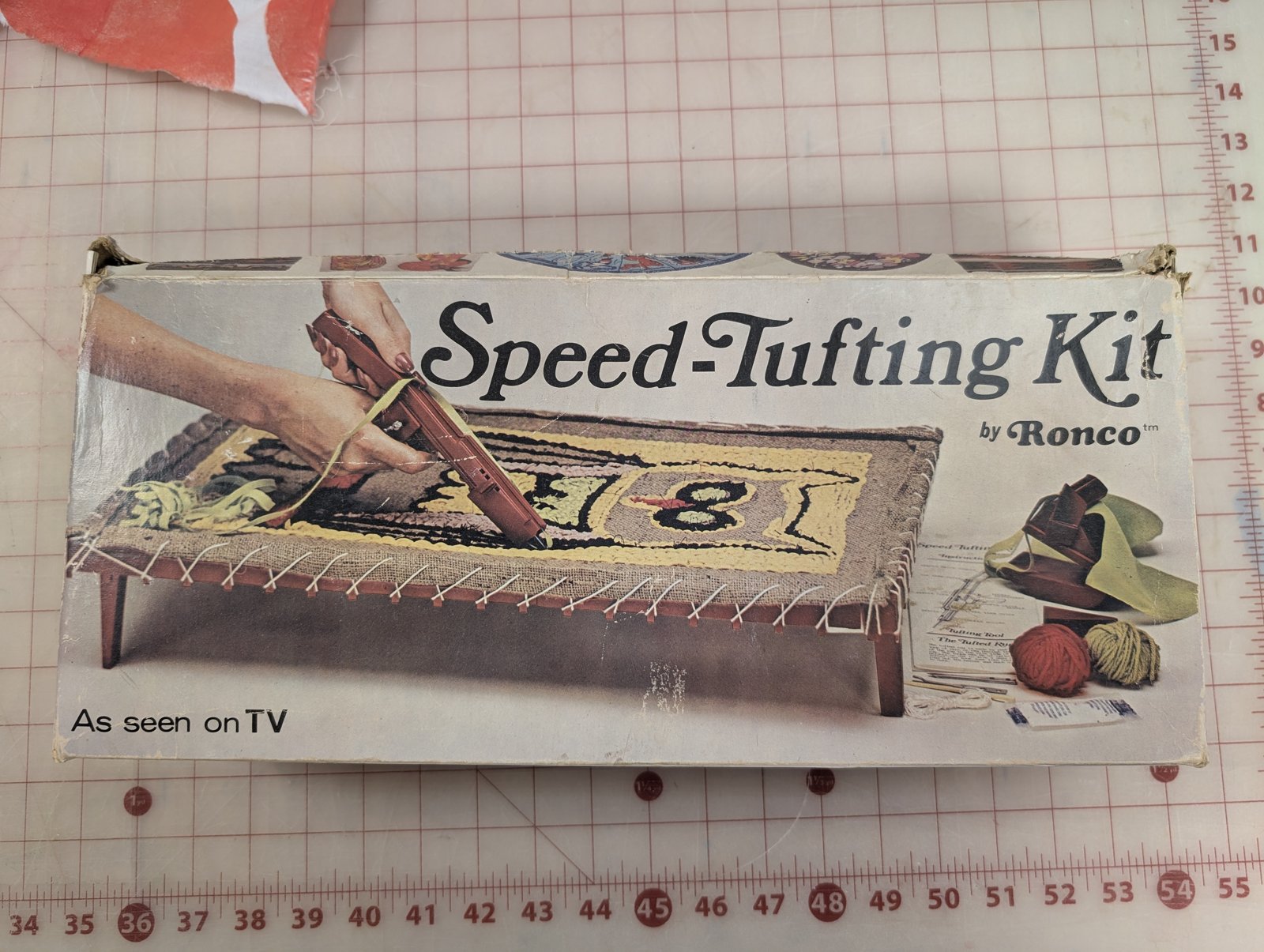
Ronco "Speed-Tufting Kit" (#1500), 1975
Tool · checked at the source
- Made by
- Southbury Manufacturing Corp., South Britain, Connecticut (maker); Ronco Teleproducts, Inc., Chicago (distributor)
- Date
- © 1975
- Place
- South Britain, Connecticut; Chicago, Illinois
- Held by
- Tuft the World (own collection)
- Number
- Ronco #1500
- Materials
- moulded plastic, steel, jute burlap, wool yarn, latex
- Themes
- Hand-tufting tools & the gun, Tools & equipment
Cite this source
Research notes
A boxed home tufting kit sold on television ("As seen on TV"), complete with its tool, fabric shredder, printed burlap backing, yarn, sample latex, instruction booklet and mail-order pattern sheet. The box end reads: "© 1975 Distributed Exclusively by Ronco Teleproducts, Inc. Chicago, Illinois 60611", "Patent Pending", "Made in USA". The backing is printed "© 1975 Southbury Mfg. Corp." with the owl pattern, and the booklet's warranty sends repairs to Southbury Manufacturing Corporation, PO Box 8, South Britain, Conn. 06487. The kit (#1500) contains a tufting tool, tufting frame, fabric shredder, rug backing with printed pattern, one rug needle and looper, one tapestry needle and looper, two balls of yarn, a sewing needle, frame string, sample rug latex and an instruction booklet. The order sheet (© 1975 Ronco Teleproducts, 919 North Michigan Ave., Chicago) prices the kit at $9.95, a Sturdy-Wood frame (No. 222) at $6.98 and Speed Tufting Latex at $4.75 a half gallon. It also sells patterns by mail at $4.75–9.75, including No. 101 Navaho, 104 Astrological, 109 Wise Owl and 120 Mod Ovals. How it works: a moulded-plastic tool with a needle drive handle and a looper drive handle, worked alternately. In the booklet's words: "With the Looper all the way up punch the needle through the backing material to form the first loop. Then push the Looper down to hold down the formed loop. With Looper down raise the needle all the way out of the backing and push down again allowing the needle to move forward one space." Needle and looper settings give different pile heights, rug and tapestry needles give coarse or fine work, and the shredder cuts old clothes, sheets or blankets into strips to tuft with, as in rag rugs. Why it matters: the same two-part alternating action as Ross's 1891 "Turfing Implement", the Susan Burr and the All Steel Shuttle Needle (ttw-susan-burr, ttw-shuttle-needle), sold to a 1970s mass market through television. It is evidence for a 1970s hobby wave between the Ross era and the gun revival of the 2020s. Southbury and South Britain are in Connecticut, as Torrington was for the Susan Burr. Patent: very likely John S. Doyel's US 3,968,757, "Rug-tufting device suitable for home use by hobyists" (filed 31 Oct 1975, granted 13 July 1976; pat-us3968757a). It describes a hand-operated device "made primarily of molded plastic components" with "a needle drive handle at the back end" and a looper, matching this tool and its booklet's wording. The patent names no assignee, so the link to Ronco and Southbury is inferred, not stated.