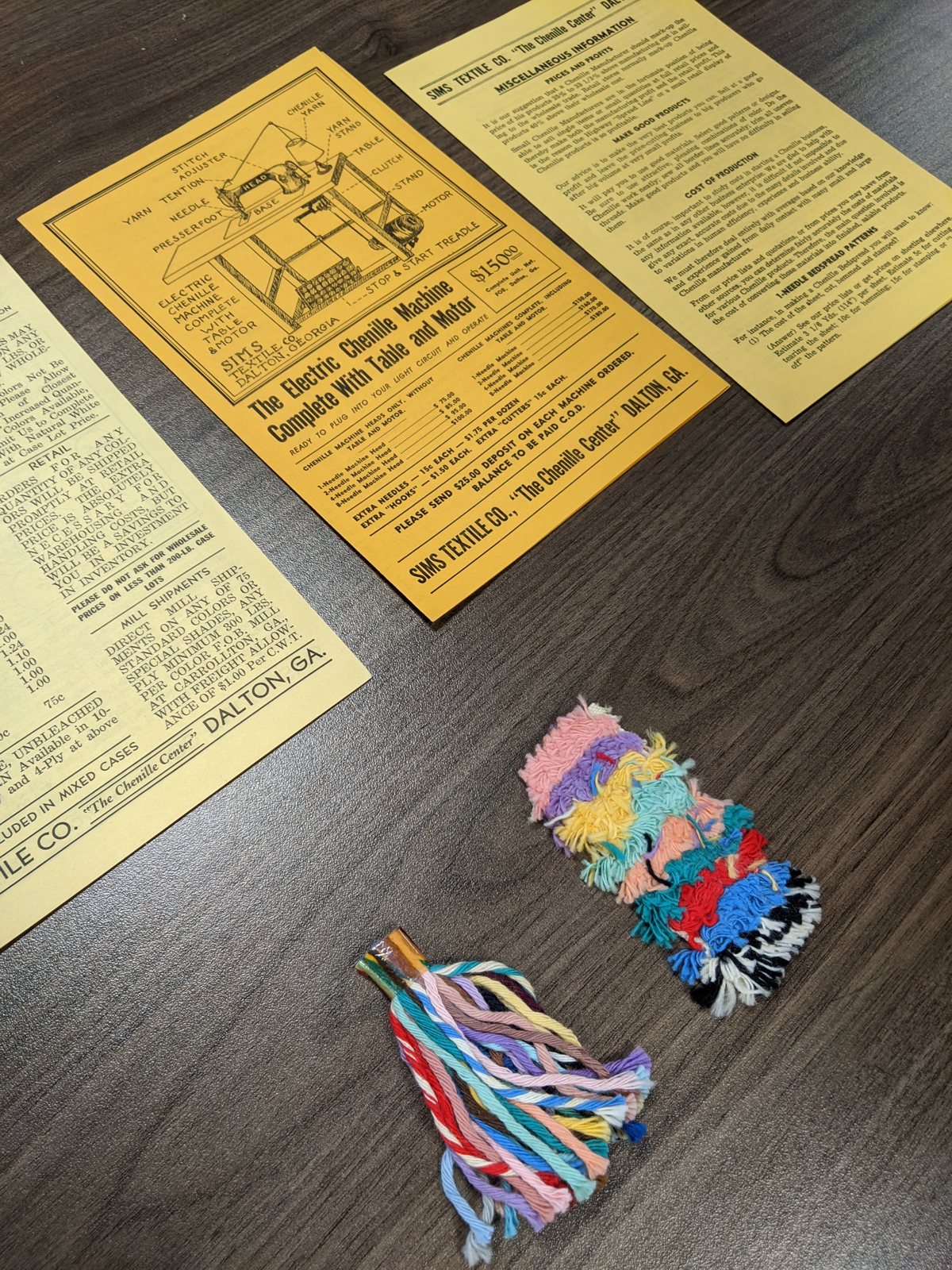
Sims Textile Co., "The Chenille Center," Dalton, Ga.: Electric Chenille Machine sheet, yarn price list and "Miscellaneous Information"
Trade catalogue · not yet checked at the source
- Made by
- Sims Textile Co.
- Date
- after 1945 (the company was founded in 1945)
- Place
- Dalton, Georgia
- Held by
- Bandy Heritage Center, Dalton State College
- Collection
- Photo: Tuft the World, taken at the Bandy Heritage Center, Dalton State College, Dalton, Georgia. The photograph is yours; the sheets belong to the center, so check its photo policy before publishing outside the database.
- Themes
- Machine tufting & Dalton, Chenille & candlewick, Trade catalogs & marketing, Tools & equipment
Cite this source
Research notes
Seen at the Bandy Heritage Center for Northwest Georgia, on the Dalton State campus (https://www.bandyheritagecenter.org/). Three mail-order sheets selling everything needed to start a home chenille business, with a small tufted sample and a yarn tassel. As read from the photo (check against the originals): - "The Electric Chenille Machine Complete With Table and Motor. Ready to plug into your light circuit and operate." A labelled drawing of a sewing-machine head (needle, presser foot, stitch adjuster, yarn tension, chenille yarn on a stand) on a table with motor, clutch and stop-and-start treadle. $150.00 complete, F.O.B. Dalton. - Heads only: 1-needle $75, 2-needle $85, 4-needle $95, 8-needle $100. Complete with table and motor: $150, $160, $170, $180. - Extra needles 15¢ each ($1.75 per dozen); extra "hooks" and "cutters" priced separately. $25 deposit per machine, balance C.O.D. - Yarn list: retail orders of any quantity; wholesale only in 200-lb case lots; direct mill shipments in 75 standard colours, minimum 300 lb per colour, F.O.B. the mill at Carrollton, Ga. - "Miscellaneous Information": advice on mark-up and profits, making good products, and the cost of producing a 1-needle bedspread (sheeting per spread, then a few cents each for tearing, hemming and stamping the pattern). It mentions the highway "Spread Line". Why it matters: shows the post-war home-industry stage, when a household could buy a motorised single- or multi-needle chenille machine by mail and plug it in. This is the bridge between hand tufting and the factory multi-needle machine. Company: per a Dalton business history, Pete Sims started Sims Textile Company in 1945, making single-needle tufting machines and selling yarn, sheeting and a mail-order catalog of bedspread patterns; it later became a warehouse (incorporated 1972). Source: https://www.fsw.cc/?p=873