Shade 4Rose1895–1949
From candlewick spreads to the Bedspread Capital
A girl's bedspread became a roadside trade, then a factory industry, and the machines it called for went on to make America's carpet.
Key dates
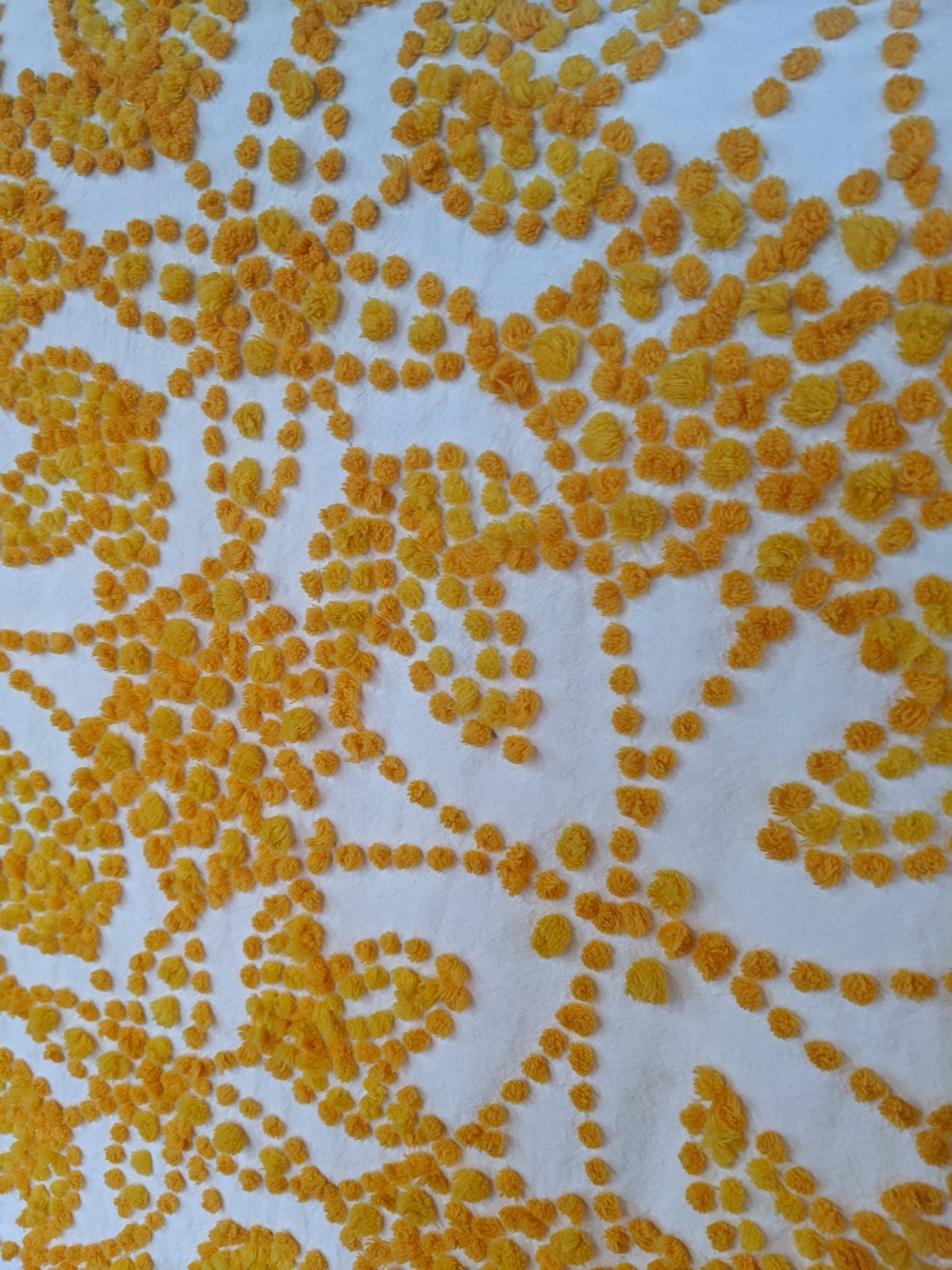
Dalton’s industry starts with one bedspread. In 1895, at fifteen, Catherine Evans made a tufted spread near Dalton by sewing thick yarn into muslin and shrinking the cloth to lock the tufts.11“Catherine Evans Whitener revives hand tufting near Dalton”, c. 1895–1900. Record “Catherine Evans made her first spread in 1895 at 15; the first sale ($2.50) came in 1900”, 1895 / 1900, research note. Record She kept it. Her first sale, for $2.50 to her brother’s new sister-in-law, came in 1900. The two dates are often merged into one; they should not be.22“Catherine Evans made her first spread in 1895 at 15; the first sale ($2.50) came in 1900”, 1895 / 1900, research note. Record
She told the story herself in the Dalton News on 11 March 1937, under the headline “Mrs. Whitener Recalls Beginning of Bedspread Industry”: a first-hand account forty years on, which has not yet been seen for this book.33Catherine Evans Whitener, “‘Mrs. Whitener Recalls Beginning of Bedspread Industry’”, 11 March 1937, The Dalton News (Dalton, Georgia), pp. 1ff.. Record A scholarly chapter on her life appears in Georgia Women: Their Lives and Times (2014).44Ann Short Chirhart, “‘Catherine Evans Whitener (1881–1964)’, in Georgia Women: Their Lives and Times, vol. 2”, 2014, Athens: University of Georgia Press, pp. 86–113, doi:10.1515/9780820376134-006. Record
Peacock Alley
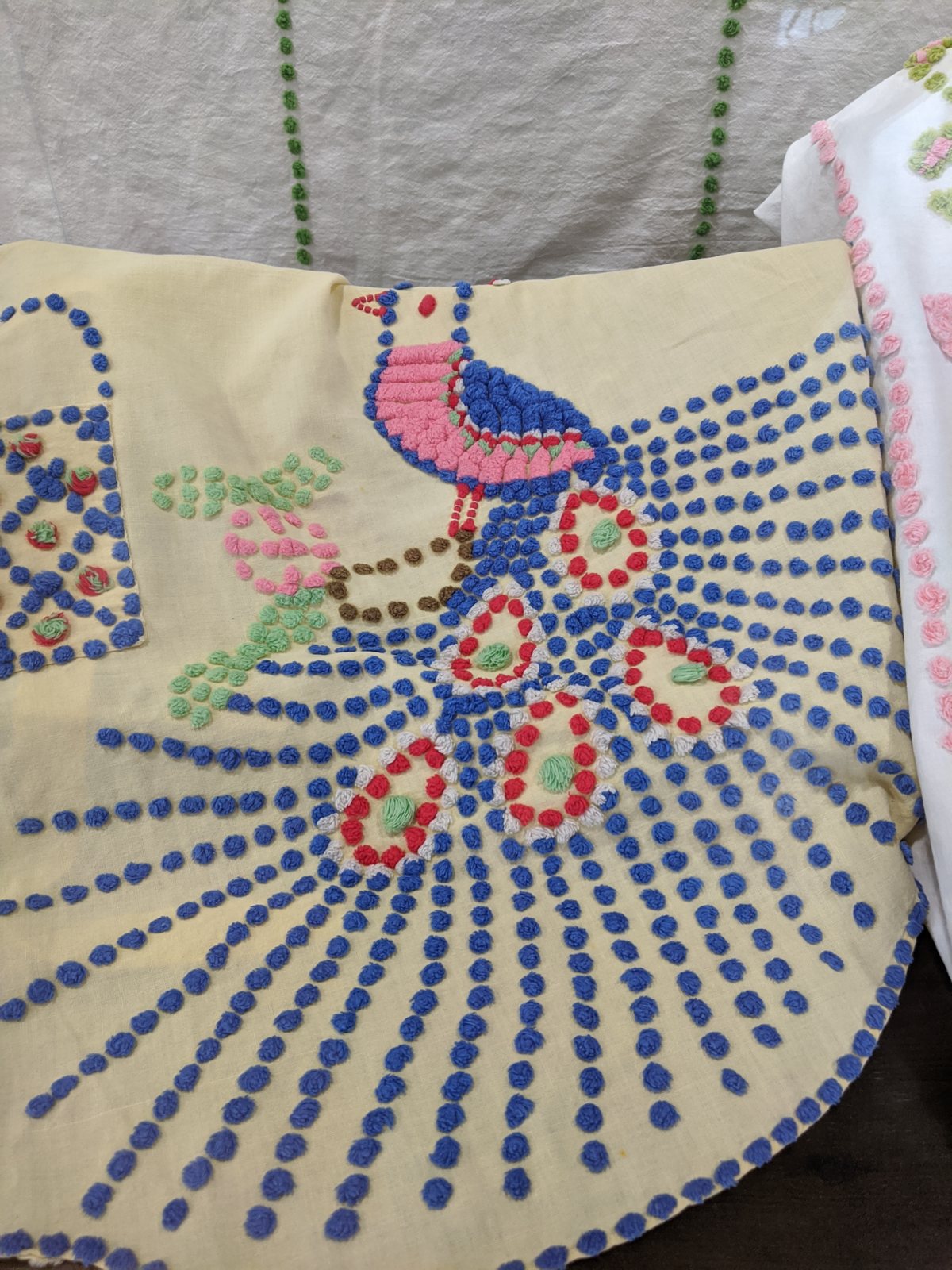
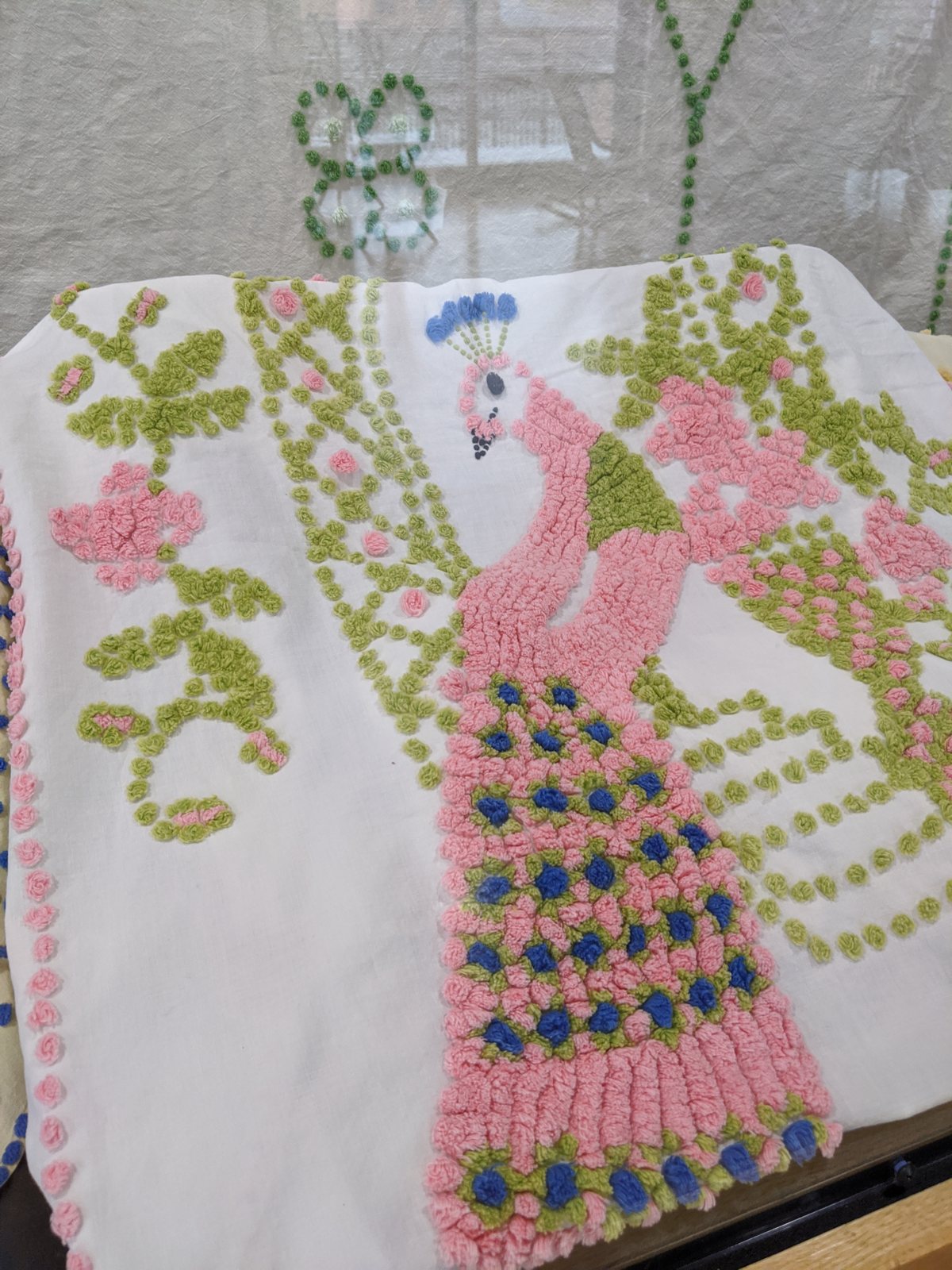
The spreads were made at home, by hand, and sold by the road.55“Chenille Bedspreads”, New Georgia Encyclopedia. Record One account puts the pay of the “turfers” who worked them at 25 to 50 cents a spread, while Sears sold the spreads for $1.59 to $2.49 as “handmade by the southern mountain women”; the figures are still to be traced to their source.66“Turfers were paid 25–50¢ a spread; Sears sold them for $1.59–$2.49 as ‘handmade by the southern mountain women’”, research note. Record By the 1930s the spreads hung for sale along U.S. Highway 41, which took the name Peacock Alley from their favourite motif.77“Chenille Bedspreads”, New Georgia Encyclopedia. Record Two peacock chenille bedspreads (yellow ground; white ground with pink peacock), undated; peacock spreads are associated with the 1930s–1950s roadside trade, Shaw Floors / Bandy art center, Dalton, Georgia. Record “Turfing” is an old word for the work: Ebenezer Ross of Toledo used it in 1891 for his patented two-handled needle tool.88Ebenezer Ross, “Turfing Implement” (US463548A), patented 17 Nov 1891. Record
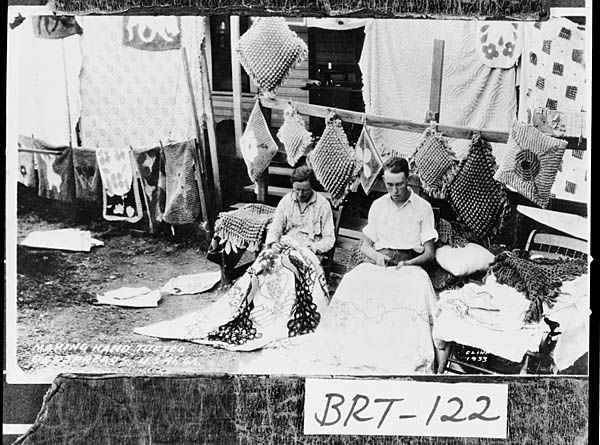
A photograph of 1933 shows Mrs. J. A. Green and her son, Allen Burton, at work at the roadside.99“Mrs. J. A. Green and son Allen Burton making tufted bedspreads on U.S. Highway 41”, 1933, Georgia Archives (Vanishing Georgia). Record The craft also made gifts. In 1936 someone made Henry Ford a red and white chenille rug as a thank-you gift, inscribed “NEW V-8 FORD 1936”: a dated, homemade tufted rug from the hand era, now at The Henry Ford.1010Chenille Rug, Gift to Henry Ford, 1936, 1936, The Henry Ford, 00.1510.19. Record

How a spread is drawn
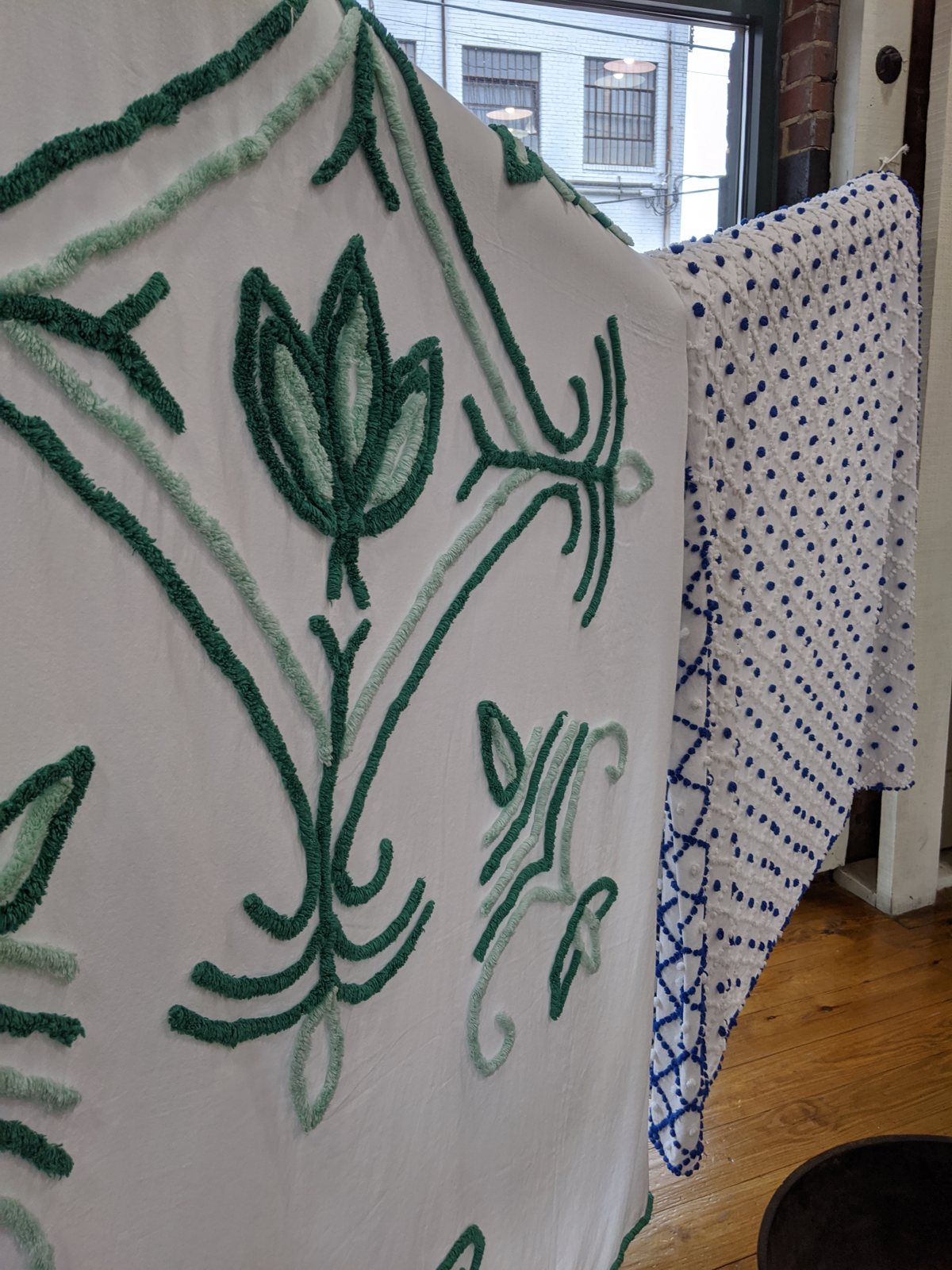
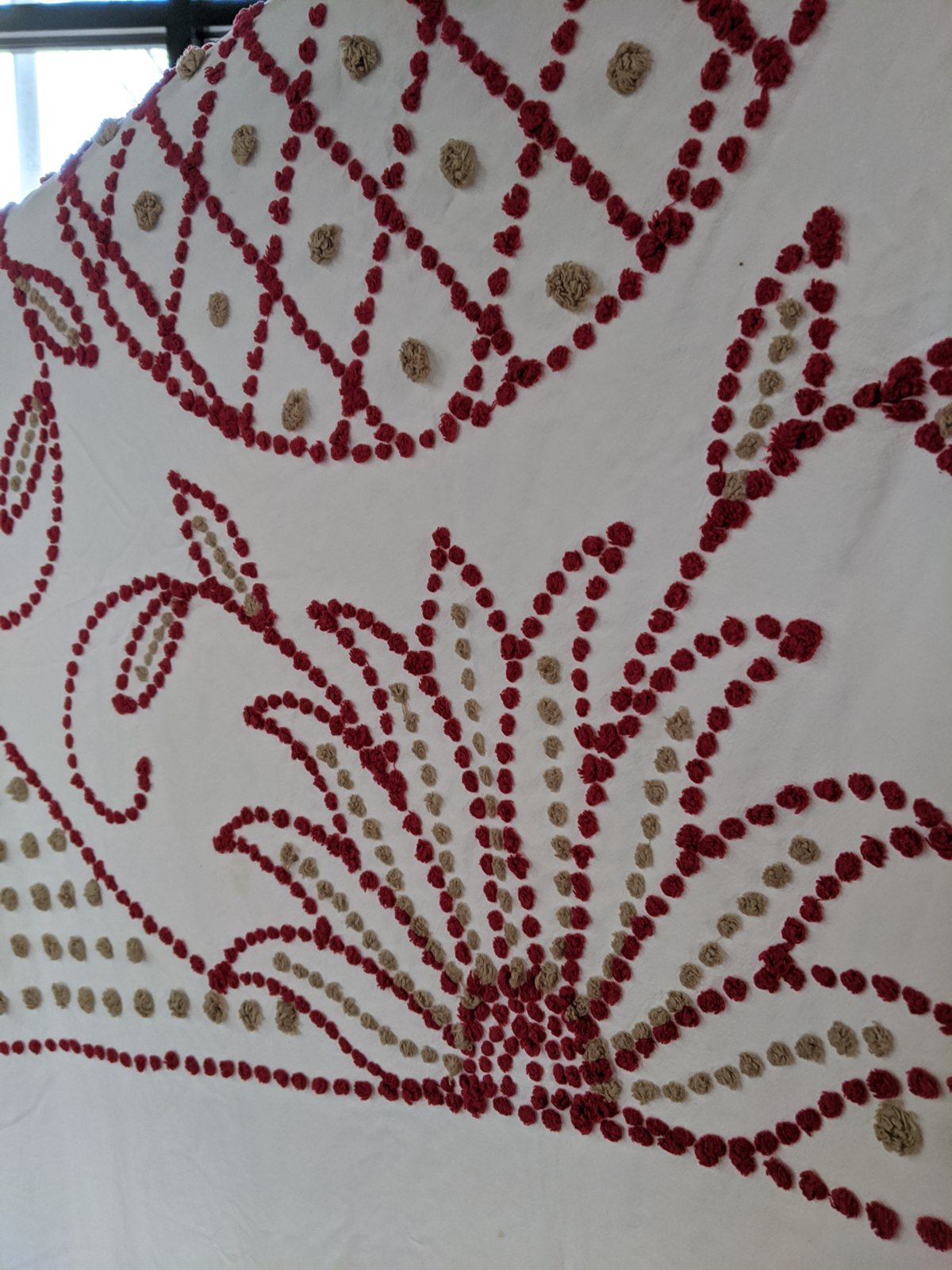
The spreads record their own technique. A single row of tufts set close together draws a line; separate tufts make dots; packed rows fill a shape. Two peacock spreads at the Shaw Floors / Bandy art center in Dalton show the motif that named the highway, a fan-tailed bird worked almost entirely in rows of separate cut tufts and a standing pink peacock with a dense tufted tail. In both, solid areas are packed rows of tufts and outlines are single rows.1111Two peacock chenille bedspreads (yellow ground; white ground with pink peacock), undated; peacock spreads are associated with the 1930s–1950s roadside trade, Shaw Floors / Bandy art center, Dalton, Georgia. Record
Other spreads there show the two looks side by side: continuous rows of cut pile drawing tulips and scrolls, and separate tufts stippling a floral.1212Chenille bedspreads: line-tufted tulips, dot-tufted florals and diamond lattice, undated (mid-20th century style), Shaw Floors / Bandy art center, Dalton, Georgia. Record The same needle and cutter give either a drawn line or a stippled dot. None of these spreads is yet catalogued with a maker or a date.
The Bandy Heritage Center at Dalton State College keeps the Sandra Mahs collection of chenille bedspreads from the cottage-industry years.1313“Sandra Mahs chenille bedspread collection”, Bandy Heritage Center, Dalton State College. Record Ashley Callahan’s Southern Tufts (2015) follows the same yarn into chenille clothing and its national craze.1414Ashley Callahan, Southern Tufts: The Regional Origins and National Craze for Chenille Fashion, 2015, ISBN 9780820345161. Record
The machine comes to the spread
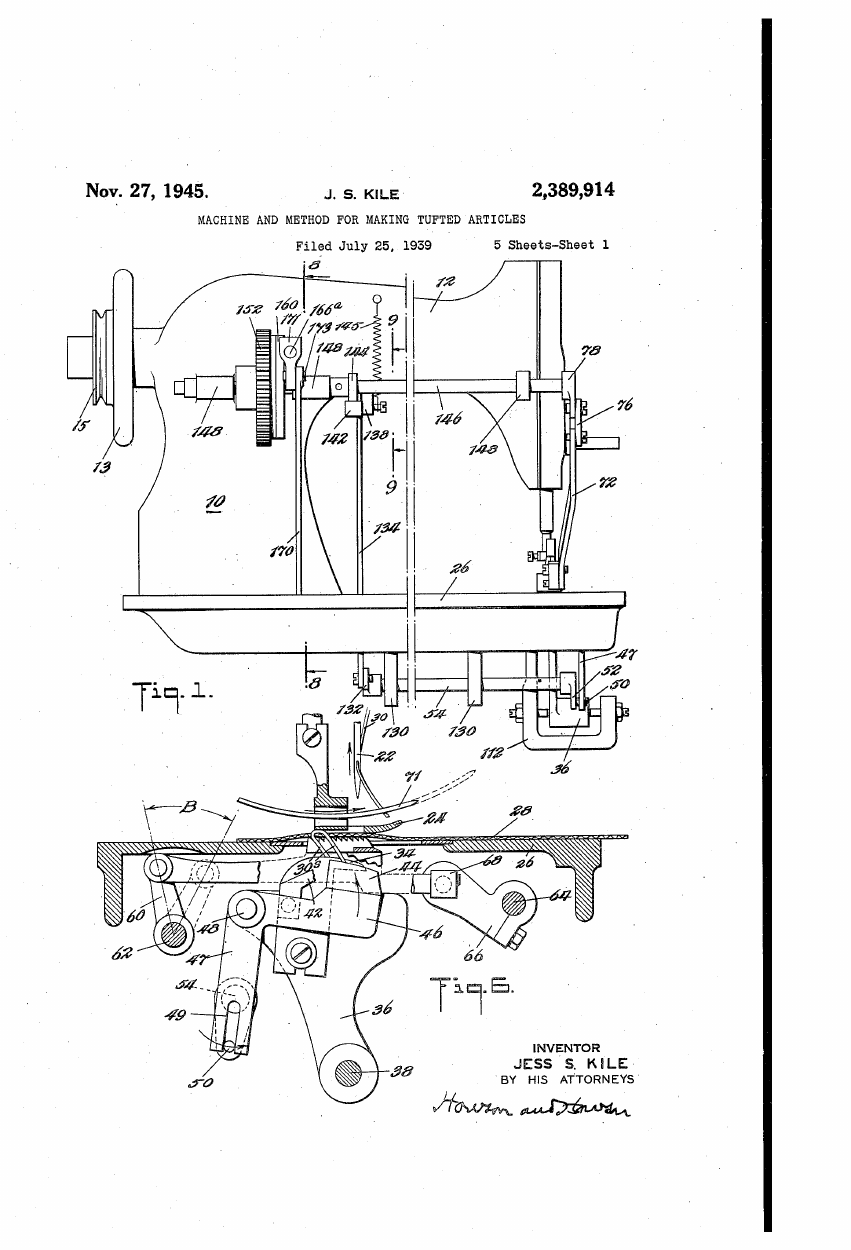
Machines arrived in the 1930s. In Dalton, according to the Carpet and Rug Institute, Glenn Looper adapted a Singer sewing machine for tufting; his patent for a “Tufting Machine” was filed in December 1936 and granted in 1938.1515“First mechanized tufting machine (Glenn Looper Foundry, Dalton)”, 1930s. Record A historical marker on the mechanization of the bedspread industry also names Joe Cobble and George Muse, whose joint patent was filed in 1941 and granted in 1943.1616“The Mechanization of the Bedspread Industry (historical marker)”, Historical Marker Database. Record Firms such as Cabin Crafts, founded by the Westcott brothers, moved spread-making from the hand to the machine.1717“Cabin Crafts”, 1930s (founding year not found), Cabin Crafts. Record Its Jess Spencer Kile filed for a “Machine and Method for Making Tufted Articles” in July 1939, assigned to Cabin Crafts and granted in 1945.1818Jess Spencer Kile, “Machine and Method for Making Tufted Articles” (US2389914A), filed 25 Jul 1939, granted 1945 (month unclear on scan). Record
The change was fast. By one count, still to be traced to its source, all but about one per cent of tufted bedspreads were machine-made by 1941.1919“By 1941, all but about 1% of tufted bedspreads were machine-made”, 1941, research note. Record That April Reader’s Digest told the whole country about the “Bedspread Bonanza”, in an article by R. E. Hamilton, later executive secretary of the Tufted Textile Manufacturers Association.2020R. E. Hamilton, “‘Bedspread Bonanza’”, April 1941, Reader's Digest, April 1941, pp. 41–44. Record A photograph at the Bandy Heritage Center shows Cabin Crafts executives with Governor Ellis Arnall and a chenille bedspread; the catalogue dates it 1962, but Arnall was governor from 1943 to 1947, so the date is still to be settled.2121“Cabin Crafts executives and Gov. Ellis Arnall with a chenille bedspread”, Bandy Heritage Center, Dalton State College. Record
The chenille machine comes home
After the war the machine went back into the home. Sims Textile Co., “The Chenille Center”, founded in Dalton in 1945, sold everything needed to start a chenille business by mail. Its sheets, now at the Bandy Heritage Center, offer an “Electric Chenille Machine Complete With Table and Motor” for $150, with heads alone from $75 for one needle to $100 for eight, yarn by the 200-pound case in 75 colours shipped from the mill at Carrollton, and advice on the cost of making a one-needle bedspread.2222“Sims Textile Co., ‘The Chenille Center,’ Dalton, Ga.: Electric Chenille Machine sheet, yarn price list and ‘Miscellaneous Information’”, after 1945 (the company was founded in 1945), Bandy Heritage Center, Dalton State College. Record
Ready to plug into your light circuit and operate.
Sims Textile Co., “The Chenille Center”, Dalton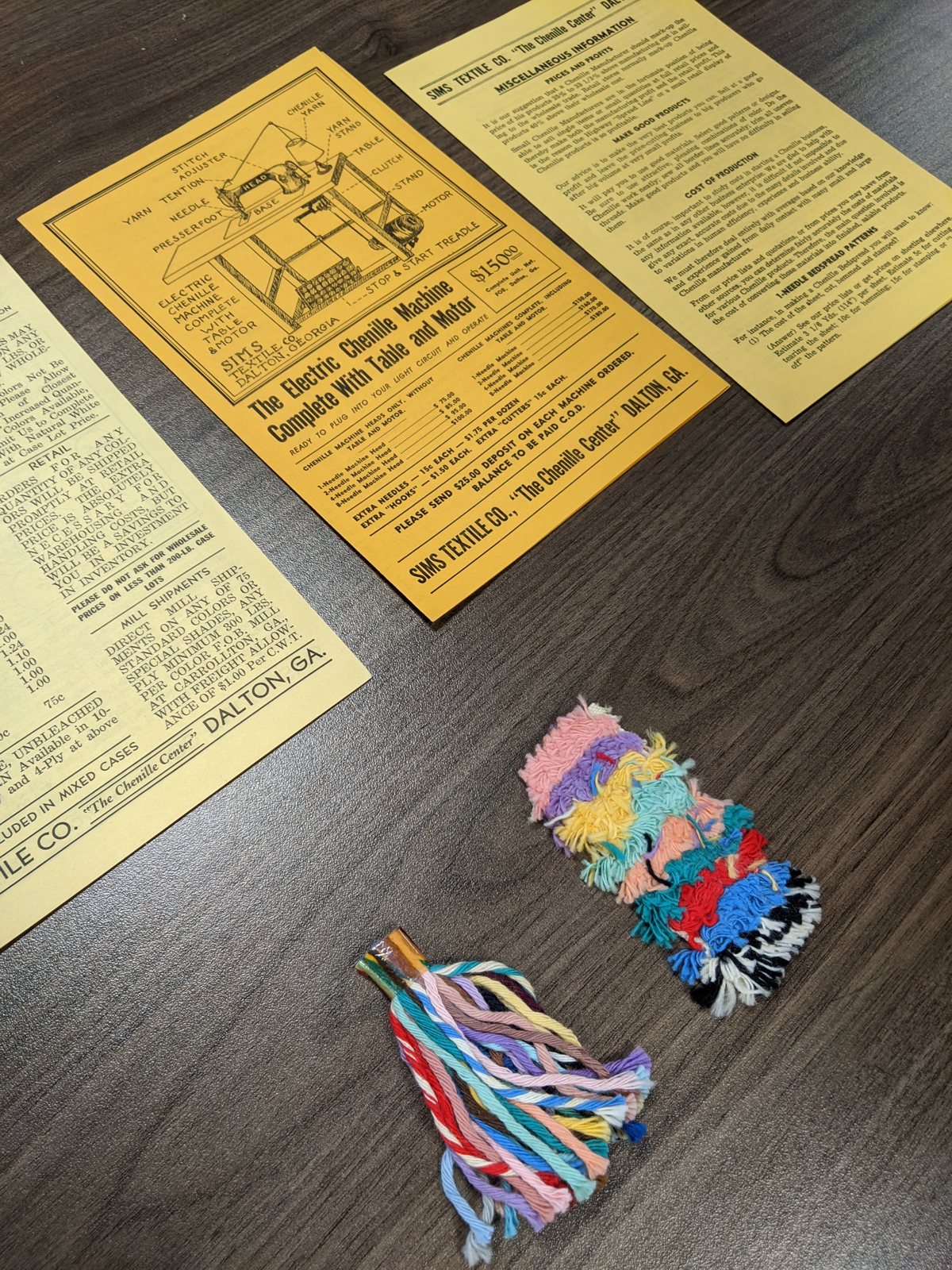
Sims also issued a map of Dalton about 1946, which Thomas Deaton credits to the Dalton-Whitfield County Historical Society.2323“Sims Textile Company map of Dalton”, c. 1946, Dalton-Whitfield County Historical Society (per Deaton). Record By about 1955 DuPont was promoting nylon for tufted bath mats and lid covers, another small tufted product on the road from the bed to the floor.2424“Nylon carpeting [tufted nylon bath mat and lid cover]”, 1955 (year approximate), Hagley, 1972341_1332. Record
From the spread to the floor
The bedspread machines were then widened, first for rugs and then for broadloom carpet.2525Carpet and Rug Institute, web page on the history of carpet, carpet-rug.org (quoted from search results; page not yet checked). Record Newcomers took the machines to the national market. Eugene Barwick, who had sold tufted goods for Sears, formed Barwick Mills in 1949; one local history says its sales doubled in 1950 and passed $26 million by 1954.2626“E. T. Barwick Mills”, founded 1949, E. T. Barwick Mills. Record Bedspread dyers became carpet firms: Shaw began in 1946 as Star Dye Co., dyeing small tufted goods, bedspreads and scatter rugs, during the chenille boom.2727“Shaw Industries Group”, founded 1946 (as Star Dye Co.), Shaw Industries Group. Record Nationally, tufted carpet sales rose from near zero in the late 1940s to more than 100 million square yards by 1958.2828Randall L. Patton, “A History of the U.S. Carpet Industry”, EH.Net Encyclopedia (Economic History Association). Record
The industry kept its own trade body, the Tufted Textile Manufacturers Association; a 1960 correspondence file under its name survives in the papers of E. C. Beetem and Son at Hagley.2929“Tufted Textile Manufacturers Association, 1960”, 1960, Hagley, Accession 1178, Box 181, Folder 491. Record Its history has been written twice from Dalton: by Thomas Deaton in Bedspreads to Broadloom (1993), whose bibliography lists about 85 interviews he made between 1972 and 1993 and whose research files, with transcripts of interviews with industry pioneers, are at the Bandy Heritage Center,3030Thomas M. Deaton, Bedspreads to Broadloom: The Story of the Tufted Carpet Industry, 1993 (Open Library gives 1994; check the copyright page). Record “Thomas Deaton research collection on the tufted carpet industry”, Bandy Heritage Center, Dalton State College. Record and by Randall Patton in Carpet Capital (1999).3131Randall L. Patton with David B. Parker, Carpet Capital: The Rise of a New South Industry, 1999, ISBN 9780820324647. Record
This chapter argues that Dalton’s carpet industry grew out of a women’s hand craft and a roadside market, through a short home-machine stage, not from the carpet mills of the North.
Notes
- 1Catherine Evans Whitener. “Catherine Evans Whitener revives hand tufting near Dalton,” c. 1895–1900. georgiaencyclopedia.org/articles/arts-culture/chenille-bedspreads. Record “Catherine Evans made her first spread in 1895 at 15; the first sale ($2.50) came in 1900.” Research note, TTW Script Bank fact-check notes (Claude research, Aug 2026). digitalcommons.unl.edu/tsaconf/506. Record
- 2“Catherine Evans made her first spread in 1895 at 15; the first sale ($2.50) came in 1900.” Research note, TTW Script Bank fact-check notes (Claude research, Aug 2026). digitalcommons.unl.edu/tsaconf/506. Record
- 3Catherine Evans Whitener. “‘Mrs. Whitener Recalls Beginning of Bedspread Industry’.” The Dalton News (Dalton, Georgia), pp. 1ff., 11 March 1937. Record
- 4Ann Short Chirhart and Kathleen Ann Clark (eds.). “‘Catherine Evans Whitener (1881–1964)’, in Georgia Women: Their Lives and Times, vol. 2.” Athens: University of Georgia Press, pp. 86–113, 2014. doi.org/10.1515/9780820376134-006. Record
- 5“Chenille Bedspreads.” New Georgia Encyclopedia, n.d. georgiaencyclopedia.org/articles/arts-culture/chenille-bedspreads. Record
- 6“Turfers were paid 25–50¢ a spread; Sears sold them for $1.59–$2.49 as ‘handmade by the southern mountain women’.” Research note, TTW Script Bank fact-check notes (Claude research, Aug 2026). Record
- 7“Chenille Bedspreads.” New Georgia Encyclopedia, n.d. georgiaencyclopedia.org/articles/arts-culture/chenille-bedspreads. Record Unknown maker. Two peacock chenille bedspreads (yellow ground; white ground with pink peacock), undated; peacock spreads are associated with the 1930s–1950s roadside trade. Shaw Floors / Bandy art center, Dalton, Georgia. Record
- 8Ebenezer Ross, “Turfing Implement” (US463548A), patented 17 Nov 1891. patents.google.com/patent/US463548A/en. Record
- 9“Mrs. J. A. Green and son Allen Burton making tufted bedspreads on U.S. Highway 41,” 1933. Georgia Archives (Vanishing Georgia). georgiaencyclopedia.org/articles/arts-culture/chenille-bedspreads/m-2383. Record
- 10Unknown maker. Chenille Rug, Gift to Henry Ford, 1936, 1936. The Henry Ford, 00.1510.19. thehenryford.org/collections/explore/artifact/66143. Record
- 11Unknown maker. Two peacock chenille bedspreads (yellow ground; white ground with pink peacock), undated; peacock spreads are associated with the 1930s–1950s roadside trade. Shaw Floors / Bandy art center, Dalton, Georgia. Record
- 12Unknown maker. Chenille bedspreads: line-tufted tulips, dot-tufted florals and diamond lattice, undated (mid-20th century style). Shaw Floors / Bandy art center, Dalton, Georgia. Record
- 13“Sandra Mahs chenille bedspread collection,” n.d. Bandy Heritage Center, Dalton State College. bandyheritagecenter.org/collection/museum-collection. Record
- 14Ashley Callahan. Southern Tufts: The Regional Origins and National Craze for Chenille Fashion. University of Georgia Press, 2015. ugapress.org/book/9780820345161/southern-tufts. Record
- 15“First mechanized tufting machine (Glenn Looper Foundry, Dalton),” 1930s. carpet-rug.org/about-us/history-of-carpet. Record
- 16“The Mechanization of the Bedspread Industry (historical marker).” Historical Marker Database, n.d. hmdb.org/m.asp?m=171571. Record
- 17Frederick R. Westcott and G. Lamar Westcott. “Cabin Crafts,” 1930s (founding year not found). Cabin Crafts. georgiaencyclopedia.org/articles/arts-culture/chenille-bedspreads. Record
- 18Jess Spencer Kile, “Machine and Method for Making Tufted Articles” (US2389914A), filed 25 Jul 1939, granted 1945 (month unclear on scan); assigned to Cabin Crafts. patents.google.com/patent/US2389914A/en. Record
- 19“By 1941, all but about 1% of tufted bedspreads were machine-made.” Research note, TTW Script Bank fact-check notes (Claude research, Aug 2026). Record
- 20R. E. Hamilton. “‘Bedspread Bonanza’.” Reader's Digest, April 1941, pp. 41–44, April 1941. Record
- 21“Cabin Crafts executives and Gov. Ellis Arnall with a chenille bedspread,” n.d. Thomas Deaton Collection, Bandy Heritage Center, Dalton State College. bandyheritagecenter.pastperfectonline.com/photo/95EA3F4C-3D88-4C76-8BE6-581372259612. Record
- 22Sims Textile Co. “Sims Textile Co., ‘The Chenille Center,’ Dalton, Ga.: Electric Chenille Machine sheet, yarn price list and ‘Miscellaneous Information’,” after 1945 (the company was founded in 1945). Photo: Tuft the World, taken at the Bandy Heritage Center, Dalton State College, Dalton, Georgia. The photograph is yours; the sheets belong to the center, so check its photo policy before publishing outside the database., Bandy Heritage Center, Dalton State College. Record
- 23Sims Textile Company. “Sims Textile Company map of Dalton,” c. 1946. Dalton-Whitfield County Historical Society (per Deaton). Record
- 24E.I. du Pont de Nemours & Company (product information photograph); mats by Neddletuft [sic]. “Nylon carpeting [tufted nylon bath mat and lid cover],” 1955 (year approximate). 1972341_1332, DuPont Company Product Information photographs (Accession 1972.341), Series V. Man made fibers, Subseries C. Nylon, Hagley Museum and Library. digital.hagley.org/1972341_1332. Record
- 25Carpet and Rug Institute, web page on the history of carpet, carpet-rug.org (quoted from search results; page not yet checked). carpet-rug.org/about-us/history-of-carpet. Record
- 26Eugene Thomas Barwick. “E. T. Barwick Mills,” founded 1949. E. T. Barwick Mills. westgatextiletrail.com/lafayette. Record
- 27Clarence Shaw; sons Robert (Bob) and J. C. (Bud) Shaw. “Shaw Industries Group,” founded 1946 (as Star Dye Co.). Shaw Industries Group. shawinc.com/Our-Company/History. Record
- 28Randall L. Patton. “A History of the U.S. Carpet Industry.” EH.Net Encyclopedia (Economic History Association), n.d. eh.net/encyclopedia/a-history-of-the-u-s-carpet-industry. Record
- 29E.C. Beetem and Son, Inc. (records). “Tufted Textile Manufacturers Association, 1960,” 1960. Accession 1178, Box 181, Folder 491, E.C. Beetem and Son, Inc. records (Accession 1178), Series III. Incoming correspondence, 1894-1967; Box 181, Folder 491, Hagley Museum and Library. findingaids.hagley.org/repositories/3/archival_objects/560954. Record
- 30Thomas M. Deaton. Bedspreads to Broadloom: The Story of the Tufted Carpet Industry. 1993 (Open Library gives 1994; check the copyright page). openlibrary.org/works/OL8896555W. Record Thomas M. Deaton. “Thomas Deaton research collection on the tufted carpet industry,” n.d. Bandy Heritage Center, Dalton State College. bandyheritagecenter.pastperfectonline.com/archive/2349F571-3AF7-4957-BDA1-373971530010. Record
- 31Randall L. Patton with David B. Parker. Carpet Capital: The Rise of a New South Industry. University of Georgia Press, 1999. ugapress.org/book/9780820324647/carpet-capital. Record
Where the sources are
- Published sources11
- Research notes, not yet traced to a public source4
- Bandy Heritage Center, Dalton State College4
- Shaw Floors / Bandy art center, Dalton, Georgia2
- US patents2
- Hagley Museum and Library2
- Georgia Archives (Vanishing Georgia)1
- The Henry Ford1
- Cabin Crafts1
- Dalton-Whitfield County Historical Society (per Deaton)1
- E. T. Barwick Mills1
- Shaw Industries Group1