Shade 2Oxblood1778–1972
Before the machine: bed rugs and needle-made pile
More than a century before Dalton, women in New England sewed pile into bedcovers with a needle, through a cloth that was already woven, which is what a tufting machine still does.

Key dates
A bedcover at Winterthur carries a name and a year: “Mary Foot AD 1778”.11Bed rug (bedcover) inscribed “Mary Foot AD 1778”, 1778, Winterthur Museum, 1960.0594. Record It is a needle-made pile textile, probably made in Connecticut. It came to the museum in the bequest of Henry Francis du Pont.22Bed rug (bedcover) inscribed “Mary Foot AD 1778”, 1778, Winterthur Museum, 1960.0594. Record It is the earliest dated piece of needle-made pile among the objects gathered for this book, and the place where the history of tufting in America can start.
Three rugs for one family
Mary Foot’s rug has relatives. Laurel Thatcher Ulrich, in The Age of Homespun (2001), links it to a bed rug marked “E.F.”, for Elizabeth Foote, at the Connecticut Historical Society, and to an unmarked rug at Historic Deerfield.33Laurel Thatcher Ulrich, The Age of Homespun: Objects and Stories in the Creation of an American Myth, 2001. Record Bed rug (bedcover) inscribed “Mary Foot AD 1778”, 1778, Winterthur Museum, 1960.0594. Record All three may commemorate the marriages of the Foot siblings on 5 November 1778.44Bed rug (bedcover) inscribed “Mary Foot AD 1778”, 1778, Winterthur Museum, 1960.0594. Record The “E.F.” rug is probably of the same year;55Bed rug marked “E.F.”, probably 1778, Connecticut Historical Society. Record the Deerfield rug is blue and white, and dated about 1778.66Blue-and-white bed rug (unmarked), c. 1778, Historic Deerfield. Record
The Deerfield rug shares its Tree of Life motif, described as Indian, with a bed rug of 1796 at the Metropolitan Museum of Art.77Blue-and-white bed rug (unmarked), c. 1778, Historic Deerfield. Record Bed rug, 1809, The Metropolitan Museum of Art, 13.207. Record How the motif reached New England is still to be traced.
A needle, not a hook
How these rugs were made matters more than what they were called. The Metropolitan Museum’s bed rug of 1809, attributed to “M. B.” and probably made in Connecticut, came to the museum through the Rogers Fund in 1913.88Bed rug, 1809, The Metropolitan Museum of Art, 13.207. Record The museum’s notes stress that the pile is needleworked, not hooked, a distinction once misunderstood.99Bed rug, 1809, The Metropolitan Museum of Art, 13.207. Record
That is the technique of the tufting machine in its simplest form. In the Britannica student encyclopedia’s account, as summarised for this book from search results still to be checked against the page, tufting adds pile yarn to a backing that already exists: a needle pierces the backing and leaves loops, which can be cut.1010“Tufting defined: needles push pile yarn through a ready-made backing, locked in with adhesive”, hand needle 18th–19th c.; machine from mid-20th c., research note. Record On the definition of yarn-sewn work given below, a bed rug worker did the same by hand, drawing the yarn through a finished cloth and leaving a loop on the face at each stitch.1111Bed rug, 1809, The Metropolitan Museum of Art, 13.207. Record Yarn-sewn hearth rug, 1800–1820 (Connecticut Historical Society 2010.409.0), 1800–1820, Connecticut Historical Society, 2010.409.0. Record

Other dated rugs extend the run into the nineteenth century. Historic Deerfield holds a bed rug marked “Esther Packard 1801”, attributed to Esther (Porter) Packard (1733–1812) and possibly made at Cummington, Massachusetts; its curator of textiles, David E. Lazaro, researched the rug when the museum acquired it, and the museum described that research in a blog post in 2017.1212Bed rug marked “Esther Packard 1801”, 1801, Historic Deerfield. Record Winterthur has a second bed rug, marked “C/1819”, possibly from the Connecticut River Valley.1313Bed rug marked “C/1819”, 1819, Winterthur Museum, 1964.1641. Record The Museum of Fine Arts, Boston, holds another, catalogued as a “Bed rugg”, whose date is still to be confirmed.1414Bed rugg, Museum of Fine Arts, Boston, 1980.447. Record
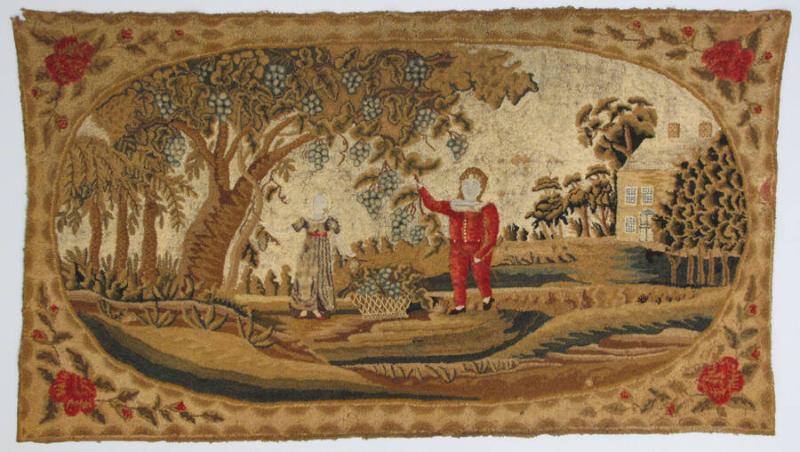
The same stitch went onto the floor. A hearth rug at the Connecticut Historical Society, dated 1800–1820 and linked by family tradition to the Samuel Hanmer house in Wethersfield, is described, in a record compiled from search results and still to be checked against the museum’s page, as cut and uncut loops of wool sewn through plain-woven linen, with a boy and girl under a grapevine in an oval medallion and roses in the corners.1515Yarn-sewn hearth rug, 1800–1820 (Connecticut Historical Society 2010.409.0), 1800–1820, Connecticut Historical Society, 2010.409.0. Record In the Getty vocabulary’s definition of “yarn-sewn” rugs, as summarised for this record, yarn is sewn with a needle in a continuous running stitch through a closely woven cloth, leaving loops on the face that are usually clipped. That definition also comes from search results and is still to be checked; Colonial Williamsburg’s laboratory reportedly found that most grounds in its exhibition of early sewn rugs were cotton, not linen, so each fibre needs checking.1616Yarn-sewn hearth rug, 1800–1820 (Connecticut Historical Society 2010.409.0), 1800–1820, Connecticut Historical Society, 2010.409.0. Record
Bed rugs were brought together in 1972 for a loan exhibition, open from 9 November to 31 December, whose 80-page catalogue, Bed Ruggs/1722–1833, was published by the Wadsworth Atheneum in Hartford. By its title, the catalogue dates the form from 1722.1717Wadsworth Atheneum, Bed Ruggs/1722–1833, 1972, OCLC 578197; LCCN 72088680. Record
Candlewick spreads
In the early nineteenth century the needle also worked candlewick spreads. The American Folk Art Museum has an Eagle Candlewick Spread of 1810–1820; the museum notes that candlewicking combined flat stitches with dimensional ones, tufting among them, and that candlewick spreads recall the earlier yarn-sewn bed rugs.1818Eagle Candlewick Spread, 1810–1820, American Folk Art Museum, 1995.13.2. Record
Several are dated or named. The Los Angeles County Museum of Art has a candlewick bedspread of 1821, attributed to Mary Smith.1919Candlewick Bedspread, 1821, Los Angeles County Museum of Art, M.74.48. Record The Connecticut Historical Society holds three candlewick bed coverings with makers’ names and dates: Thankful Stanton’s of 1820, Esther M. C. Peck’s of 1824 and Susannah Courtney’s of 1825.2020Dated candlewick bed coverings (Peck 1824, Courtney 1825, Stanton 1820), 1820–1825, Connecticut Historical Society. Record Historic New England has a candlewick bedspread with a vase and vine motif, dated 1820–1830, from Hamilton House at South Berwick, Maine.2121Candlewick bedspread with vase and vine motif, 1820–1830, Historic New England, 1949.1018. Record
The word candlewick returns at the start of the Dalton story. Catherine Evans’s spread of about 1895–1900 is described as a candlewick bedspread, made by sewing thick yarn into muslin and shrinking the cloth to lock the tufts (chapter 4).2222“Catherine Evans Whitener revives hand tufting near Dalton”, c. 1895–1900. Record What, if anything, joins the New England spreads of the 1820s to north Georgia in the 1890s is not yet documented.
On the floor, and in the record
Needlework also made carpets. The “Caswell carpet” at the Metropolitan Museum was made by Zeruah H. Guernsey Caswell at Castleton, Vermont, in 1832–35, and is signed with her initials and dated 1835. It is catalogued as an embroidered carpet and has a detachable hearth rug section.2323Embroidered Carpet (the “Caswell carpet”), 1832–35, The Metropolitan Museum of Art. Record The Met questions how much of the base cloth and yarn Caswell made herself.2424Embroidered Carpet (the “Caswell carpet”), 1832–35, The Metropolitan Museum of Art. Record

The Caswell carpet was lent in 2007 to the American Folk Art Museum’s exhibition “The Great Cover-Up: American Rugs on Beds, Tables, and Floors”, which brought together yarn-sewn, shirred, appliquéd and embroidered early American rugs.2525“Exhibition: ‘The Great Cover-Up: American Rugs on Beds, Tables, and Floors’”, 2007, American Folk Art Museum. Record Embroidered Carpet (the “Caswell carpet”), 1832–35, The Metropolitan Museum of Art. Record Its title is a reminder that in early America a rug could lie on a bed or a table as well as on a floor.
The word “tufted” itself appears on a later record. About 1938 Orville A. Carroll painted a watercolour of a “Shaker Tufted Wool Rug” in Kentucky for the Index of American Design.2626“Orville A. Carroll, Shaker Tufted Wool Rug, c. 1938 (Index of American Design)”, c. 1938, National Gallery of Art, Index of American Design (via Wikimedia Commons), NGA 25792. Record What “tufted” means on that rug, whether sewn tufts, shirring or yarn-sewn pile, is not stated, and the rug’s own date is not known.2727“Orville A. Carroll, Shaker Tufted Wool Rug, c. 1938 (Index of American Design)”, c. 1938, National Gallery of Art, Index of American Design (via Wikimedia Commons), NGA 25792. Record

This chapter argues that pile sewn with a needle through a finished cloth, the principle of tufting, was practised in New England from at least 1778, on bed rugs marked with women’s names, and was carried onto the candlewick spreads of the 1810s and 1820s. The machine did not invent the technique.
Notes
- 1Mary Foot. Bed rug (bedcover) inscribed “Mary Foot AD 1778”, 1778. Winterthur Museum, 1960.0594. museumcollection.winterthur.org/object/16695. Record
- 2Mary Foot. Bed rug (bedcover) inscribed “Mary Foot AD 1778”, 1778. Winterthur Museum, 1960.0594. museumcollection.winterthur.org/object/16695. Record
- 3Laurel Thatcher Ulrich. The Age of Homespun: Objects and Stories in the Creation of an American Myth. Alfred A. Knopf, 2001. randomhouse.com/knopf/authors/ulrich/desktopflowercloth.html. Record Mary Foot. Bed rug (bedcover) inscribed “Mary Foot AD 1778”, 1778. Winterthur Museum, 1960.0594. museumcollection.winterthur.org/object/16695. Record
- 4Mary Foot. Bed rug (bedcover) inscribed “Mary Foot AD 1778”, 1778. Winterthur Museum, 1960.0594. museumcollection.winterthur.org/object/16695. Record
- 5Elizabeth Foote. Bed rug marked “E.F.”, probably 1778. Connecticut Historical Society. randomhouse.com/knopf/authors/ulrich/desktopflowercloth.html. Record
- 6Unknown maker. Blue-and-white bed rug (unmarked), c. 1778. Historic Deerfield. randomhouse.com/knopf/authors/ulrich/desktopflowercloth.html. Record
- 7Unknown maker. Blue-and-white bed rug (unmarked), c. 1778. Historic Deerfield. randomhouse.com/knopf/authors/ulrich/desktopflowercloth.html. Record Attributed to "M. B.". Bed rug, 1809. The Metropolitan Museum of Art, 13.207. metmuseum.org/art/collection/search?q=13.207. Record
- 8Attributed to "M. B.". Bed rug, 1809. The Metropolitan Museum of Art, 13.207. metmuseum.org/art/collection/search?q=13.207. Record
- 9Attributed to "M. B.". Bed rug, 1809. The Metropolitan Museum of Art, 13.207. metmuseum.org/art/collection/search?q=13.207. Record
- 10“Tufting defined: needles push pile yarn through a ready-made backing, locked in with adhesive.” Research note. kids.britannica.com/students/article/rug-and-carpet/276811. Record
- 11Attributed to "M. B.". Bed rug, 1809. The Metropolitan Museum of Art, 13.207. metmuseum.org/art/collection/search?q=13.207. Record Unknown maker. Yarn-sewn hearth rug, 1800–1820 (Connecticut Historical Society 2010.409.0), 1800–1820. Connecticut Historical Society, 2010.409.0. emuseum.chs.org/emuseum/objects/13050/hearth-rug. Record
- 12Esther (Porter) Packard (1733–1812), attributed. Bed rug marked “Esther Packard 1801”, 1801. Historic Deerfield. historic-deerfield.org/2017-7-21-going-to-the-sources-researching-the-esther-packard-1801-bed-rug. Record
- 13Unknown maker. Bed rug marked “C/1819”, 1819. Winterthur Museum, 1964.1641. museumcollection.winterthur.org/object/27031. Record
- 14Unknown maker. Bed rugg, n.d. Museum of Fine Arts, Boston, 1980.447. mfaboston6.emuseum.com/objects/126054/bed-rugg. Record
- 15Unknown maker. Yarn-sewn hearth rug, 1800–1820 (Connecticut Historical Society 2010.409.0), 1800–1820. Connecticut Historical Society, 2010.409.0. emuseum.chs.org/emuseum/objects/13050/hearth-rug. Record
- 16Unknown maker. Yarn-sewn hearth rug, 1800–1820 (Connecticut Historical Society 2010.409.0), 1800–1820. Connecticut Historical Society, 2010.409.0. emuseum.chs.org/emuseum/objects/13050/hearth-rug. Record
- 17Wadsworth Atheneum. Bed Ruggs/1722–1833. Wadsworth Atheneum, 1972. nypl.org/research/research-catalog/bib/b10248634. Record
- 18Unknown maker. Eagle Candlewick Spread, 1810–1820. American Folk Art Museum, 1995.13.2. collection.folkartmuseum.org/objects/2249/eagle-candlewick-spread. Record
- 19Mary Smith (attributed). Candlewick Bedspread, 1821. Los Angeles County Museum of Art, M.74.48. collections.lacma.org/object/33639. Record
- 20Esther M. C. Peck; Susannah Courtney; Thankful Stanton. Dated candlewick bed coverings (Peck 1824, Courtney 1825, Stanton 1820), 1820–1825. Connecticut Historical Society. emuseum.chs.org/emuseum/objects/13443/candlewick-bedcovering. Record
- 21Unknown maker. Candlewick bedspread with vase and vine motif, 1820–1830. Historic New England, 1949.1018. google.com/search?q=site%3Ahistoricnewengland.org+1949.1018+candlewick. Record
- 22Catherine Evans Whitener. “Catherine Evans Whitener revives hand tufting near Dalton,” c. 1895–1900. georgiaencyclopedia.org/articles/arts-culture/chenille-bedspreads. Record
- 23Zeruah H. Guernsey Caswell. Embroidered Carpet (the “Caswell carpet”), 1832–35. The Metropolitan Museum of Art. metmuseum.org/art/collection/search/13576. Record
- 24Zeruah H. Guernsey Caswell. Embroidered Carpet (the “Caswell carpet”), 1832–35. The Metropolitan Museum of Art. metmuseum.org/art/collection/search/13576. Record
- 25“Exhibition: ‘The Great Cover-Up: American Rugs on Beds, Tables, and Floors’,” 2007. American Folk Art Museum. folkartmuseum.org/exhibitions/the-great-cover-up-american-rugs-on-beds-tables-and-floors. Record Zeruah H. Guernsey Caswell. Embroidered Carpet (the “Caswell carpet”), 1832–35. The Metropolitan Museum of Art. metmuseum.org/art/collection/search/13576. Record
- 26Orville A. Carroll. “Orville A. Carroll, Shaker Tufted Wool Rug, c. 1938 (Index of American Design),” c. 1938. NGA 25792, National Gallery of Art, Index of American Design (via Wikimedia Commons). commons.wikimedia.org/wiki/File:Orville_A._Carroll,_Shaker_Tufted_Wool_Rug,_c._1938,_NGA_25792.jpg. Record
- 27Orville A. Carroll. “Orville A. Carroll, Shaker Tufted Wool Rug, c. 1938 (Index of American Design),” c. 1938. NGA 25792, National Gallery of Art, Index of American Design (via Wikimedia Commons). commons.wikimedia.org/wiki/File:Orville_A._Carroll,_Shaker_Tufted_Wool_Rug,_c._1938,_NGA_25792.jpg. Record

Where the sources are
- Published sources3
- Connecticut Historical Society3
- Winterthur Museum2
- Historic Deerfield2
- The Metropolitan Museum of Art2
- American Folk Art Museum2
- Research notes, not yet traced to a public source1
- Museum of Fine Arts, Boston1
- Los Angeles County Museum of Art1
- Historic New England1
- National Gallery of Art, Index of American Design (via Wikimedia Commons)1