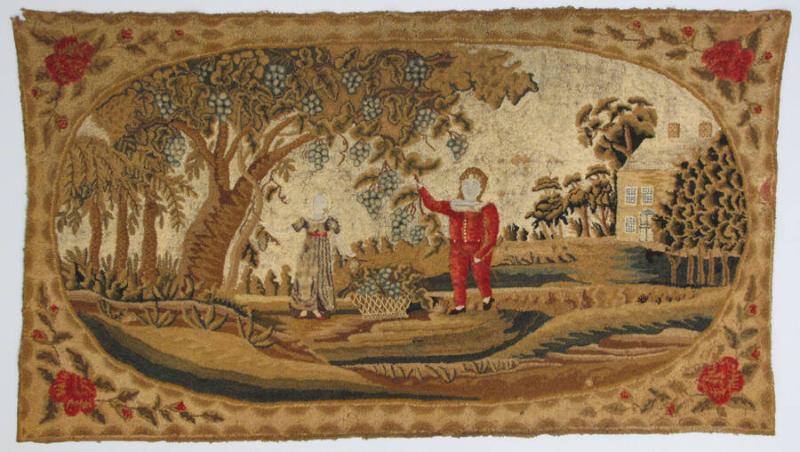
Yarn-sewn hearth rug, 1800–1820 (Connecticut Historical Society 2010.409.0)
Object · not yet checked at the source · Image permission pending
- Date
- 1800–1820
- Place
- Wethersfield, Connecticut (family tradition)
- Held by
- Connecticut Historical Society
- Number
- 2010.409.0
- Materials
- wool, linen
- Themes
- Rug-making techniques, Early tufting: bed rugs & needlework pile
Cite this source
Research notes
How it works: yarn is sewn with a needle in a continuous running stitch through a closely woven cloth, leaving loops on the face that are usually clipped (Getty AAT definition, via search). The Met's bed rugs use the same needle-worked running stitch, 'not hooked, as was once assumed'. This links yarn-sewn rugs to the bed rugs (1720s–1830s) already in the repo. This object: cut and uncut loops of multi-ply wool (or bunches of fine singles) on plain-woven linen. It has an oval medallion with a boy and girl under a grapevine and roses in the corners, 33 1/8 × 61 1/4 in. A family tradition links it to the Samuel Hanmer house (built 1765). Caveat: Colonial Williamsburg's lab found most grounds in its early sewn-rug exhibition were cotton, not linen, so check each fibre ID. Sources: https://emuseum.chs.org/emuseum/objects/13050/hearth-rug · https://www.metmuseum.org/toah/works-of-art/33.122 · https://collection.beta.fitz.ms/id/terminology/term-73016 · https://www.themagazineantiques.com/?p=11067 Research note (Oct 2026): from search results; pages not opened.