Chapter 15th–4th c. BCE–1971
How rugs are made, and where tufting fits
Six objects, from a carpet frozen in an Altai tomb to a patent drawing of 1941, show the ways rug-makers have made pile, and where tufting's way began.

Key dates
- 5th–4th c. BCEThe Pazyryk knotted carpet
- 1800–20A yarn-sewn hearth rug, Connecticut
- 1832Whytock’s “Tapestry carpet loom” (date disputed)
- 1839Templeton and Quiglay’s chenille patent
- 1860Oldest known Canadian hooked rug
- 1891Ross’s “Turfing Implement”
- 1941Multiple-needle tufting machine filed
- 1971Flocked Flotex launched in Britain
The plainest way to see where tufting fits is to look closely at a handful of rugs and ask of each one where its pile came from. Some answer with a knot, some with the loom, and some with a needle and a cloth that was finished before the pile went in; a few have no pile at all. Tufting gives the needle’s answer: it puts pile yarn into a backing that already exists, where a loom makes pile and backing together.11“Tufting defined: needles push pile yarn through a ready-made backing, locked in with adhesive”, hand needle 18th–19th c.; machine from mid-20th c., research note. Record The six objects below are taken in turn, ending where the rest of this book begins.
A carpet in the ice
In 1949 Sergei Rudenko’s excavation of Barrow 5 in the Pazyryk valley, in the Altai Mountains, found a wool pile carpet frozen in ice. Looters had been there first and left the tomb open.22Rudenko 1953, pp. 351–356, pl. CXV–CXVI; Rudenko 1968, ch. 2; Rudenko 1970, pp. 298–304, pl. 174–175; Opie, Tribal Rugs, ch. 3 (publications listed in the University of Washington Silk Road caption). Record The carpet measures 72 in x 78.75 in (183 cm x 200 cm). Its field carries a cross-like motif, and deer and mounted horsemen ride round its borders.33Rudenko 1953, pp. 351–356, pl. CXV–CXVI; Rudenko 1968, ch. 2; Rudenko 1970, pp. 298–304, pl. 174–175; Opie, Tribal Rugs, ch. 3 (publications listed in the University of Washington Silk Road caption). Record
Look closely and every tuft is a knot. The weaver tied short lengths of yarn round pairs of warps, one row at a time, cut them to height and locked each row with wefts; the knot used is the symmetric one, often called Turkish or Ghiordes.44Rudenko 1953, pp. 351–356, pl. CXV–CXVI; Rudenko 1968, ch. 2; Rudenko 1970, pp. 298–304, pl. 174–175; Opie, Tribal Rugs, ch. 3 (publications listed in the University of Washington Silk Road caption). Record Its date is still argued, between the 5th to 4th century BCE given by radiocarbon and the 252–238 BCE at which the Hermitage listing dates the barrow, but no older knotted-pile carpet is known.55Rudenko 1953, pp. 351–356, pl. CXV–CXVI; Rudenko 1968, ch. 2; Rudenko 1970, pp. 298–304, pl. 174–175; Opie, Tribal Rugs, ch. 3 (publications listed in the University of Washington Silk Road caption). Record
The knot did not stay the same. Weavers also use an asymmetric knot, called Persian or Senneh, which is said to allow finer, more curving designs;66“Knot types: symmetric (Turkish/Ghiordes) and asymmetric (Persian/Senneh)”, symmetric knot attested from 5th–4th century BCE (Pazyryk), research note. Record in Spain they tied a knot round a single warp, as in an armorial carpet of 1415–1458 in the Textile Museum;77Single-warp ‘Spanish’ knot: armorial carpet, 1415–1458 (Textile Museum R44.4.1), 1415–1458, The George Washington University Museum and The Textile Museum, R44.4.1. Record and in Finland they spaced rows of long knots far apart to make the shaggy ryijy, or rya, first used on beds.88Finnish ryijy (rya) with long knotted pile, dated 1814 (V&A T.123-1924), 1814 (object); documented from mid-15th century, Victoria and Albert Museum, T.123-1924. Record According to Britannica, Tibetan weavers loop the yarn over a metal gauge rod and then cut the whole row of loops with a knife run along a groove in the rod.99“Tibetan 'slit-loop' knot: continuous yarn looped over a gauge rod, then cut”, tradition undated; similar technique in Coptic Egyptian and Central Asian fragments (Britannica), research note. Record That order, loops first and cut afterwards, is one tufting shares.1010“Tufting defined: needles push pile yarn through a ready-made backing, locked in with adhesive”, hand needle 18th–19th c.; machine from mid-20th c., research note. Record
The Pazyryk burials also held felts with no pile at all: appliqué hangings, among them pieces from Barrow 5, and saddlecloths and cushions, with felt cut and sewn onto felt grounds.1111Pazyryk felt appliqué hangings and furnishings (Altai burial mounds), 5th–3rd century BCE (dating disputed), State Hermitage Museum, St Petersburg, not found (inventory numbers for these felts were not in search results). Record Felt is wool, fur or some hair fibres locked together by heat, moisture and friction, and Britannica says that non-woven felts are considered the first textile goods produced.1212“Felt: fibres matted together with heat, moisture and friction rather than woven”, before weaving (traditional claim); firm evidence from 5th–3rd century BCE (Pazyryk), research note. Record Kyrgyz women still make felt floor rugs called shyrdaks, cutting two felts of contrasting colour at once and swapping the pieces, a craft UNESCO placed on its Urgent Safeguarding List in 2012.1313Kyrgyz shyrdak: felt cut in counterchange, sewn and quilted (British Museum As1995,20.14), object 1955; craft listed by UNESCO 2012, British Museum, As1995,20.14. Record


A dhurrie from North India
The second object has no pile either, but it is woven. The Penn Museum’s cotton dhurrie from North India, made in the late 19th century, is 91 in x 54 in (232 cm x 137 cm), with elephants and horses that the museum links to Mughal hunting carpets and Iranian medallion rugs.1414Cotton dhurrie, North India, late 19th century (Penn Museum 29-96-81), late 19th century, Penn Museum (University of Pennsylvania Museum of Archaeology and Anthropology), 29-96-81. Record Dhurrie weavers beat the wefts down with a panja, a hand tool with metal prongs, until they cover the warp completely. The museum adds that dhurries of the time were mostly made by prison labour.1515Cotton dhurrie, North India, late 19th century (Penn Museum 29-96-81), late 19th century, Penn Museum (University of Pennsylvania Museum of Archaeology and Anthropology), 29-96-81. Record
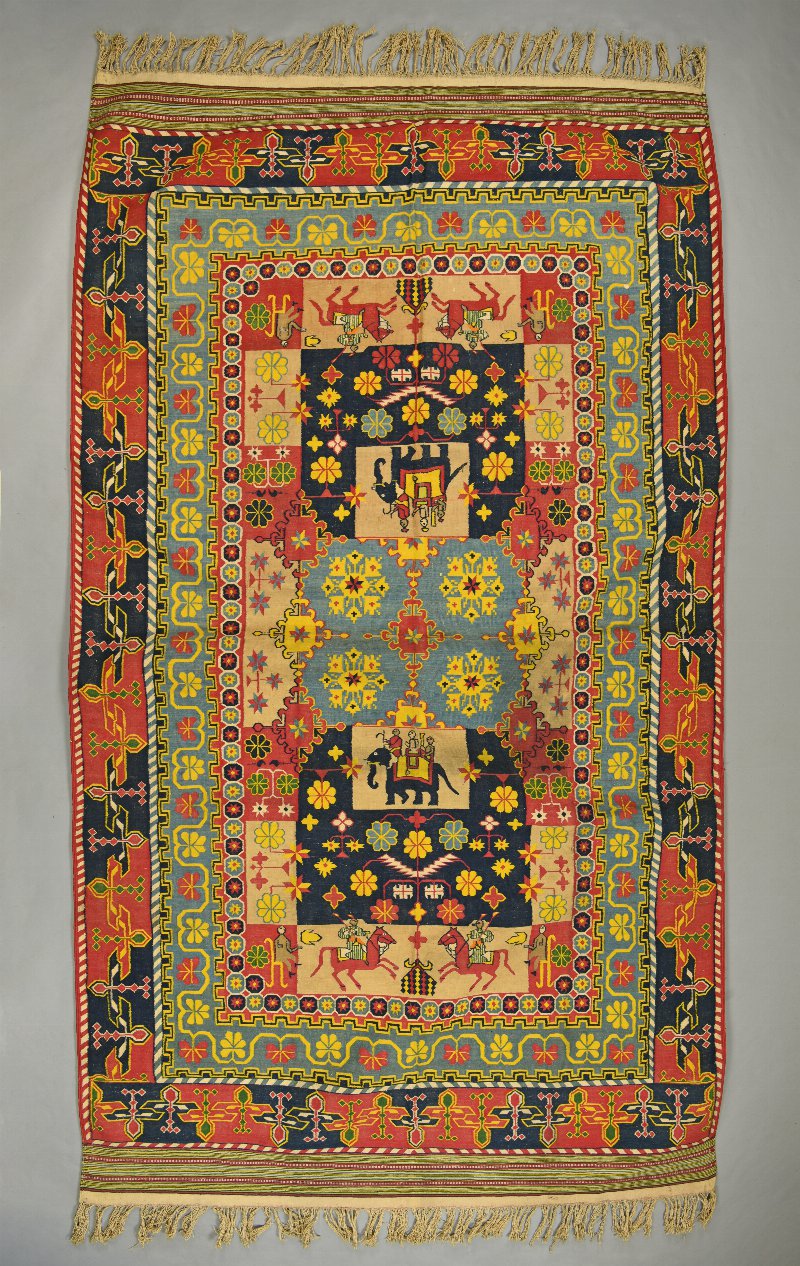
The dhurrie is a tapestry weave, like the kilim, the Navajo blanket and the Swedish rölakan: each coloured weft runs back and forth only where its colour is needed. Britannica dates the earliest known tapestry to Egyptian linen of 1483–1411 BCE from the tomb of Thutmose IV; a 1923 account gives the tomb of Thutmose III and 1500–1400 BCE.1616“Earliest tapestry weave: linen fragments from the tomb of Thutmose IV, Egypt (c. 1483–1400 BCE)”, c. 1483–1411 BCE (Britannica); 1500–1400 BCE (Glazier 1923), Egyptian Museum, Cairo (CG 46526, per V&A), CG 46526. Record Where two colours meet, a kilim weaver can leave a slit, dovetail the wefts round a shared warp, or interlock them.1717Kilim in slit tapestry, 17th century (Fine Arts Museums of San Francisco 1988.11.561), 17th century, Fine Arts Museums of San Francisco (Caroline and H. McCoy Jones Collection), 1988.11.561. Record Navajo weavers work tapestry on an upright loom with no moving parts, and from the 1880s traders such as J. L. Hubbell at Ganado steered them towards bordered floor rugs for Anglo buyers.1818“Navajo (Diné) weaving: tapestry on the upright loom, from wearing blankets (1600s–) to floor rugs (1880s–1920)”, weaving c. 1600–1700 (disputed); rug era c. 1880–1920, research note. Record
A carpet from Devon, and a sample from Glasgow
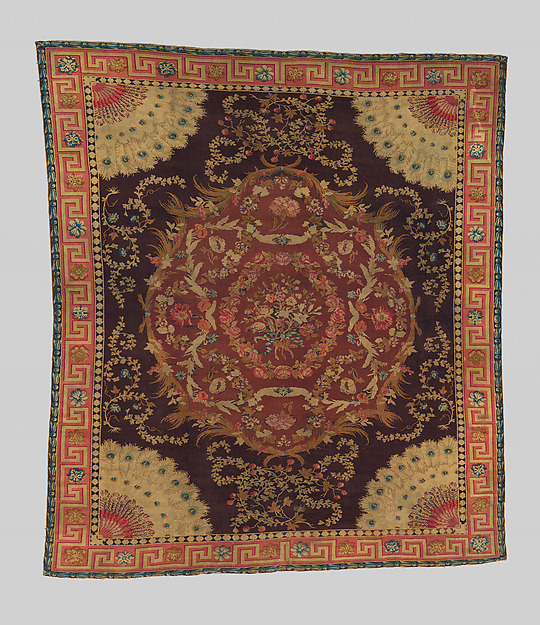
Around 1765 the Axminster carpet manufactory in Devon made a hand-knotted wool carpet that the Metropolitan Museum attributes to Thomas Whitty. It measures 204 in x 179.75 in (518 cm x 457 cm), and the Met acquired it in 2025.1919Axminster carpet attributed to Thomas Whitty, ca. 1765 (Met 2025.725), ca. 1765, The Metropolitan Museum of Art, 2025.725. Record It was made in a European workshop, but every tuft in it is a knot, as at Pazyryk.2020Axminster carpet attributed to Thomas Whitty, ca. 1765 (Met 2025.725), ca. 1765, The Metropolitan Museum of Art, 2025.725. Record Rudenko 1953, pp. 351–356, pl. CXV–CXVI; Rudenko 1968, ch. 2; Rudenko 1970, pp. 298–304, pl. 174–175; Opie, Tribal Rugs, ch. 3 (publications listed in the University of Washington Silk Road caption). Record
Europe’s carpet makers were already learning to make the loom form the pile instead.2121“Brussels carpet: looped wool pile raised over steel wires on the loom”, by the 1740s, research note. Record In Brussels carpet, long steel wires are laid between the warps and the worsted pile yarn loops up over them; Wilton is the same carpet with the loops cut.2222“Brussels carpet: looped wool pile raised over steel wires on the loom”, by the 1740s, research note. Record “Wilton: Huguenot weavers (1720s) and the first Wilton loom (1741)”, 1720s–1741, research note. Record Colour remained the difficulty, since a Brussels loom ran five or six coloured yarns in every pile line. Richard Whytock of Edinburgh printed the pattern onto one pile warp before weaving; the Glasgow School of Art Archives say he patented his “Tapestry carpet loom” in 1832, though another account dates it to about 1840 and the patent has not been found.2323‘Tapestry’ carpet: pile from warp yarns printed before weaving (Richard Whytock, Edinburgh, patented 1832); V&A sample c. 1850, patent 1832 (GSA Archives); 'about 1840' (Britain at Work); sample c. 1850, Victoria and Albert Museum, V&A system no. O258617 (museum number not seen). Record
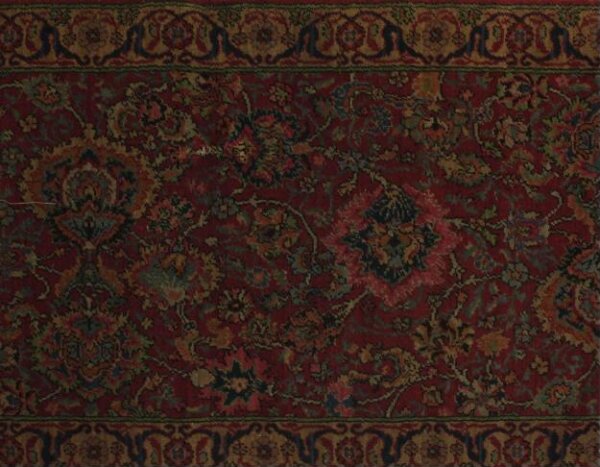
The Victoria and Albert Museum keeps a stair-carpet sample by James Templeton of Glasgow, from the late 19th century, with a Persian palmette design. Its pile is not knotted at all.2424Chenille Axminster: James Templeton and William Quiglay’s chenille patent (Glasgow, 1839); V&A Templeton sample, patent July 1839; sample late 19th century, Victoria and Albert Museum, V&A system no. O352290 (museum number not seen). Record Templeton and William Quiglay patented an improved chenille method in July 1839: a “weft blanket” is woven in the pattern colours and cut into strips, each strip is folded into a furry chenille yarn, and that yarn is woven into a backing as the pile.2525Chenille Axminster: James Templeton and William Quiglay’s chenille patent (Glasgow, 1839); V&A Templeton sample, patent July 1839; sample late 19th century, Victoria and Albert Museum, V&A system no. O352290 (museum number not seen). Record In 1876, according to Britannica’s student encyclopedia, Halcyon Skinner perfected a power loom for Royal Axminster that made patterned cut pile cheaper, a claim still to be checked against a second source.2626“Halcyon Skinner perfected the power loom for Royal Axminster (1876)”, 1876, research note. Record Different as they are, the Whitty carpet and the Templeton sample share one thing: the pile and the backing were made together.2727“Tufting defined: needles push pile yarn through a ready-made backing, locked in with adhesive”, hand needle 18th–19th c.; machine from mid-20th c., research note. Record
A hearth rug from Connecticut
The fourth object reverses that. A hearth rug in the Connecticut Historical Society, made between 1800 and 1820, has an oval medallion with a boy and a girl under a grapevine, and roses in the corners. Family tradition links it to the Samuel Hanmer house in Wethersfield.2828Yarn-sewn hearth rug, 1800–1820 (Connecticut Historical Society 2010.409.0), 1800–1820, Connecticut Historical Society, 2010.409.0. Record Its pile was not woven in. The maker took a plain-woven linen cloth and sewed wool through it with a needle in a continuous running stitch, leaving loops on the face, some cut and some not.2929Yarn-sewn hearth rug, 1800–1820 (Connecticut Historical Society 2010.409.0), 1800–1820, Connecticut Historical Society, 2010.409.0. Record
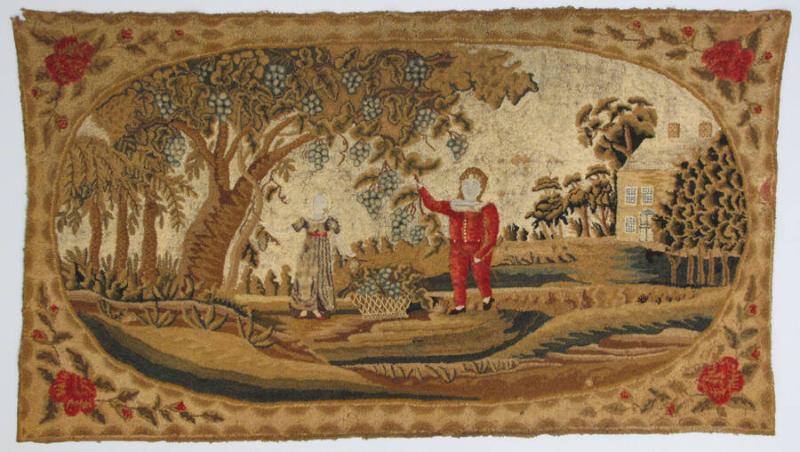
The Metropolitan Museum’s bed rugs are worked the same way, in a needle-worked running stitch “not hooked, as was once assumed”; they are the subject of chapter 2.3030Yarn-sewn hearth rug, 1800–1820 (Connecticut Historical Society 2010.409.0), 1800–1820, Connecticut Historical Society, 2010.409.0. Record Bed rug, 1809, The Metropolitan Museum of Art, 13.207. Record Others sewed on cloth instead of yarn. In a chenille-shirred rug, a fabric strip is stitched down the middle, gathered into a caterpillar-like strand and sewn flat along the pattern. Historic New England catalogues its “Apple Tree Farm” rug of 1820–1830, from Cogswell’s Grant in Essex, Massachusetts, as shirred.3131Shirred rug ‘Apple Tree Farm’, 1820–1830 (Historic New England 1991.1525), 1820–1830, Historic New England, 1991.1525. Record
Two sisters in New Brunswick
In 1860, at New Maryland near Fredericton, New Brunswick, Susanna Smith, aged sixteen, designed a rug and her sister Abigail, aged thirteen, hooked it. The Canadian Museum of History calls it the oldest known Canadian hooked rug.3232“Rug hooking’s origin debate: Yorkshire (Kent), or several centres at once (Québec, Maritimes, New England); burlap from the 1850s”, 1840s–1860 (earliest firm North American dates), research note. Record A hooker pulls strips of fabric or yarn up through a woven foundation with a hook, making loops on the surface. The usual foundation was burlap, which the same museum says was not sold commercially in North America until the 1850s.3333“Rug hooking’s origin debate: Yorkshire (Kent), or several centres at once (Québec, Maritimes, New England); burlap from the 1850s”, 1840s–1860 (earliest firm North American dates), research note. Record
Where hooking began is argued. W. W. Kent’s The Hooked Rug (1930) traced it to Yorkshire, as Wikipedia reports, while a Colonial Williamsburg label says it seems to have begun in New England and south-east Canada in the 1840s and spread once burlap arrived.3434“Rug hooking’s origin debate: Yorkshire (Kent), or several centres at once (Québec, Maritimes, New England); burlap from the 1850s”, 1840s–1860 (earliest firm North American dates), research note. Record Hooked rug on burlap, ca. 1875 (Colonial Williamsburg 1983.611.1), ca. 1875, Colonial Williamsburg Foundation, 1983.611.1. Record
By the early 20th century, hooking could also be organised as charitable outwork. The Grenfell Mission in northern Newfoundland and Labrador gave women kits of pre-dyed material and burlap stencilled with designs, and sold the mats to fund its medical work; sources date the start to 1906, 1909 or 1913.3535“Grenfell mats: a mission cottage industry of hooked mats in Newfoundland and Labrador (1906/1909/1913 to late 1960s)”, founded 1906, 1909 or 1913 (sources differ); peak late 1920s–early 1930s, research note. Record Its “Polar Bear on Ice Floe”, of about 1930, now in the Baltimore Museum of Art, is hooked in wool and rayon or silk jersey on jute burlap. The Mission supplied used stockings donated by women in North American and British cities.3636Grenfell hooked mat ‘Polar Bear on Ice Floe’, c. 1930 (Baltimore Museum of Art 1996.165), c. 1930, Baltimore Museum of Art, 1996.165. Record
When your stockings run, let them run to Labrador!
Grenfell Mission slogan, quoted by the Baltimore Museum of Art
Some strip rugs needed no foundation cloth at all. Braided rugs coil a three-strand braid of cloth strips and sew it edge to edge into a round or oval mat,3737Circular braided wool rug, 1860–1890 (Historic New England 1998.1344), 1860–1890, Historic New England, 1998.1344. Record and crocheted rugs work strips into chained loops with a hook; the American Folk Art Museum has one of 1880–1900 made partly from recycled ingrain carpet.3838Crocheted rug, 1880–1900 (American Folk Art Museum 1985.21.1), 1880–1900, American Folk Art Museum, 1985.21.1. Record
A patent drawing, 1941
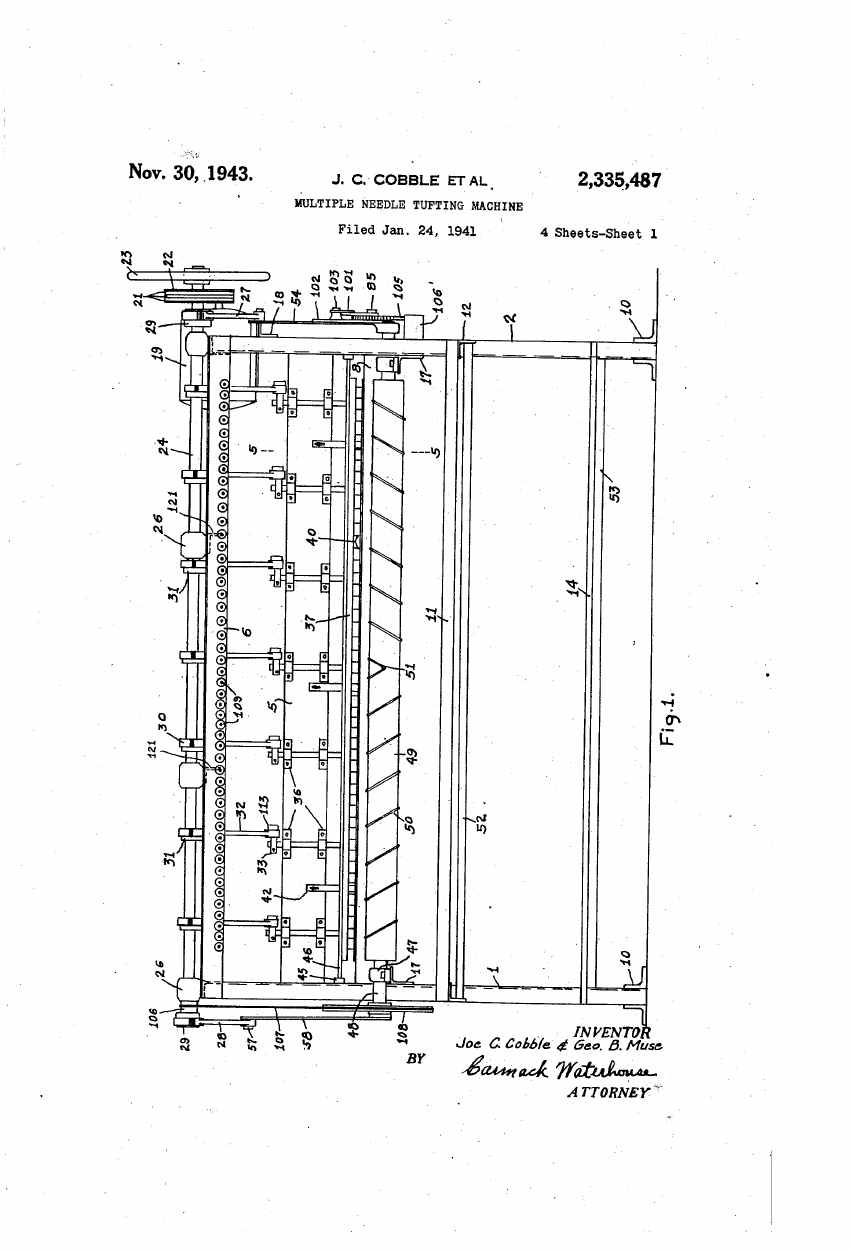
The last object is a drawing. In January 1941 Joe C. Cobble and George B. Muse filed for a “Multiple Needle Tufting Machine”, granted in November 1943.3939Joe C. Cobble, “Multiple Needle Tufting Machine” (US2335487A), filed 24 Jan 1941, granted 30 Nov 1943. Record Fifty years earlier Ebenezer Ross of Toledo, Ohio, had patented a two-handled needle-and-gauge tool as a “Turfing Implement” (chapter 9).4040Ebenezer Ross, “Turfing Implement” (US463548A), patented 17 Nov 1891. Record Both work with needles, as the maker of the Connecticut hearth rug did.
In tufting, a needle, or a bar of hundreds of needles, pierces a primary backing and leaves loops, which can be cut. The tufts are then locked with latex or another adhesive, often with a secondary backing laminated on. Unlike a loom, the tufting needle does not make the cloth it works in.4141“Tufting defined: needles push pile yarn through a ready-made backing, locked in with adhesive”, hand needle 18th–19th c.; machine from mid-20th c., research note. Record According to the Carpet and Rug Institute, machinery developed for chenille rugs was widened to make larger rugs and broadloom carpet (chapters 4 and 5).4242Carpet and Rug Institute, web page on the history of carpet, carpet-rug.org (quoted from search results; page not yet checked). Record By one count, still to be traced to its source, 10 per cent of American carpet was tufted in 1950;4343“1950: 10% of US carpet was tufted; today over 90%”, 1950–today, research note. Record one textile source puts tufted products at more than 90 per cent of carpet now.4444“Tufting defined: needles push pile yarn through a ready-made backing, locked in with adhesive”, hand needle 18th–19th c.; machine from mid-20th c., research note. Record
Industry has also found ways to make a floor covering with no yarn construction at all: barbed needles that tangle a loose web of fibres into a felt-like fabric,4545“Needle-punch (needlefelt): barbed needles mat a fibre web into a non-woven floor covering (padding from late 1800s; synthetics late 1950s)”, late 1800s (padding); late 1950s (synthetic home-furnishing products); mid-1980s (random velour looms), research note. Record nylon fibres shot upright into wet adhesive in an electric field,4646“Flocked floor covering (Flotex): short nylon fibres shot upright into adhesive by an electric field (France, 1960s; UK 1971–72)”, 1960s (France); 1971 UK launch; Ripley factory 1972, research note. Record and pile yarn set into a layer of PVC.4747“Fusion-bonded carpet: cut pile yarn set into a PVC adhesive layer (Debron, Kidderminster; US rights to Milliken 1969)”, by 1969, research note. Record Britannica’s student encyclopedia still names weaving and tufting as the two main methods of making carpet.4848“Tufting defined: needles push pile yarn through a ready-made backing, locked in with adhesive”, hand needle 18th–19th c.; machine from mid-20th c., research note. Record
This chapter argues that tufting belongs with the sewn and hooked rugs rather than with the loom. The Pazyryk carpet, the Whitty carpet and the Templeton sample were made with their pile; the Connecticut hearth rug, the Smith sisters’ rug and the tufting machine all start from a cloth that already exists and put the pile into it.4949“Tufting defined: needles push pile yarn through a ready-made backing, locked in with adhesive”, hand needle 18th–19th c.; machine from mid-20th c., research note. Record
Notes
- 1“Tufting defined: needles push pile yarn through a ready-made backing, locked in with adhesive.” Research note. kids.britannica.com/students/article/rug-and-carpet/276811. Record
- 2Rudenko 1953, pp. 351–356, pl. CXV–CXVI; Rudenko 1968, ch. 2; Rudenko 1970, pp. 298–304, pl. 174–175; Opie, Tribal Rugs, ch. 3 (publications listed in the University of Washington Silk Road caption). depts.washington.edu/silkroad/museums/shm/shmpazyryk.html. Record
- 3Rudenko 1953, pp. 351–356, pl. CXV–CXVI; Rudenko 1968, ch. 2; Rudenko 1970, pp. 298–304, pl. 174–175; Opie, Tribal Rugs, ch. 3 (publications listed in the University of Washington Silk Road caption). depts.washington.edu/silkroad/museums/shm/shmpazyryk.html. Record
- 4Rudenko 1953, pp. 351–356, pl. CXV–CXVI; Rudenko 1968, ch. 2; Rudenko 1970, pp. 298–304, pl. 174–175; Opie, Tribal Rugs, ch. 3 (publications listed in the University of Washington Silk Road caption). depts.washington.edu/silkroad/museums/shm/shmpazyryk.html. Record
- 5Rudenko 1953, pp. 351–356, pl. CXV–CXVI; Rudenko 1968, ch. 2; Rudenko 1970, pp. 298–304, pl. 174–175; Opie, Tribal Rugs, ch. 3 (publications listed in the University of Washington Silk Road caption). depts.washington.edu/silkroad/museums/shm/shmpazyryk.html. Record
- 6“Knot types: symmetric (Turkish/Ghiordes) and asymmetric (Persian/Senneh).” Research note. en.wikipedia.org/wiki/Knotted-pile_carpet. Record
- 7Mudéjar weavers. Single-warp ‘Spanish’ knot: armorial carpet, 1415–1458 (Textile Museum R44.4.1), 1415–1458. The George Washington University Museum and The Textile Museum, R44.4.1. collections-gwu.zetcom.net/en/collection/item/7980. Record
- 8Unknown maker. Finnish ryijy (rya) with long knotted pile, dated 1814 (V&A T.123-1924), 1814 (object); documented from mid-15th century. Victoria and Albert Museum, T.123-1924. collections.vam.ac.uk/item/O102075/carpet-unknown. Record
- 9“Tibetan 'slit-loop' knot: continuous yarn looped over a gauge rod, then cut.” Research note. britannica.com/art/Tibetan-carpet. Record
- 10“Tufting defined: needles push pile yarn through a ready-made backing, locked in with adhesive.” Research note. kids.britannica.com/students/article/rug-and-carpet/276811. Record
- 11Pazyryk culture (Early Iron Age Altai). Pazyryk felt appliqué hangings and furnishings (Altai burial mounds), 5th–3rd century BCE (dating disputed). State Hermitage Museum, St Petersburg, not found (inventory numbers for these felts were not in search results). depts.washington.edu/silkroad/museums/shm/shmpazyryk.html. Record
- 12“Felt: fibres matted together with heat, moisture and friction rather than woven.” Research note. britannica.com/technology/felt. Record
- 13Kyrgyz women felt-makers. Kyrgyz shyrdak: felt cut in counterchange, sewn and quilted (British Museum As1995,20.14), object 1955; craft listed by UNESCO 2012. British Museum, As1995,20.14. britishmuseum.org/collection/object/W_As1995-20-14. Record
- 14Unknown maker. Cotton dhurrie, North India, late 19th century (Penn Museum 29-96-81), late 19th century. Penn Museum (University of Pennsylvania Museum of Archaeology and Anthropology), 29-96-81. collections.penn.museum/collections/object/72254. Record
- 15Unknown maker. Cotton dhurrie, North India, late 19th century (Penn Museum 29-96-81), late 19th century. Penn Museum (University of Pennsylvania Museum of Archaeology and Anthropology), 29-96-81. collections.penn.museum/collections/object/72254. Record
- 16“Earliest tapestry weave: linen fragments from the tomb of Thutmose IV, Egypt (c. 1483–1400 BCE).” Research note. britannica.com/art/tapestry/Periods-and-centres-of-activity. Record
- 17Unknown maker. Kilim in slit tapestry, 17th century (Fine Arts Museums of San Francisco 1988.11.561), 17th century. Fine Arts Museums of San Francisco (Caroline and H. McCoy Jones Collection), 1988.11.561. famsf.org/artworks/kilim. Record
- 18“Navajo (Diné) weaving: tapestry on the upright loom, from wearing blankets (1600s–) to floor rugs (1880s–1920).” Research note. statemuseum.arizona.edu/online-exhibit/19-century-navajo-weaving-asm/navajo-weaving-methods. Record
- 19Attributed to Thomas Whitty (1713–1792); Axminster carpet manufactory. Axminster carpet attributed to Thomas Whitty, ca. 1765 (Met 2025.725), ca. 1765. The Metropolitan Museum of Art, 2025.725. metmuseum.org/art/collection/search/928622. Record
- 20Attributed to Thomas Whitty (1713–1792); Axminster carpet manufactory. Axminster carpet attributed to Thomas Whitty, ca. 1765 (Met 2025.725), ca. 1765. The Metropolitan Museum of Art, 2025.725. metmuseum.org/art/collection/search/928622. Record Rudenko 1953, pp. 351–356, pl. CXV–CXVI; Rudenko 1968, ch. 2; Rudenko 1970, pp. 298–304, pl. 174–175; Opie, Tribal Rugs, ch. 3 (publications listed in the University of Washington Silk Road caption). depts.washington.edu/silkroad/museums/shm/shmpazyryk.html. Record
- 21“Brussels carpet: looped wool pile raised over steel wires on the loom.” Research note. britannica.com/topic/Brussels-carpet. Record
- 22“Brussels carpet: looped wool pile raised over steel wires on the loom.” Research note. britannica.com/topic/Brussels-carpet. Record “Wilton: Huguenot weavers (1720s) and the first Wilton loom (1741).” Research note. wiltoncarpets.com/about-us/our-heritage. Record
- 23Richard Whytock (inventor); G. P. Simcox, Kidderminster (sample maker). ‘Tapestry’ carpet: pile from warp yarns printed before weaving (Richard Whytock, Edinburgh, patented 1832); V&A sample c. 1850, patent 1832 (GSA Archives); 'about 1840' (Britain at Work); sample c. 1850. Victoria and Albert Museum, V&A system no. O258617 (museum number not seen). collections.vam.ac.uk/item/O258617. Record
- 24James Templeton; William Quiglay (Quigley). Chenille Axminster: James Templeton and William Quiglay’s chenille patent (Glasgow, 1839); V&A Templeton sample, patent July 1839; sample late 19th century. Victoria and Albert Museum, V&A system no. O352290 (museum number not seen). collections.vam.ac.uk/item/O352290/carpet-james-templeton. Record
- 25James Templeton; William Quiglay (Quigley). Chenille Axminster: James Templeton and William Quiglay’s chenille patent (Glasgow, 1839); V&A Templeton sample, patent July 1839; sample late 19th century. Victoria and Albert Museum, V&A system no. O352290 (museum number not seen). collections.vam.ac.uk/item/O352290/carpet-james-templeton. Record
- 26“Halcyon Skinner perfected the power loom for Royal Axminster (1876).” Research note. kids.britannica.com/students/article/rug-and-carpet/276811. Record
- 27“Tufting defined: needles push pile yarn through a ready-made backing, locked in with adhesive.” Research note. kids.britannica.com/students/article/rug-and-carpet/276811. Record
- 28Unknown maker. Yarn-sewn hearth rug, 1800–1820 (Connecticut Historical Society 2010.409.0), 1800–1820. Connecticut Historical Society, 2010.409.0. emuseum.chs.org/emuseum/objects/13050/hearth-rug. Record
- 29Unknown maker. Yarn-sewn hearth rug, 1800–1820 (Connecticut Historical Society 2010.409.0), 1800–1820. Connecticut Historical Society, 2010.409.0. emuseum.chs.org/emuseum/objects/13050/hearth-rug. Record
- 30Unknown maker. Yarn-sewn hearth rug, 1800–1820 (Connecticut Historical Society 2010.409.0), 1800–1820. Connecticut Historical Society, 2010.409.0. emuseum.chs.org/emuseum/objects/13050/hearth-rug. Record Attributed to "M. B.". Bed rug, 1809. The Metropolitan Museum of Art, 13.207. metmuseum.org/art/collection/search?q=13.207. Record
- 31Unknown maker. Shirred rug ‘Apple Tree Farm’, 1820–1830 (Historic New England 1991.1525), 1820–1830. Historic New England, 1991.1525. historicnewengland.org/explore/collections-access/gusn/3034. Record
- 32“Rug hooking’s origin debate: Yorkshire (Kent), or several centres at once (Québec, Maritimes, New England); burlap from the 1850s.” Research note. web.archive.org/web/20240319123851/https://www.historymuseum.ca/cmc/exhibitions/arts/rugs/rugs02e.html. Record
- 33“Rug hooking’s origin debate: Yorkshire (Kent), or several centres at once (Québec, Maritimes, New England); burlap from the 1850s.” Research note. web.archive.org/web/20240319123851/https://www.historymuseum.ca/cmc/exhibitions/arts/rugs/rugs02e.html. Record
- 34“Rug hooking’s origin debate: Yorkshire (Kent), or several centres at once (Québec, Maritimes, New England); burlap from the 1850s.” Research note. web.archive.org/web/20240319123851/https://www.historymuseum.ca/cmc/exhibitions/arts/rugs/rugs02e.html. Record Unknown maker. Hooked rug on burlap, ca. 1875 (Colonial Williamsburg 1983.611.1), ca. 1875. Colonial Williamsburg Foundation, 1983.611.1. emuseum.colonialwilliamsburg.org/objects/59028/hooked-rug. Record
- 35“Grenfell mats: a mission cottage industry of hooked mats in Newfoundland and Labrador (1906/1909/1913 to late 1960s).” Research note. textilemuseum.ca/collection/hooked-rug-t84-0117. Record
- 36Grenfell Mission Industrial Department (label: Grenfell Labrador Industries). Grenfell hooked mat ‘Polar Bear on Ice Floe’, c. 1930 (Baltimore Museum of Art 1996.165), c. 1930. Baltimore Museum of Art, 1996.165. artbma.org/artwork/polar-bear-on-ice-floe. Record
- 37Unknown maker. Circular braided wool rug, 1860–1890 (Historic New England 1998.1344), 1860–1890. Historic New England, 1998.1344. historicnewengland.org/explore/collections-access/gusn/18698. Record
- 38Unknown maker. Crocheted rug, 1880–1900 (American Folk Art Museum 1985.21.1), 1880–1900. American Folk Art Museum, 1985.21.1. collection.folkartmuseum.org/objects/922/crocheted-rug. Record
- 39Joe C. Cobble, “Multiple Needle Tufting Machine” (US2335487A), filed 24 Jan 1941, granted 30 Nov 1943. patents.google.com/patent/US2335487A/en. Record
- 40Ebenezer Ross, “Turfing Implement” (US463548A), patented 17 Nov 1891. patents.google.com/patent/US463548A/en. Record
- 41“Tufting defined: needles push pile yarn through a ready-made backing, locked in with adhesive.” Research note. kids.britannica.com/students/article/rug-and-carpet/276811. Record
- 42Carpet and Rug Institute, web page on the history of carpet, carpet-rug.org (quoted from search results; page not yet checked). carpet-rug.org/about-us/history-of-carpet. Record
- 43“1950: 10% of US carpet was tufted; today over 90%.” Research note, TTW Script Bank fact-check notes (Claude research, Aug 2026). Record
- 44“Tufting defined: needles push pile yarn through a ready-made backing, locked in with adhesive.” Research note. kids.britannica.com/students/article/rug-and-carpet/276811. Record
- 45“Needle-punch (needlefelt): barbed needles mat a fibre web into a non-woven floor covering (padding from late 1800s; synthetics late 1950s).” Research note. apparelsearch.com/education/research/nonwoven/2001_kermit_duckett/education_research_nonwoven_needle_punched_nonwovens.htm. Record
- 46“Flocked floor covering (Flotex): short nylon fibres shot upright into adhesive by an electric field (France, 1960s; UK 1971–72).” Research note. bdonline.co.uk/cpd/cpd-26-2013-electrostatically-flocked-flooring/5063206.article. Record
- 47“Fusion-bonded carpet: cut pile yarn set into a PVC adhesive layer (Debron, Kidderminster; US rights to Milliken 1969).” Research note. floordaily.net/floorfocus/carpet-tile-50-years-later-augsep-2007. Record
- 48“Tufting defined: needles push pile yarn through a ready-made backing, locked in with adhesive.” Research note. kids.britannica.com/students/article/rug-and-carpet/276811. Record
- 49“Tufting defined: needles push pile yarn through a ready-made backing, locked in with adhesive.” Research note. kids.britannica.com/students/article/rug-and-carpet/276811. Record
Where the sources are
- Research notes, not yet traced to a public source15
- Victoria and Albert Museum3
- State Hermitage Museum, St Petersburg2
- The Metropolitan Museum of Art2
- Historic New England2
- US patents2
- The George Washington University Museum and The Textile Museum1
- British Museum1
- Penn Museum (University of Pennsylvania Museum of Archaeology and Anthropology)1
- Egyptian Museum, Cairo (CG 46526, per V&A)1
- Fine Arts Museums of San Francisco (Caroline and H. McCoy Jones Collection)1
- Connecticut Historical Society1
- Colonial Williamsburg Foundation1
- Baltimore Museum of Art1
- American Folk Art Museum1