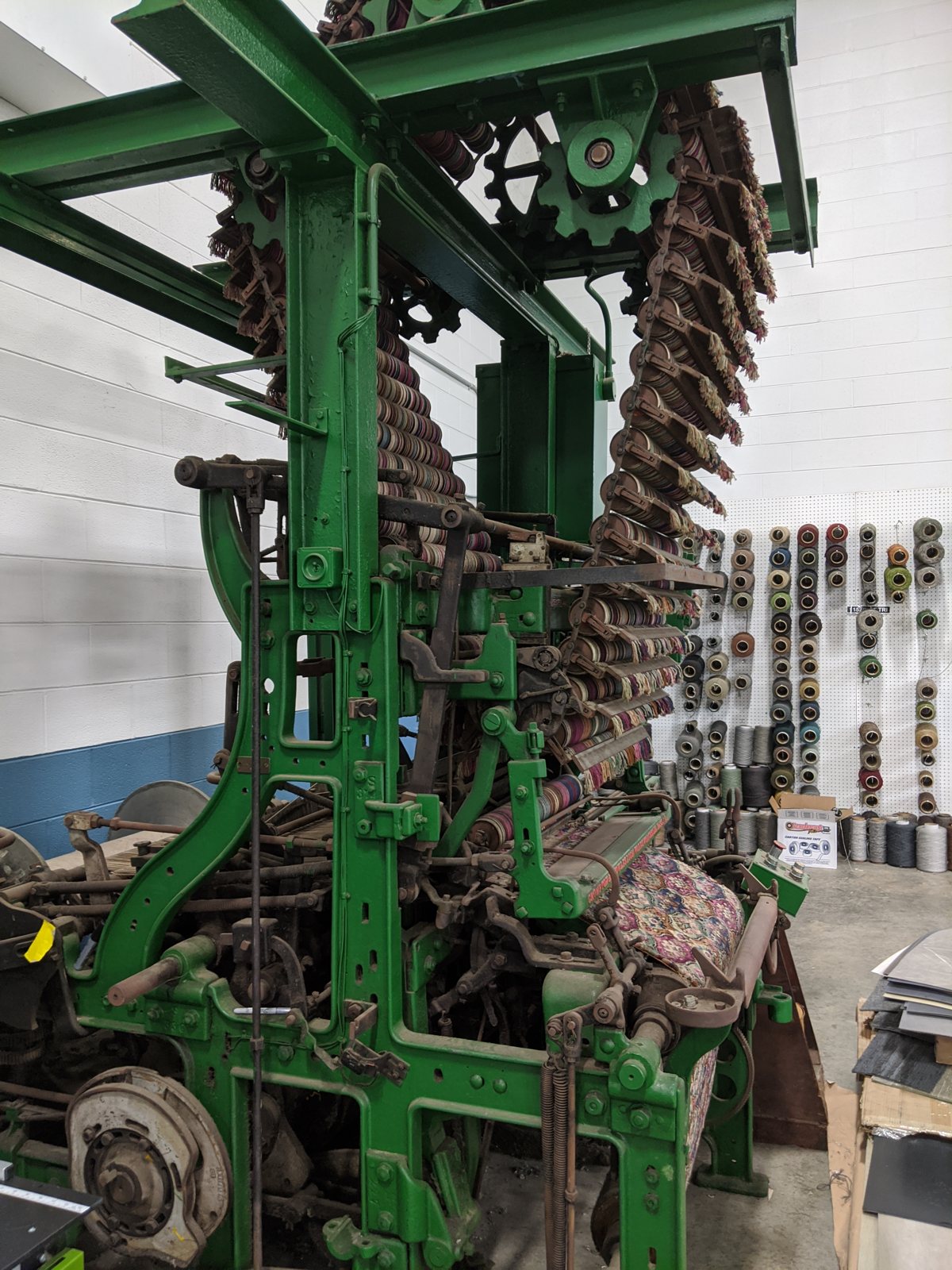
Spool Axminster power loom (identified from photograph)
Tool · not yet checked at the source
- Date
- undated; the spool Axminster type dates from Skinner's 1876 loom
- Place
- Dalton, Georgia
- Held by
- Shaw Industries, Dalton, Georgia
- Collection
- Photo: Tuft the World, taken at Shaw Industries, Dalton, Georgia. The photograph is yours; the loom is Shaw's, so check with Shaw before publishing outside the database.
- Themes
- Woven carpet, Tools & equipment
Cite this source
Research notes
A large green cast-iron carpet loom. The tall chains overhead carry the tube frames ("spools"), each pre-wound with one row of coloured pile yarn. The loom takes one spool at a time, inserts a row of tufts, cuts them and weaves them in, which gives unlimited colours per row. The patterned multicolour carpet on the cloth beam is typical of Axminster. Behind it, a pegboard wall of yarn cones. Why it matters: in Axminster weaving, cut tufts are inserted row by row, the woven industry's answer to many-coloured pile. It was the high-volume rival tufted broadloom had to undercut. Link to Halcyon Skinner's 1876 loom and to Bigelow-Sanford. Identification is from the photo only. Photographed at Shaw Industries in Dalton. A woven-carpet loom kept by the largest tufted-carpet maker is worth a line in the book: ask Shaw where it came from (a Shaw woven plant, an acquired mill?) and whether it still runs. To record: the maker's plate and serial number (often cast on the frame), the loom width, and its date.