Chapter 31627–1956
Brussels, Wilton and Kidderminster: woven carpet before tufting
From the 1730s British looms wove carpet for buyers who could not afford knotted pile, and the woven industry that grew from them in Britain and America was the one tufted carpet later undercut.
Key dates
On 30 May 1800 the London auctioneer James Christie offered 150 lots of carpet in a single sale. His eight-page catalogue named four kinds, Brussels, Wilton, Venetian and Kidderminster, and every one of them was woven on the loom. A microfilm of the catalogue is at the New York Public Library; it has not yet been seen for this book.11James Christie (1730–1803), Christie’s sale catalogue of 150 lots of Brussels, Wilton, Venetian and Kidderminster carpets, 30 May 1800, 1800, New York Public Library (microfilm), *ZM MAY p.v. 1, no. 18; OCLC 44515494. Record This chapter traces how the loom came to supply a whole market, from the cheap floor to the dear one, and how that market was the one tufted carpet later took.
A carpet for the Grande Galerie, 1680
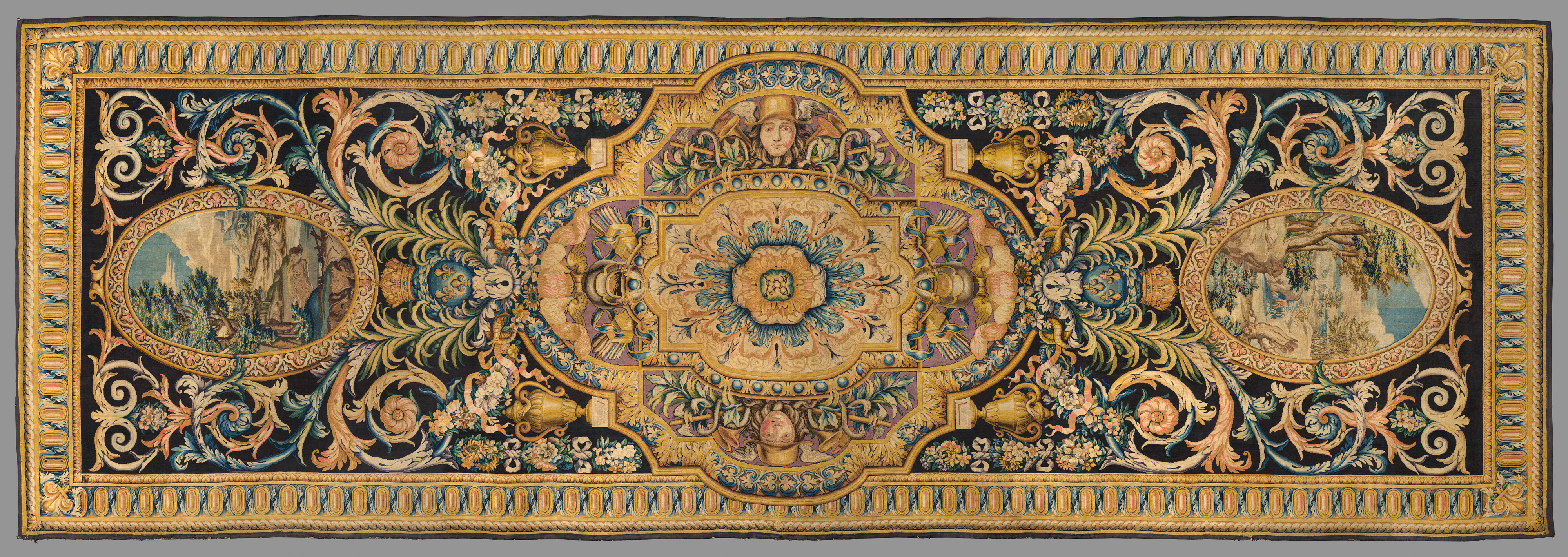
The standard that the loom had to answer was French and knotted by hand. The Metropolitan Museum’s carpet of 1680, after designs by Charles Le Brun, is one of the series woven for the Grande Galerie of the Louvre: knotted wool pile, nearly nine metres long. By Sotheby’s count, Pierre Dupont’s workshop made 32 of the series and the Lourdet workshops 60.22Grande Galerie carpet with landscapes (Savonnerie, after Charles Le Brun), 1680, 1680, The Metropolitan Museum of Art, 1976.155.114. Record Dupont is said to have set up a workshop in a former soap factory at Chaillot around 1615, and in 1627 Louis XIII granted him and his former apprentice Simon Lourdet an eighteen-year monopoly on carpets “in the Turkish manner”.33“Savonnerie, Paris: Dupont’s workshop (1615) and the 1627 royal monopoly with Lourdet for knotted 'Turkish-manner' carpets”, 1615; 1627, research note. Record
In the 1750s that model was tried in England, and it proved too dear. Peter Parisot employed workers from Chaillot, first at Paddington and then at Fulham, with money from the Duke of Cumberland. The Victoria County History records that his goods were judged too costly, and his stock was auctioned in January 1756; the venture’s start is dated 1750 in one account and 1753 in another.44“Peter Parisot’s Fulham carpet manufactory (1750/1753–55): Savonnerie weavers in London”, 1750 or 1753–1755, research note. Record Claude Passavant, a Swiss Huguenot, moved the weavers to Exeter, where, according to Axminster Heritage, the works stopped trading in 1761 because its carpets were too expensive.55“Claude Passavant’s Exeter carpet manufactory (1756–1761): costly knotted carpets, three survivors”, 1756–1761, research note. Record At Axminster, meanwhile, another knotter was competing on price.
Thomas Whitty’s carpet, about 1765
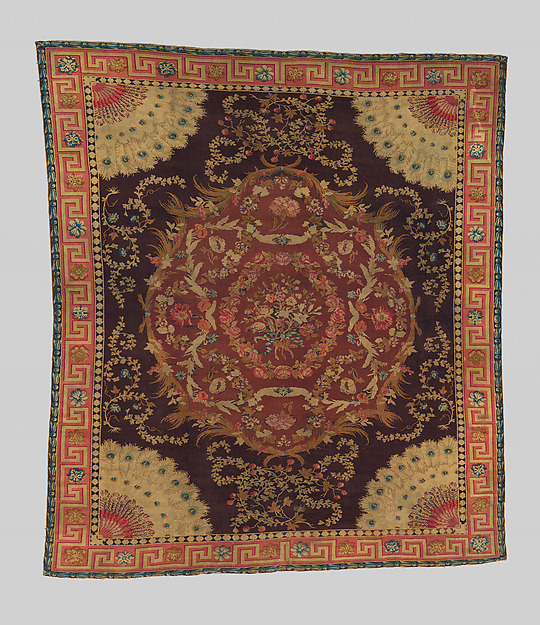
The carpet in the picture to the right of this chapter is knotted wool, 204 in x 179.75 in (518 cm x 457 cm), attributed to Thomas Whitty of the Axminster carpet manufactory and dated about 1765. The Metropolitan Museum acquired it in 2025.66Axminster carpet attributed to Thomas Whitty, ca. 1765 (Met 2025.725), ca. 1765, The Metropolitan Museum of Art, 2025.725. Record Whitty had run a cloth business since 1737, and he finished his first knotted carpet at Axminster at midsummer 1755.77“Thomas Whitty finishes his first hand-knotted carpet at Axminster on Midsummer Day 1755”, 1755, research note. Record
Price was what set him apart. The Society of Arts offered prizes for English “Turkey” carpets, and in 1757 Thomas Moore of Moorfields made the finest carpet, but at forty guineas. Whitty’s, at £15, was judged the best value, and the prize was split; in 1759 Whitty won outright.88“Society of Arts carpet premiums, 1757–59: Moore and Whitty share 1757; Whitty wins outright in 1759”, 1757–1759. Record Moore also made carpets to Robert Adam’s designs, among them the drawing-room carpet at Osterley.99“Thomas Moore’s Moorfields manufactory: knotted carpets for Robert Adam (Osterley)”, c. 1757–1770s, research note. Record Hand-knotted carpet, even at Whitty’s prices, sat at the top of the market. Below it, Britain’s looms were already making a flat carpet.
A sample of Kidderminster cloth
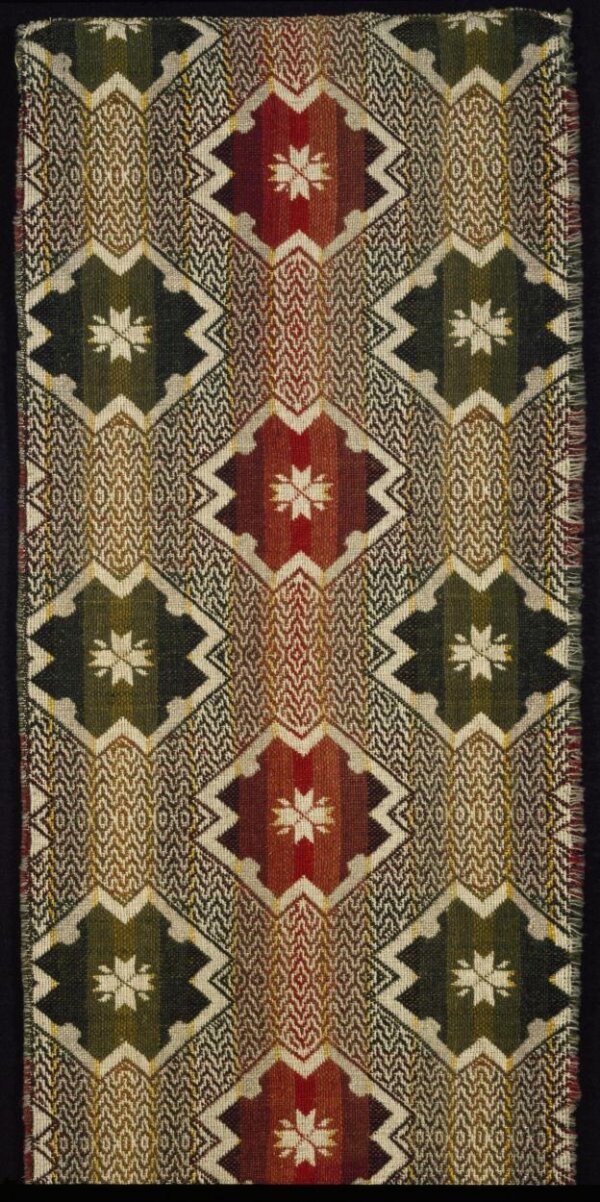
The Victoria and Albert Museum keeps a mid-nineteenth-century sample of Kidderminster carpeting by Dove & Co. of Leeds, with a star-and-cross design. It is woven in double cloth with a worsted warp and a woollen weft, “a construction particular to this type of carpet”. The 1842 Britannica described such carpet as “composed of two plies of cloth”, with the colours reversed on the back.1010Sample of Kidderminster carpeting, double cloth (Dove & Co., Leeds, mid-19th century), mid-19th century, Victoria and Albert Museum, T.5-1959. Record It has no pile at all.
The town it is named for turned to this cloth in 1735. That year, the 1911 Encyclopaedia Britannica says, Kidderminster’s woollen trade “was however replaced by that of carpets”, and at first the town made only “Kidderminster” carpets. Local historians credit John Pearsall with the first, or else two stuff weavers. By 1772, according to the 1797 Britannica, the town had over 250 carpet looms.1111“Kidderminster begins weaving flat, double-cloth 'Kidderminster' (ingrain) carpet in 1735”, 1735, research note. Record The same cloth went by other names: one local history says it was called ingrain, then Kidderminster, then Scotch once the process moved to Scotland.1212“Kidderminster begins weaving flat, double-cloth 'Kidderminster' (ingrain) carpet in 1735”, 1735, research note. Record
Its market is described in a study of a Scottish account book. Vanessa Habib has used Thomas Gilfillan’s cash book and ledger of 1764 to 1770 as rare evidence of a working Scotch carpet manufactory at Stirling, and she quotes an observer of 1776 on whom such carpets suited:1313Vanessa Habib, “Scotch carpets at Stirling: Thomas Gilfillan’s cash book and ledger, 1764–1770 (and Axminster manufacture in Edinburgh)”, 2000; 2005. Record
cannot afford the extravagant prices of Wilton, Axminster, and other more expensive manufactories
An observer of 1776, quoted by Vanessa HabibVenetian carpet, the fourth of Christie’s kinds, was flat too; the 1842 Britannica says it was used mostly for stairs, passages and lobbies.1414“Venetian carpet: striped, worsted-warp flat carpet for stairs and passages”, 17th–19th century, research note. Record Above these flat cloths, the loom had also found a way to make pile.
Two samples: Brussels and Wilton
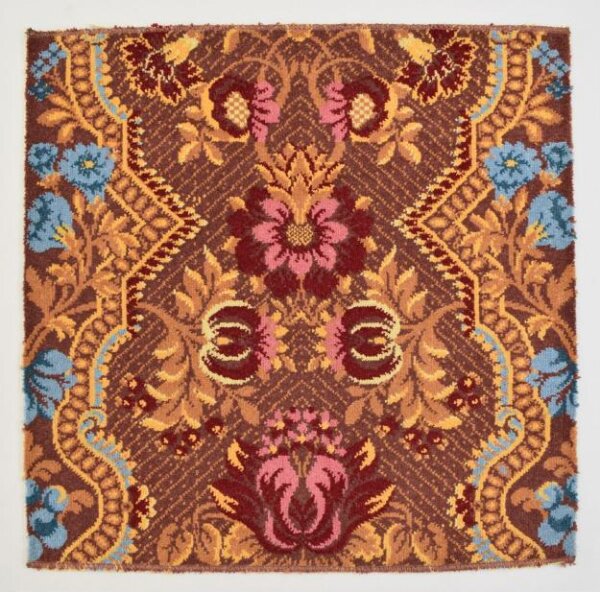
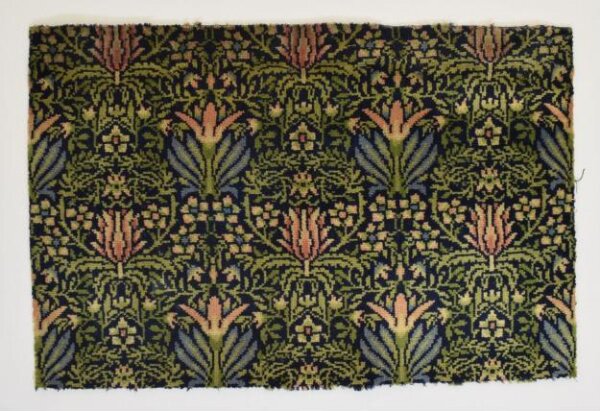
Two more samples at the Victoria and Albert Museum show the loom’s pile. One is a Brussels carpet sample woven in 1980 by Hugh Mackay & Co. after a design by Anna Maria Garthwaite dated 1753.1515Brussels carpet sample woven in 1980 after a design by Anna Maria Garthwaite dated 1753, 1980 (design dated 1753), Victoria and Albert Museum, T.11-1981. Record The other is the “Lily” Wilton sample, designed by William Morris in 1875 and woven by the Wilton Royal Carpet Factory.1616“How cutting the loops made Wilton: the bladed or grooved wire and the 'travat' knife”, 18th century (exact date disputed), research note. Record
Brussels pile is looped; Wilton has the loops cut. In the 1842 Britannica’s account, long steel wires were inserted between the linen and worsted warps of a Brussels loom, and the worsted pile looped up over them; Brussels and Wilton were woven “in looms of the same construction”. The National Park Service adds that Brussels was woven in strips on a 27 in (69 cm) loom.1717“Brussels carpet: looped wool pile raised over steel wires on the loom”, by the 1740s, research note. Record Wilton’s wires had a groove along which a knife, the “travat”, was run, cutting the loops to give a velvet surface. Merriam-Webster dates the first known use of “Wilton” for the carpet to 1774.1818“How cutting the loops made Wilton: the bladed or grooved wire and the 'travat' knife”, 18th century (exact date disputed), research note. Record
When the cutting began is disputed. All accounts credit the 9th Earl of Pembroke with bringing French weavers to Wilton, smuggled in wine barrels in one legend; the town’s heritage trail says 1741, the firm Wilton Carpets 1721.1919“The Earl of Pembroke’s French weavers at Wilton: 1721 or 1741? (and the 'wine cask' story)”, 1721 or 1741 (conflict), research note. Record The Victoria County History gives the first written evidence of carpet at Wilton as a patent of 1741 to Ignatius Couran, John Barford and William Moody for carpeting “known as Moccadoes”. It notes that the patented loom had no device for cutting the loops, and points to French moquettes as their likelier origin; the firm credits a weaver it calls Defosse with the cutting.2020“1741 patent to Couran, Barford and Moody for carpet 'Moccadoes', the first written evidence of Wilton carpet”, 1741, research note. Record “Wilton: Huguenot weavers (1720s) and the first Wilton loom (1741)”, 1720s–1741, research note. Record
Kidderminster set up a Brussels loom in 1749. Tradition says John Broom “travelled to Brussels, Tournai, or Wilton” and came back with the plans and the workers; the local-history site that tells it warns that none of the versions can be proved and all suggest industrial espionage. The two towns became rivals.2121“1749: Brussels looms reach Kidderminster (John Broom and John Pearsall) and the town makes carpets 'the same as Wilton'”, 1749, research note. Record “1741 patent to Couran, Barford and Moody for carpet 'Moccadoes', the first written evidence of Wilton carpet”, 1741, research note. Record By the time of Christie’s sale in 1800, all four woven kinds were stock in trade, and they were also crossing the Atlantic.
Dye notebooks from Tariffville, Connecticut, about 1840
The Winterthur Library holds two notebooks of recipes for dyeing wool for Brussels carpets at the mills of the Tariff Manufacturing Company, from about 1840. The mills closed in 1867 after a fire.2222“Tariff Manufacturing Company, Brussels colours dyed at Tariffville, Conn., c. 1840 (two dye-recipe notebooks)”, c. 1840, Winterthur Library, 2017x85.30a-b (ATHM 2009.33). Record The notebooks show an American mill dyeing yarn for the loom’s pile carpet, and they come late in a story that began with imports.
The National Park Service finds Brussels and Wilton in American inventories and advertisements from the 1750s.2323“Brussels and Wilton carpet reached America in the 1750s; Americans favoured Wilton”, 1750s, research note. Record But the Park Service also says that by the last quarter of the century most middle-class houses had inexpensive Scotch carpeting, floorcloths or straw mats, and it quotes Tobias Lear, writing for George Washington in 1790: “Scotch Carpeting is almost the only kind to be found here in New York”.2424“By the late 18th century most middle-class American houses had cheap 'Scotch' carpeting (Lear letter, 1790)”, c. 1775–1790, research note. Record
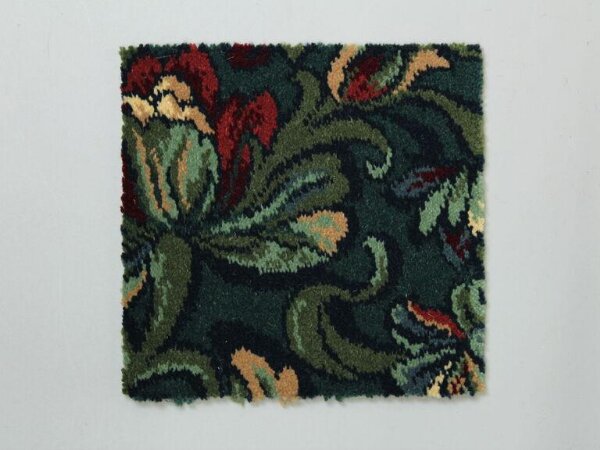
American weaving started at the dear end and then moved to the cheap one. By the Park Service’s account, America’s first full commercial carpet factory, William Peter Sprague’s in Philadelphia (1791), knotted carpet in the Axminster manner. Ingrain came to American mills later: the Tariff Manufacturing Company at Simsbury, Connecticut, incorporated in 1825, and Orrin Thompson’s works at Thompsonville, founded in 1828, which made “inexpensive flat-woven ingrain carpeting” and became Bigelow-Hartford.2525“American carpet weaving: Sprague’s knotted carpets (1791), then ingrain mills at Tariffville (1825) and Thompsonville (1828)”, 1791; 1825–1829, research note. Record An ingrain fragment at Historic New England keeps both its selvages, showing the narrow loom width that was sewn into room-size carpet.2626Ingrain carpet fragment, floral design on striped green ground (Parson Smith House, Maine), 1851–1875, Historic New England, 1959.7B (GUSN-8721). Record The next change came to the loom itself.
Bigelow’s patent model, 1838

The Smithsonian holds Erastus Bigelow’s patent model of a loom, dated 1838.2727Bigelow’s patent model of a loom (1838), 1838, Smithsonian, National Museum of American History, nmah_1070864. Record It came after three decades of change in how carpet looms made pattern. On the draw loom, a second worker, the drawboy, selected the warp ends for each pattern pick. Britannica dates Joseph-Marie Jacquard’s punched-card attachment to 1804–05 (another account says 1801), and a Worcester local history says it reached Kidderminster by 1825. Another account says it replaced the “mounture” of the Brussels loom and was hard for small loom shops to afford, hastening the move out of the cottages.2828“From draw-loom and drawboy to Jacquard (1804–05): pattern control on carpet looms, adopted at Kidderminster by 1825”, 1725; 1804–05; c. 1825, research note. Record The older method survives on paper: Michelle McFadden’s 1993 Winterthur Program thesis studies 46 watercolour drafts for Brussels or Wilton carpet, signed and dated by I. Arbuthnot in 1803–06 and 1813–17, which, according to its abstract, hold information on the draw-loom weaving process. Where the drafts are now is not yet known.2929Michelle McFadden (M.A. thesis, Early nineteenth-century British carpet patterns (46 ‘Brussels’ drafts by I. Arbuthnot, 1803–06 and 1813–17), 1993 (drafts 1803–1817), University of Delaware (UDSpace). Record
Bigelow went further and drove the loom by power. He built power looms for ingrain about 1839–41 (sources vary between 1839, 1841 and 1843) and then for Brussels and Wilton, between 1845 and 1851. Accounts tie them to cheaper production, with lower-paid women and boys in place of male weavers.3030“Erastus Bigelow’s power looms: ingrain (c. 1839–41), then Brussels and Wilton (1845–51)”, 1839–1851, research note. Record The power Brussels loom went into production at the Bigelow mill in Clinton, Massachusetts, which dates from 1848.3131“Bigelow Carpet Mill, Clinton, Massachusetts”. Record
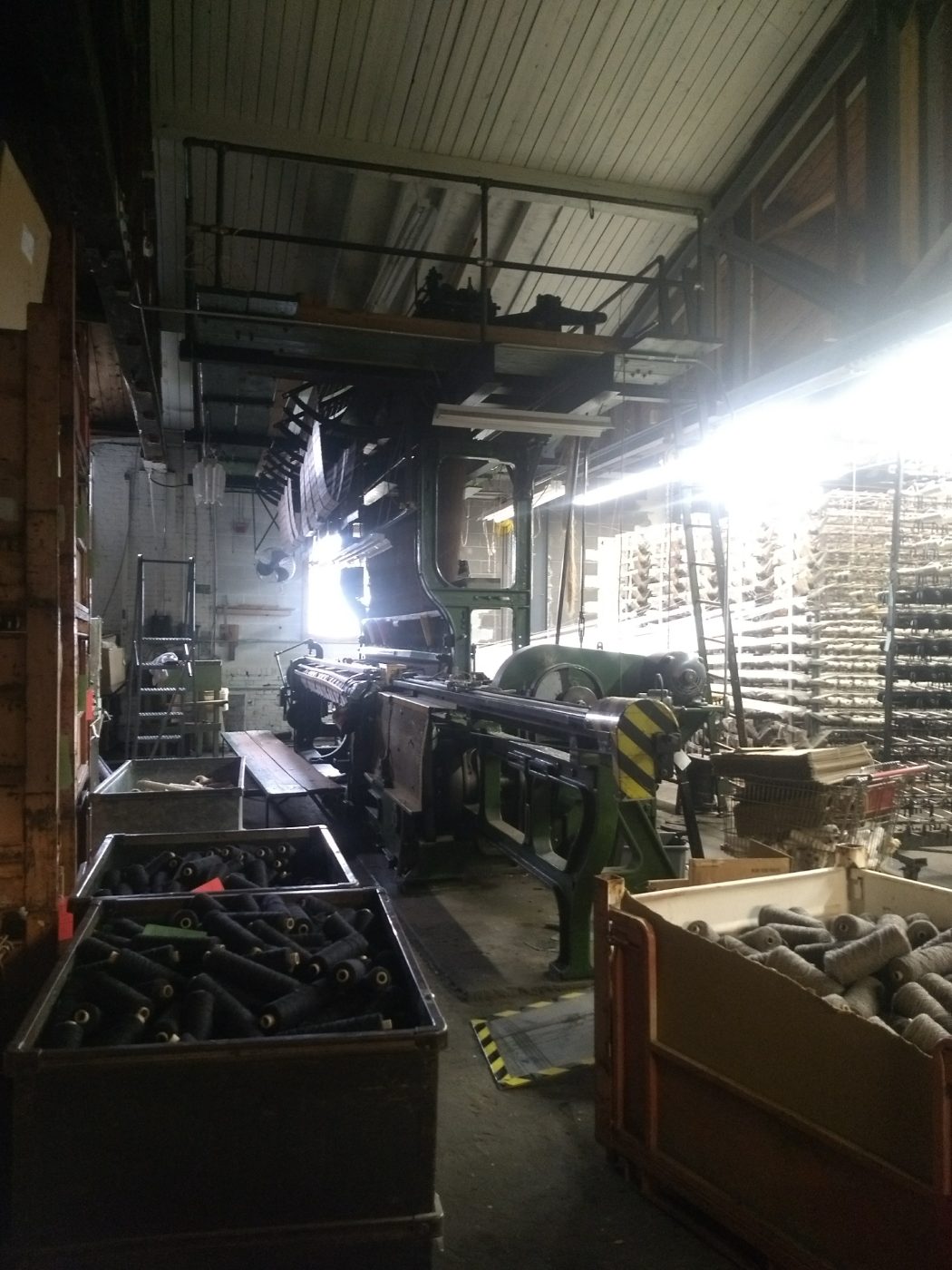
The knotted carpet’s name then returned on a machine. Halcyon Skinner is credited with perfecting the power loom for “Royal Axminster” in 1876, for Alexander Smith & Sons of Yonkers, a claim still to be corroborated.3232“Halcyon Skinner perfected the power loom for Royal Axminster (1876)”, 1876, research note. Record The machine Axminster only borrowed the name of Whitty’s hand-knotted carpet.3333“Thomas Whitty finishes his first hand-knotted carpet at Axminster on Midsummer Day 1755”, 1755, research note. Record A spool Axminster loom photographed at Shaw Industries in Dalton carries tube frames overhead, each wound with one row of coloured pile yarn; the loom inserts a row of tufts from one spool, cuts them and weaves them in. The identification rests on the photograph alone.3434“Spool Axminster power loom (identified from photograph)”, undated; the spool Axminster type dates from Skinner's 1876 loom, Shaw Industries, Dalton, Georgia. Record Those were the looms tufting would meet.
Mohasco’s annual report for 1957

The Hagley Museum and Library holds the 1957 annual report of Mohasco Industries, a pamphlet of 19 pages. Under “Products” it reports new manufacturing techniques for the company’s “tufted and velvet fabric lines”, perfected during the year, with patents received or pending.3535“1957 Annual Report, Mohasco Industries, Inc.”, 1957, Hagley, 72430_477, page image 7. Record Behind Mohasco stood old weaving firms. Mohawk’s founders, the Shuttleworths, came from England in 1875 and wove carpet at Amsterdam, New York, on secondhand looms; a merger of 1920 made Mohawk Carpet Mills.3636“Mohawk Industries”, founded 1878 (Amsterdam, New York), Mohawk Industries. Record Its 1956 merger with Alexander Smith made Mohasco, as chapter 6 tells.3737“1956: Mohawk merges with Alexander Smith to form Mohasco, as tufting takes over”, 1956, research note. Record
By one account the woven firms were already weak: carpet sales fell in the mid-1920s and firms such as Bigelow and Mohawk struggled before the Depression.3838“Mid-1920s: carpet sales fell and woven firms like Bigelow and Mohawk struggled; then the Depression”, 1920s–1930s, research note. Record The rival was cheaper: tufted carpet reportedly sold wholesale at about half the price of woven,3939“Tufted carpet sold wholesale at about half the price of woven”, 1950s, research note. Record made, according to the Carpet and Rug Institute, on machinery developed for chenille rugs and then widened to make broadloom (chapter 4).4040Carpet and Rug Institute, web page on the history of carpet, carpet-rug.org (quoted from search results; page not yet checked). Record Mohasco then moved south, to a tufted plant at Dublin, Georgia; its weaving of Wilton and velvet at Laurens, South Carolina, had ended by 1965, and carpet making at Amsterdam ended about 1968.4141“Mohawk Industries”, founded 1878 (Amsterdam, New York), Mohawk Industries. Record Langhorne Carpet in Pennsylvania, noted in the research for this book as one of the last American Wilton mills, closed at the end of 2023 4242“Langhorne Carpet, Pennsylvania: one of the last American Wilton mills, now closed”, research note. Record.
This chapter argues that tufting entered a market the loom had already made. Knotted carpet stayed costly, and from the 1730s British and then American looms supplied the rest of the market, from flat Scotch cloth to Wilton pile, with power looms making it cheaper again. It was this woven industry that tufted carpet, reportedly at about half its wholesale price, undercut.
Notes
- 1James Christie (1730–1803). Christie’s sale catalogue of 150 lots of Brussels, Wilton, Venetian and Kidderminster carpets, 30 May 1800. London, 1800. nypl.org/research/research-catalog/bib/b14693993. Record
- 2Savonnerie Manufactory, after designs by Charles Le Brun. Grande Galerie carpet with landscapes (Savonnerie, after Charles Le Brun), 1680, 1680. The Metropolitan Museum of Art, 1976.155.114. metmuseum.org/art/collection/search/206403. Record
- 3“Savonnerie, Paris: Dupont’s workshop (1615) and the 1627 royal monopoly with Lourdet for knotted 'Turkish-manner' carpets.” Research note. en.wikipedia.org/wiki/Savonnerie_manufactory. Record
- 4“Peter Parisot’s Fulham carpet manufactory (1750/1753–55): Savonnerie weavers in London.” Research note. british-history.ac.uk/vch/middx/vol2/pp138-139. Record
- 5“Claude Passavant’s Exeter carpet manufactory (1756–1761): costly knotted carpets, three survivors.” Research note. huguenotsofspitalfields.org/huguenot-towns/exeter. Record
- 6Attributed to Thomas Whitty (1713–1792); Axminster carpet manufactory. Axminster carpet attributed to Thomas Whitty, ca. 1765 (Met 2025.725), ca. 1765. The Metropolitan Museum of Art, 2025.725. metmuseum.org/art/collection/search/928622. Record
- 7“Thomas Whitty finishes his first hand-knotted carpet at Axminster on Midsummer Day 1755.” Research note. axminsterheritage.org/the-birth-of-axminster-carpets. Record
- 8Society for the Encouragement of Arts, Manufactures and Commerce (now RSA). “Society of Arts carpet premiums, 1757–59: Moore and Whitty share 1757; Whitty wins outright in 1759,” 1757–1759. axminsterheritage.org/wp-content/uploads/2015/01/the-story-of-axminster-carpets.pdf. Record
- 9“Thomas Moore’s Moorfields manufactory: knotted carpets for Robert Adam (Osterley).” Research note. collections.soane.org/ARC4174. Record
- 10Dove & Co. Sample of Kidderminster carpeting, double cloth (Dove & Co., Leeds, mid-19th century), mid-19th century. Victoria and Albert Museum, T.5-1959. collections.vam.ac.uk/item/O93057. Record
- 11“Kidderminster begins weaving flat, double-cloth 'Kidderminster' (ingrain) carpet in 1735.” Research note. revolutionaryplayers.org.uk/the-origins-of-carpet-making-in-kidderminster. Record
- 12“Kidderminster begins weaving flat, double-cloth 'Kidderminster' (ingrain) carpet in 1735.” Research note. revolutionaryplayers.org.uk/the-origins-of-carpet-making-in-kidderminster. Record
- 13Vanessa Habib. “Scotch carpets at Stirling: Thomas Gilfillan’s cash book and ledger, 1764–1770 (and Axminster manufacture in Edinburgh).” 2000; 2005. journals.socantscot.org/index.php/psas/article/view/9541. Record
- 14“Venetian carpet: striped, worsted-warp flat carpet for stairs and passages.” Research note. jimclifford.ca/early_encyclopedia_britannica/articles/1842/eb_7th_1842_004597.html. Record
- 15Hugh Mackay & Co. (weaver); Anna Maria Garthwaite (designer). Brussels carpet sample woven in 1980 after a design by Anna Maria Garthwaite dated 1753, 1980 (design dated 1753). Victoria and Albert Museum, T.11-1981. collections.vam.ac.uk/item/O258637/carpet-sample-anna-maria-garthwaite. Record
- 16“How cutting the loops made Wilton: the bladed or grooved wire and the 'travat' knife.” Research note. jimclifford.ca/early_encyclopedia_britannica/articles/1842/eb_7th_1842_004597.html. Record
- 17“Brussels carpet: looped wool pile raised over steel wires on the loom.” Research note. britannica.com/topic/Brussels-carpet. Record
- 18“How cutting the loops made Wilton: the bladed or grooved wire and the 'travat' knife.” Research note. jimclifford.ca/early_encyclopedia_britannica/articles/1842/eb_7th_1842_004597.html. Record
- 19“The Earl of Pembroke’s French weavers at Wilton: 1721 or 1741? (and the 'wine cask' story).” Research note. wiltontowncouncil.gov.uk/heritage-trail. Record
- 20“1741 patent to Couran, Barford and Moody for carpet 'Moccadoes', the first written evidence of Wilton carpet.” Research note. british-history.ac.uk/vch/wilts/vol4/pp148-182. Record “Wilton: Huguenot weavers (1720s) and the first Wilton loom (1741).” Research note. wiltoncarpets.com/about-us/our-heritage. Record
- 21“1749: Brussels looms reach Kidderminster (John Broom and John Pearsall) and the town makes carpets 'the same as Wilton'.” Research note. revolutionaryplayers.org.uk/the-origins-of-carpet-making-in-kidderminster-2. Record “1741 patent to Couran, Barford and Moody for carpet 'Moccadoes', the first written evidence of Wilton carpet.” Research note. british-history.ac.uk/vch/wilts/vol4/pp148-182. Record
- 22Tariff Manufacturing Company. “Tariff Manufacturing Company, Brussels colours dyed at Tariffville, Conn., c. 1840 (two dye-recipe notebooks),” c. 1840. 2017x85.30a-b (ATHM 2009.33), Swatch Book Collection (Col. 50), Winterthur Library. findingaid.winterthur.org/html/HTML_Finding_Aids/col0050.htm. Record
- 23“Brussels and Wilton carpet reached America in the 1750s; Americans favoured Wilton.” Research note. web.archive.org/web/20250206041128/https://www.nps.gov/parkhistory/online_books/inde/anderson/chap2.htm. Record
- 24“By the late 18th century most middle-class American houses had cheap 'Scotch' carpeting (Lear letter, 1790).” Research note. web.archive.org/web/20250206041128/https://www.nps.gov/parkhistory/online_books/inde/anderson/chap2.htm. Record
- 25“American carpet weaving: Sprague’s knotted carpets (1791), then ingrain mills at Tariffville (1825) and Thompsonville (1828).” Research note. connecticuthistory.org/first-connecticut-carpet-mills-emerge-in-simsbury-and-enfield. Record
- 26Unknown maker. Ingrain carpet fragment, floral design on striped green ground (Parson Smith House, Maine), 1851–1875. Historic New England, 1959.7B (GUSN-8721). historicnewengland.org/explore/collections-access/gusn/8721. Record
- 27Unknown maker. Bigelow’s patent model of a loom (1838), 1838. Smithsonian, National Museum of American History, nmah_1070864. si.edu/object/1838-bigelows-patent-model-loom:nmah_1070864. Record
- 28“From draw-loom and drawboy to Jacquard (1804–05): pattern control on carpet looms, adopted at Kidderminster by 1825.” Research note. britannica.com/print/article/299152. Record
- 29Michelle McFadden (M.A. thesis, University of Delaware / Winterthur Program, 1993). Early nineteenth-century British carpet patterns (46 ‘Brussels’ drafts by I. Arbuthnot, 1803–06 and 1813–17). England, 1993 (drafts 1803–1817). udspace.udel.edu/items/87a6bdac-8a10-499b-8263-a957d9a595d7. Record
- 30“Erastus Bigelow’s power looms: ingrain (c. 1839–41), then Brussels and Wilton (1845–51).” Research note. britannica.com/biography/Erastus-Brigham-Bigelow. Record
- 31“Bigelow Carpet Mill, Clinton, Massachusetts.” 1848. en.wikipedia.org/wiki/Bigelow_Carpet_Mill. Record
- 32“Halcyon Skinner perfected the power loom for Royal Axminster (1876).” Research note. kids.britannica.com/students/article/rug-and-carpet/276811. Record
- 33“Thomas Whitty finishes his first hand-knotted carpet at Axminster on Midsummer Day 1755.” Research note. axminsterheritage.org/the-birth-of-axminster-carpets. Record
- 34Unknown maker. Spool Axminster power loom (identified from photograph), undated; the spool Axminster type dates from Skinner's 1876 loom. Shaw Industries, Dalton, Georgia. Record
- 35Mohasco Industries. “1957 Annual Report, Mohasco Industries, Inc.,” 1957. 72430_477, Joseph Bancroft and Sons Company, Miss America collection (Accession 1972.430), Box 3, Folder 13, Hagley Museum and Library, page image 7. digital.hagley.org/72430_477. Record
- 36Shuttleworth family (William Shuttleworth and sons). “Mohawk Industries,” founded 1878 (Amsterdam, New York). Mohawk Industries. mohawkind.com/about/our-growth-story.php. Record
- 37“1956: Mohawk merges with Alexander Smith to form Mohasco, as tufting takes over.” Research note. en.wikipedia.org/wiki/Mohawk_Industries. Record
- 38“Mid-1920s: carpet sales fell and woven firms like Bigelow and Mohawk struggled; then the Depression.” Research note. philadelphiaencyclopedia.org/essays/carpet-weaving-and-rug-making-2. Record
- 39“Tufted carpet sold wholesale at about half the price of woven.” Research note. georgiaencyclopedia.org/articles/business-economy/carpet-industry. Record
- 40Carpet and Rug Institute, web page on the history of carpet, carpet-rug.org (quoted from search results; page not yet checked). carpet-rug.org/about-us/history-of-carpet. Record
- 41Shuttleworth family (William Shuttleworth and sons). “Mohawk Industries,” founded 1878 (Amsterdam, New York). Mohawk Industries. mohawkind.com/about/our-growth-story.php. Record
- 42“Langhorne Carpet, Pennsylvania: one of the last American Wilton mills, now closed.” Research note. Record
Where the sources are
- Research notes, not yet traced to a public source24
- Published sources3
- The Metropolitan Museum of Art2
- Victoria and Albert Museum2
- New York Public Library (microfilm)1
- Winterthur Library1
- Historic New England1
- Smithsonian, National Museum of American History1
- University of Delaware (UDSpace)1
- Shaw Industries, Dalton, Georgia1
- Hagley Museum and Library1
- Mohawk Industries1