Shade 5Ochre1920–1981
Building the machine
The tufting machine began as an attachment for the sewing machine, patented in Tennessee and Georgia from the 1920s, and became the multi-needle broadloom machine of the Chattanooga builders.
Key dates
- 1920Barnett’s “Sewing Machine”, a tufting machine
- 1922Carter’s tufting attachment, Chattanooga
- 1928Gladish’s machine for Valway Rug Mills
- 1941Cobble and Muse: many needles
- 1955J. L. Card’s thread feed and pattern control
- 1960Southern Machine Company, later Tuftco
- 1965Singer-Cobble patent from Blackburn
- 1981Charles Monroe Company, later Card-Monroe
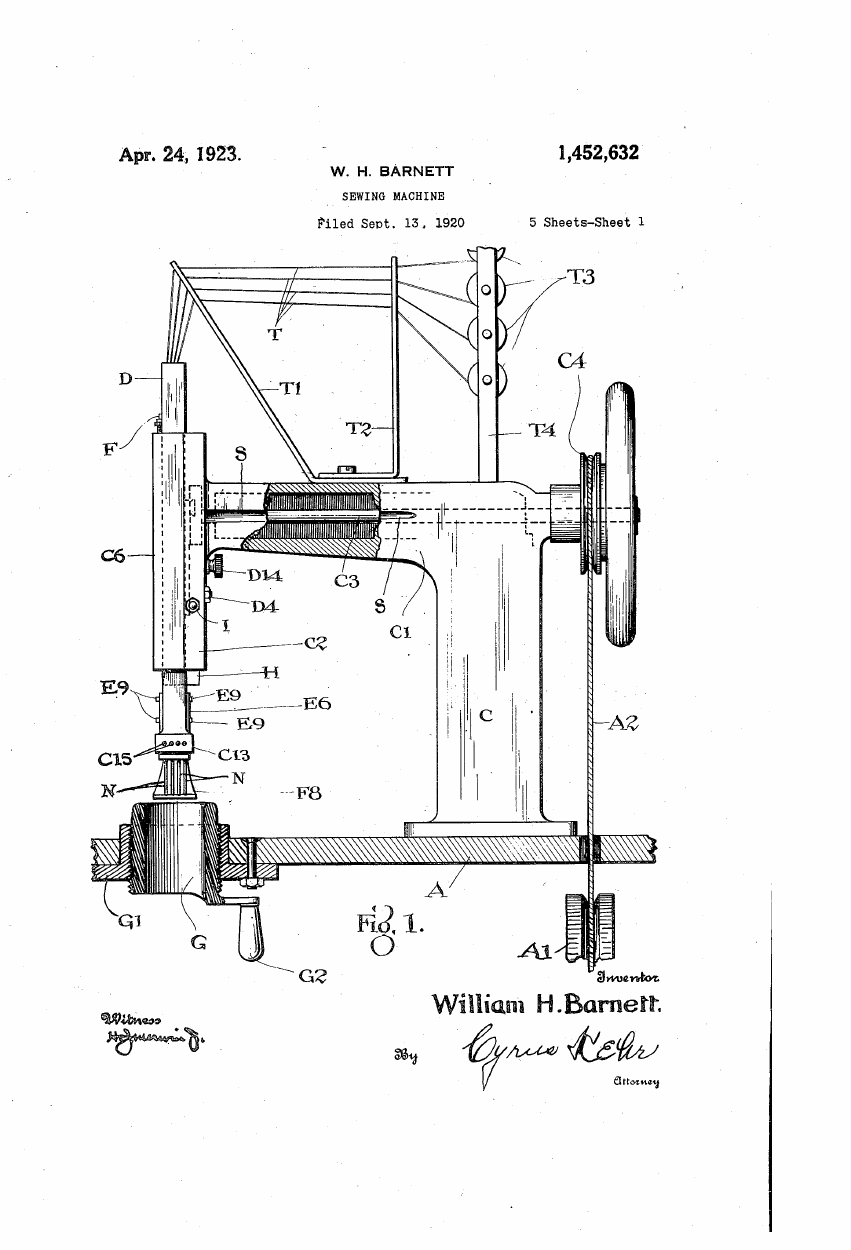
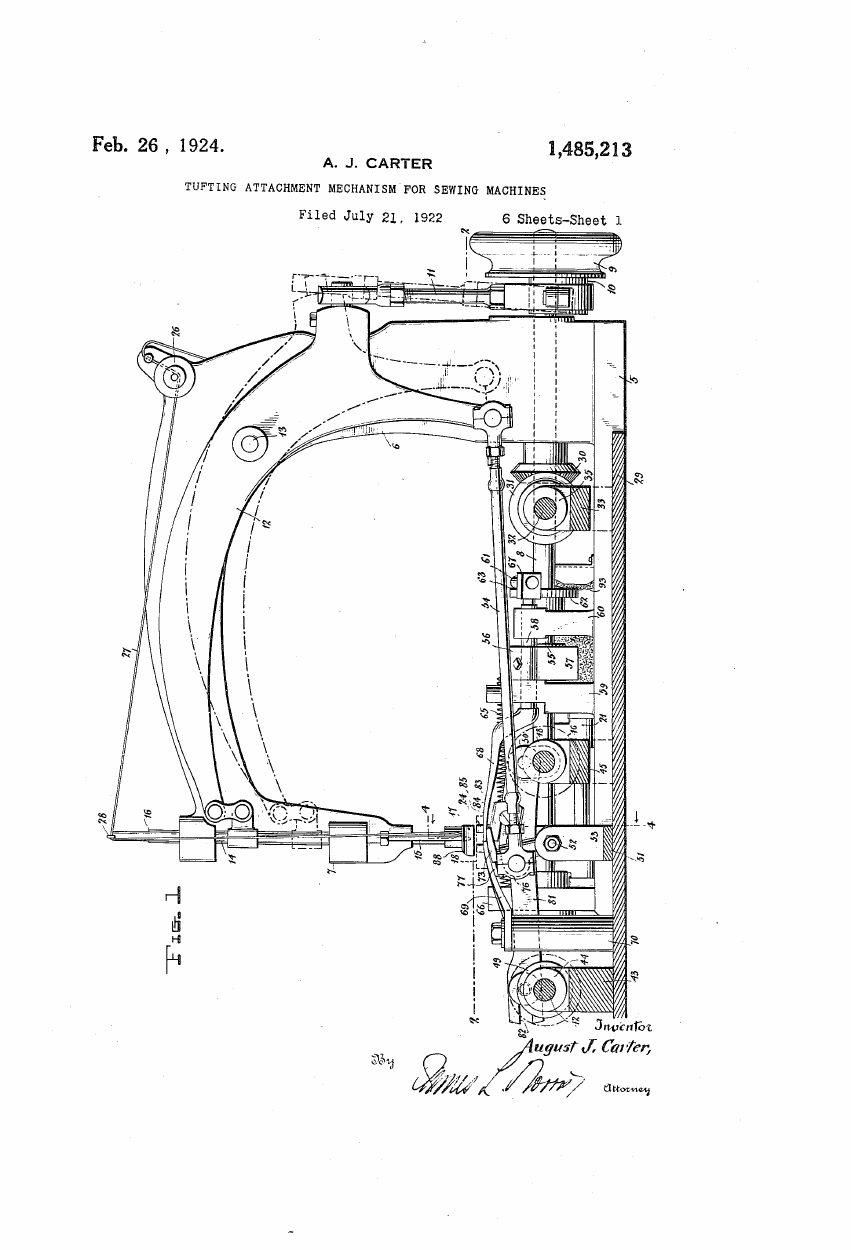
In 1920 William H. Barnett of Knoxville, Tennessee, applied for a patent on a “Sewing Machine”. It was granted on 24 April 1923, and its text says the machine “may be more specifically termed a tufting machine”.11William H. Barnett, “Sewing Machine” (US1452632A), filed 18 Sep 1920, granted 24 Apr 1923. Record On 21 July 1922 August J. Carter of Chattanooga filed for a “Tufting-Attachment Mechanism for Sewing Machines”, granted on 26 February 1924. It put a needle, a loop former and a separate cutting knife on a sewing machine.22August J. Carter, “Tufting-Attachment Mechanism for Sewing Machines” (US1485213A), filed 21 Jul 1922, granted 26 Feb 1924. Record By this book’s research notes it is the first patent in this database to combine the three, and with Barnett’s it suggests that the machine line starts from the sewing machine, not from the old hand tools.33“Carter Brothers, Chattanooga, 1922: first patent claiming needle + loop former + separate cutting knife”, 1922, research note. Record
Chapter 4 told how machines came to Dalton’s bedspread trade in the 1930s. This chapter starts earlier and goes on later. It corrects one museum’s line on the way: the claim that the first tufting machine was built in 1930 has no patent behind it.44“DO NOT SAY: ‘The first tufting machine was built in 1930’”, research note. Record The patents show work going back to 1920.
Sewing-machine makers and rug mills, 1920–1936
Carter’s firm went on patenting. John M. Gladish filed a “Tufting Attachment Mechanism for Sewing Machines” on 20 September 1927, assigned to Carter Brothers Inc. of Chattanooga,55John M. Gladish, “Tufting Attachment Mechanism for Sewing Machines” (US1800522A), filed 20 Sep 1927, granted 14 Apr 1931. Record and Carter himself patented a “Tufted Rug”, filed in 1933 and also assigned to Carter Brothers: a patent for the product, not the machine.66August J. Carter, “Tufted Rug” (US2042503A), filed 26 Aug 1933, granted 2 Jun 1936. Record
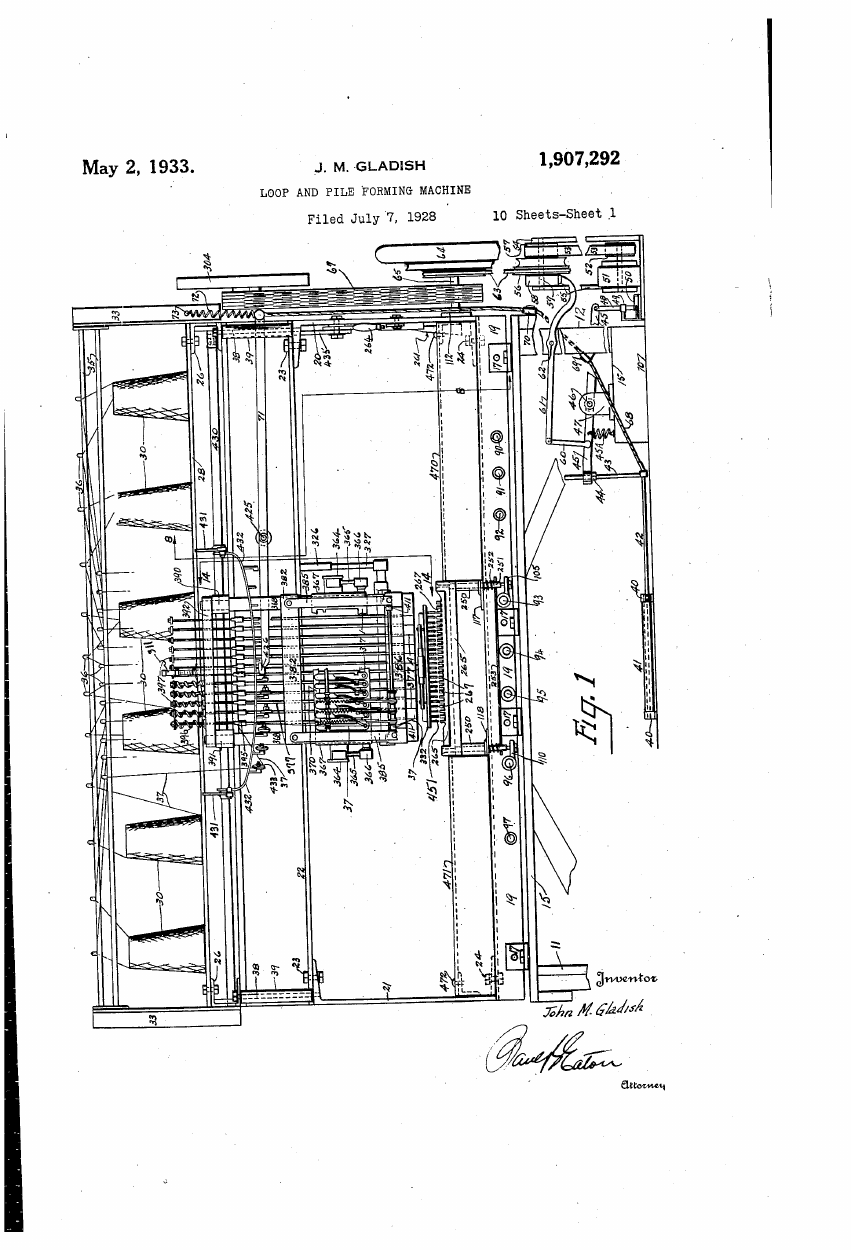
Gladish’s next three patents, a “Loop and Pile Forming Machine” (filed 7 July 1928), a “Tufting Machine Looper and Cutter” (filed 2 October 1929) and a “Tufting Machine” (filed 21 January 1930), were assigned to a rug mill, Valway Rug Mills of LaGrange, Georgia, and granted in May 1933.77John M. Gladish, “Loop and Pile Forming Machine” (US1907292A), filed 7 Jul 1928, granted 2 May 1933. Record John M. Gladish, “Tufting Machine Looper and Cutter” (US1909530A), filed 2 Oct 1929, granted 16 May 1933. Record John M. Gladish, “Tufting Machine” (US1909531A), filed 21 Jan 1930, granted 16 May 1933. Record A fifth, filed in 1934 from Chattanooga, was assigned half to Robert Blair Cannon.88John M. Gladish, “Tufting Machine” (US2224866A), filed 25 May 1934, granted 17 Dec 1940. Record Another “Tufting machine”, granted in 1933 to L. A. Smith, also comes from LaGrange and was assigned to Truline.99L. A. Smith, “Tufting machine” (US1903946A), filed , granted 1933. Record
The sewing-machine industry took an interest too. The “Rug Tufting Machine” of Harry E. Dykeman of Chicago, filed on 30 November 1928, was assigned to the sewing-machine maker Union Special Machine Co.1010Harry E. Dykeman, “Rug Tufting Machine” (US1831485A), filed 30 Nov 1928, granted 10 Nov 1931. Record Walter Loos patented a “Machine for Making Rugs, Carpets, and the Like” (filed 1932) and a “Tufting Machine” (filed 1935).1111Walter Loos, “Machine for Making Rugs, Carpets, and the Like” (US1970703A), filed 20 Sep 1932, granted 21 Aug 1934. Record Walter Loos, “Tufting Machine” (US2070287A), filed 2 Oct 1935, granted 9 Feb 1937. Record Further patents titled “Tufting machine” were granted to Maples and Weaver of Scottsboro, Alabama, in 1934 and to Warren in 1936.1212Maples, “Tufting machine” (US1963441A), filed , granted 1934. Record Warren, “Tufting machine” (US2058047A), filed , granted 1936. Record
One machine of these years has its own monument. The carpet tufting apparatus of Ernest J. Moench, dated 1928 and now displayed at Shaw Industries in Dalton, was a single-needle machine that punched loops of thick yarn through a backing; Moench patented a multi-needle version, which was cited in improvement patents as late as 1980. The American Society of Mechanical Engineers named it Historic Mechanical Engineering Landmark no. 266 on 31 July 2018 and credits Moench with the first machine, where Dalton accounts credit Looper. Moench’s patent number has not been found, and ASME sources give both a “1928 patent” and one “issued 1934”.1313“Moench carpet tufting apparatus”, 1928, Shaw Industries. Record
Most of these patents came from Chattanooga and LaGrange, not Dalton. In this database, Dalton’s own patents begin in the 1930s: Lawrence P. Smith’s handheld “Motor Operated Tufting Machine” for Cabin Crafts, filed in 1932 (chapter 9),1414Lawrence P. Smith, “Motor Operated Tufting Machine” (US1917162A), filed 23 Jun 1932, granted 4 Jul 1933. Record then Glenn Looper’s “Tufting Machine”, filed in 1936, and Jess Spencer Kile’s “Machine and Method for Making Tufted Articles”, filed in 1939 (chapter 4).1515Glenn Looper, “Tufting Machine” (US2123114A), filed 15 Dec 1936, granted 5 Jul 1938. Record Jess Spencer Kile, “Machine and Method for Making Tufted Articles” (US2389914A), filed 25 Jul 1939, granted 1945 (month unclear on scan). Record Roy H. Windham of Rome, Georgia, shared a “Tufting machine” patent granted in 1938, assigned to Polly Prentiss, and filed a “Tufting Machine and Method” on 6 October 1939, assigned to Burl J. Bandy of Dalton.1616Windham et al., “Tufting machine” (US2112512A), filed , granted 1938. Record Roy H. Windham, “Tufting Machine and Method” (US2311802A), filed 6 Oct 1939, granted 23 Feb 1943. Record Roy H. Windham, The Tufting Machine: A Practical Text of Instruction for Machine Fixers (3rd ed.), 1941. Record Windham also wrote The Tufting Machine: A Practical Text of Instruction for Machine Fixers, published at Rome by the Southern Craft Company and in its third edition by 1941. No copy has been found on the Internet Archive or Open Library.1717Roy H. Windham, The Tufting Machine: A Practical Text of Instruction for Machine Fixers (3rd ed.), 1941. Record
Many needles
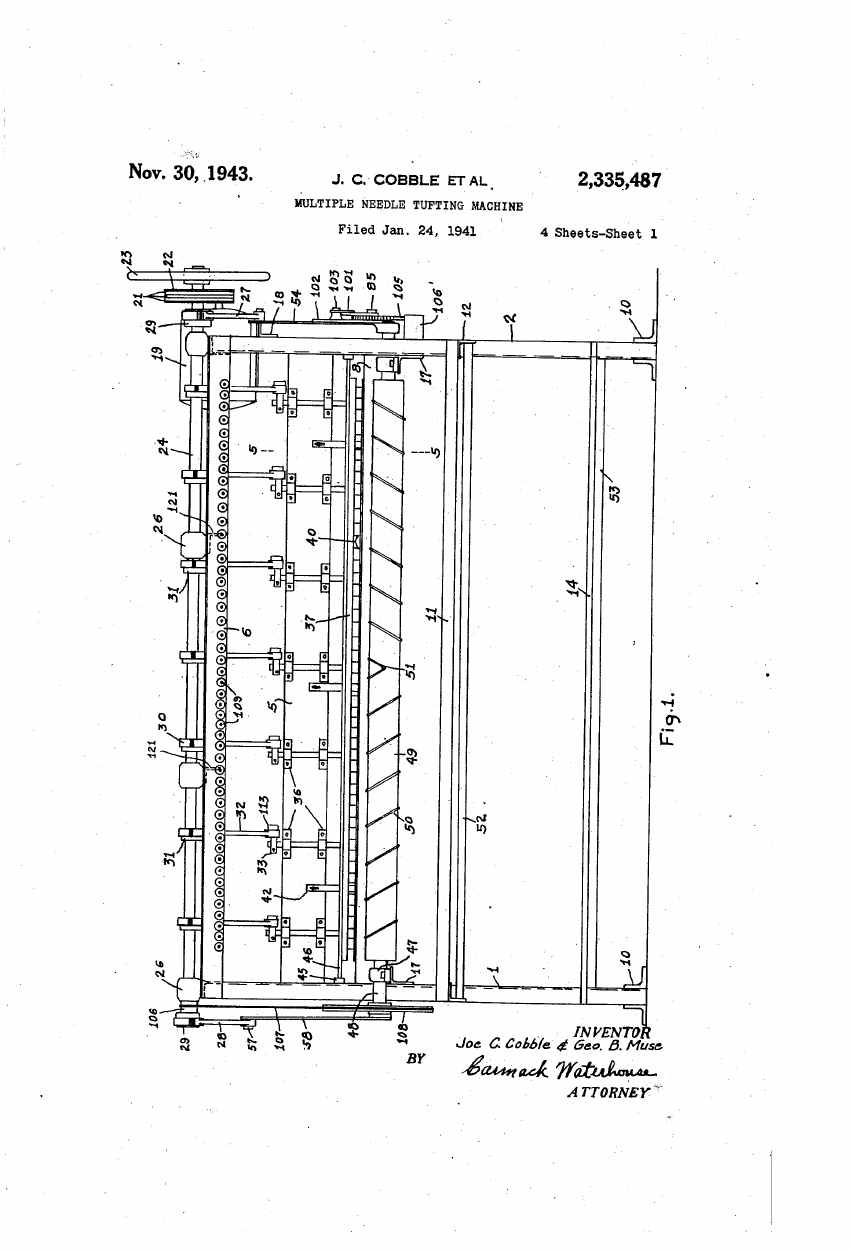
Chapter 4 records the joint patent of Joe C. Cobble and George B. Muse. Its title names the change: “Multiple Needle Tufting Machine”. It was filed on 24 January 1941 and granted on 30 November 1943, and it gives Chattanooga, Tennessee, and Sugar Valley, Georgia.1818Joe C. Cobble, “Multiple Needle Tufting Machine” (US2335487A), filed 24 Jan 1941, granted 30 Nov 1943. Record It is credited locally as the basis of modern tufting machines.1919“Cobble (Cobble Brothers / Singer-Cobble / Vandewiele)”, 1930s (Cobble brothers); UK subsidiary 1955, Cobble (Cobble Brothers / Singer-Cobble / Vandewiele). Record
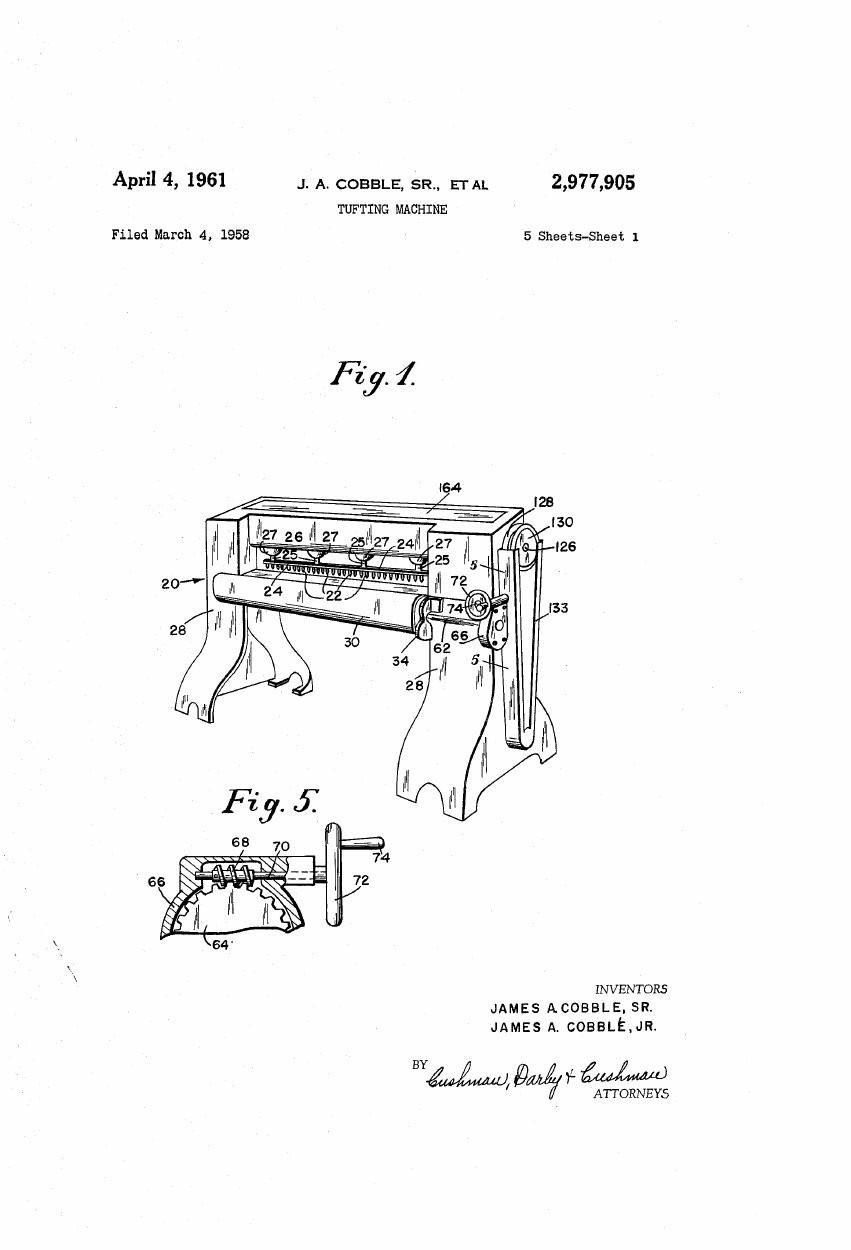
Other multi-needle patents followed. Lyman Hamrick of Gaffney, South Carolina, filed a “Multiple Needle Tufting Machine” in July 1944, granted in 1946,2020Lyman Hamrick, “Multiple Needle Tufting Machine” (US2411267A), filed Jul 1944, granted 19 Nov 1946. Record and Walter W. Hamby of Dalton filed one of the same name on 20 May 1949, with a fifth share assigned to Isaac C. Adams.2121Walter W. Hamby, “Multiple Needle Tufting Machine” (US2595355A), filed 20 May 1949, granted 6 May 1952. Record Patents titled simply “Tufting machine” went to Bills and Patey of Dalton in 1944 and to C. M. Jones of Calhoun, Georgia, in 1954.2222Bills, “Tufting machine” (US2346467A), filed , granted 1944. Record C. M. Jones, “Tufting machine” (US2679218A), filed , granted 1954. Record At Cobble Brothers in Chattanooga, James A. Cobble Sr. and Jr. filed a “Tufting Machine” on 4 March 1958, granted in 1961.2323James A. Cobble Sr. & Jr., “Tufting Machine” (US2977905A), filed 4 Mar 1958, granted 4 Apr 1961. Record
According to the Carpet and Rug Institute, as quoted in search results not yet checked against its page, the machinery developed for making chenille rugs was widened, creating larger rugs and broadloom carpet.2424Carpet and Rug Institute, web page on the history of carpet, carpet-rug.org (quoted from search results; page not yet checked). Record Which machine first tufted at broadloom width, and when, is still to be found. A photograph at the Bandy Heritage Center is described, in search results not yet checked, as showing a Cobble Brothers loop-pile machine 216 inches wide, but it is undated.2525“Before computers: chain-driven roll and scroll pattern attachments on broadloom tufting machines”, 1950s–1990s, Bandy Heritage Center (Dalton). Record By one count, still to be traced to its source, 10 per cent of American carpet was tufted in 1950 and more than 90 per cent is today;2626“1950: 10% of US carpet was tufted; today over 90%”, 1950–today, research note. Record another source, so far seen only in search results, puts tufted products at more than 90 per cent of carpet.2727“Tufting defined: needles push pile yarn through a ready-made backing, locked in with adhesive”, hand needle 18th–19th c.; machine from mid-20th c., research note. Record William A. Reynolds’s Innovation in the United States Carpet Industry, 1947–1963 (1968) covers these years.2828William A. Reynolds, Innovation in the United States Carpet Industry, 1947–1963, 1968. Record
Telling the needles what to do
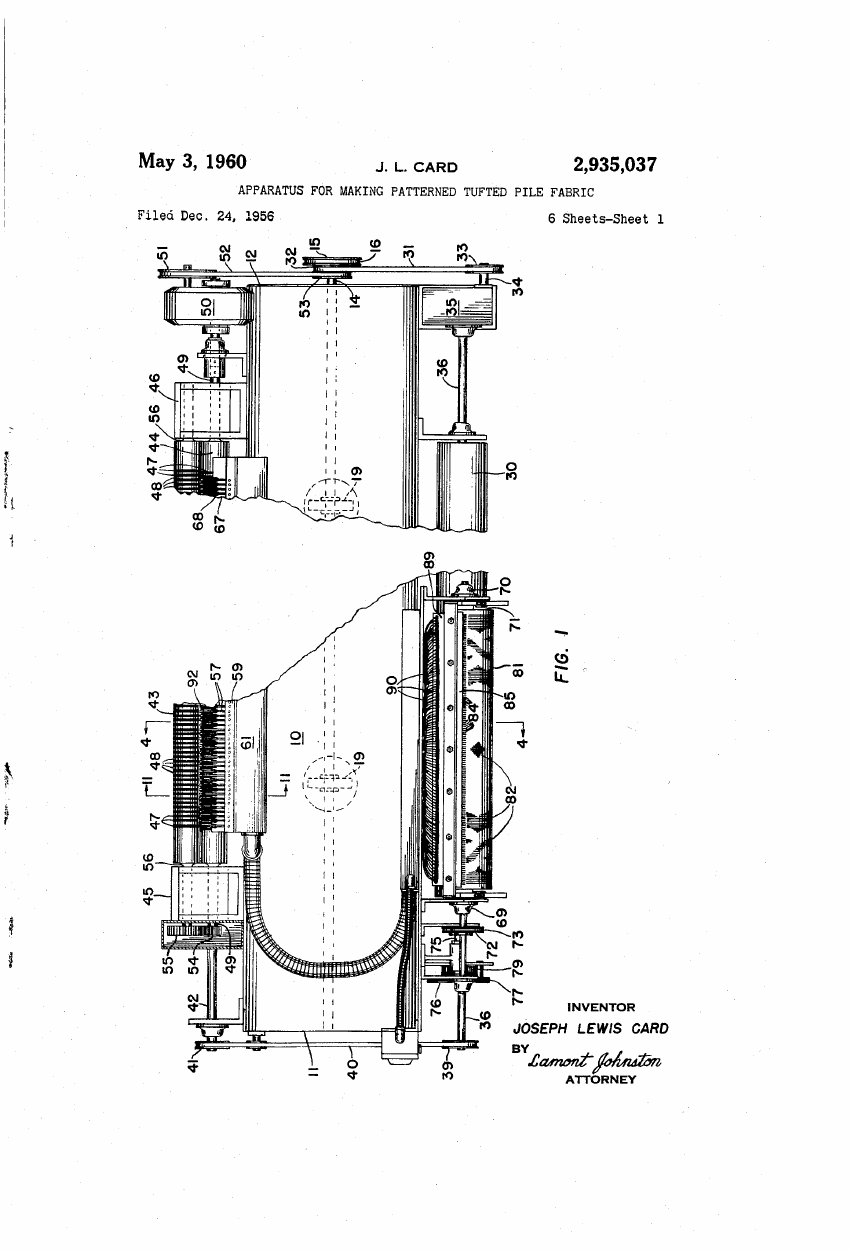
With many needles came patents for varying what they did. J. L. Card filed a “Thread Feed Mechanism and Pattern Control” on 16 May 1955, granted in 1958,2929J. L. Card, “Thread Feed Mechanism and Pattern Control” (US2862465A), filed 16 May 1955, granted 2 Dec 1958. Record and Joseph L. Card an “Apparatus for Making Patterned Tufted Pile Fabric” on 24 December 1956, assigned to Cobble Brothers Machinery Co. of Chattanooga and granted on 3 May 1960.3030Joseph L. Card, “Apparatus for Making Patterned Tufted Pile Fabric” (US2935037A), filed 24 Dec 1956, granted 3 May 1960. Record A British filing of the same apparatus was made in 1957, though it has so far been identified only from search results.3131Cobble Brothers Machinery (attrib.), “Apparatus for making patterned tufted pile fabric” (GB853746A), US original 1956; GB filed 1957; published 9 Nov 1960. Record Card’s “Loop Shedder”, filed in 1958, was assigned to Singer-Cobble Inc.3232Joseph Lewis Card, “Loop Shedder” (US2975736A), filed 23 Jun 1958, granted 21 Mar 1961. Record How pattern control grew from these mechanical devices into computer control is the subject of chapter 12.
The machine builders
The machines were built by a few firms, mostly around Chattanooga, and their histories are known so far mainly from their own accounts and from search summaries still to be checked. According to Card-Monroe’s history, the Cobble brothers began making tufting equipment for chenille bedspreads in the 1930s.3333“Cobble (Cobble Brothers / Singer-Cobble / Vandewiele)”, 1930s (Cobble brothers); UK subsidiary 1955, Cobble (Cobble Brothers / Singer-Cobble / Vandewiele). Record “Card-Monroe Corp. (CMC)”, founded 1981 (as Charles Monroe Company); Card-Monroe 1983, Card-Monroe Corp. (CMC). Record Grace’s Guide says Cobble Brothers Machinery opened a British subsidiary in 1955, and that by 1960 the American parent had been taken over by Singer, making Singer-Cobble, which also absorbed British Tufting Machinery of Blackburn. The same summaries say that Spencer H. Wright led Cobble for more than thirty years, with plants in Blackburn and Dalton, and Vandewiele’s own timeline says that the Belgian group bought the firm in 2013.3434“Cobble (Cobble Brothers / Singer-Cobble / Vandewiele)”, 1930s (Cobble brothers); UK subsidiary 1955, Cobble (Cobble Brothers / Singer-Cobble / Vandewiele). Record A Cotton Town caption says instead that Cobble took over Albert Mill in 1956, so the start of the British plant is still to be settled.3535Cobble Brothers Machinery (attrib.), “Apparatus for making patterned tufted pile fabric” (GB853746A), US original 1956; GB filed 1957; published 9 Nov 1960. Record
The British arm also filed its own inventions. A British priority filing of 9 July 1960, so far identified only from search results, underlies a Singer-Cobble needle-plate patent,3636Singer Cobble (attrib.), “Improvements in machines for making tufted fabrics” (GB880860A), priority 9 Jul 1960. Record and Ernest Kenneth Lund of Singer-Cobble Ltd, Blackburn, filed “Improvements in or relating to tufting machines” on 19 March 1965, published in 1967, details again taken from search results.3737Ernest Kenneth Lund / Singer-Cobble Ltd, “Improvements in or relating to tufting machines” (GB1067502A), filed 19 Mar 1965 (GB11648/65); published 3 May 1967. Record The same searches record that Edgar Pickering left Singer-Cobble to found his own Blackburn firm in 1964, and Ronald Ellison founded Ellison Tufting Machinery in 1961.3838Ernest Kenneth Lund / Singer-Cobble Ltd, “Improvements in or relating to tufting machines” (GB1067502A), filed 19 Mar 1965 (GB11648/65); published 3 May 1967. Record
The Card family carried the trade on in Chattanooga. Tuftco says it was founded in 1960 as Southern Machine Company to build and sell tufting machines, and sold them in Europe, Asia and South America in the 1960s; an obituary of Lewis Card Sr. says instead that he and his brother Roy, after working at Cobble, founded Tuftco “in the late 1950s”.3939“Tuftco”, founded 1960 (as Southern Machine Company), Tuftco. Record Card-Monroe says that Roy and Lewis Card Sr., the Cobbles’ nephews, started at Cobble in the 1940s (an obituary says Lewis joined in 1939). The Charles Monroe Company was founded in 1981 by Charles Monroe and Lewis Card Jr., and became Card-Monroe in 1983 when Lewis and Roy Card invested. By the company’s own figures it has more than 2,500 machines in 38 countries.4040“Card-Monroe Corp. (CMC)”, founded 1981 (as Charles Monroe Company); Card-Monroe 1983, Card-Monroe Corp. (CMC). Record
Many of the needles now come from Germany. According to the company’s history, as summarised in search results, Groz-Beckert of Ebingen made only knitting needles until 1980; in 1998 it bought the tufting-needle business of Josef Zimmermann of Aachen, sold under the brand “Eisbär”, and then added tufting knives, loopers and reed fingers by acquisition up to 2004. It is now a major supplier of needles and parts for tufting machines.4141“Groz-Beckert (tufting needles)”, founded 1852; tufting needles from 1998, Groz-Beckert (tufting needles). Record German Wikipedia, as mirrored by DeWiki and seen so far in search results, credits the machine itself to the United States and Britain, and no German builder of industrial broadloom tufting machines has been found,4242“Germany tufted early but never built the machines”, research note. Record though Girmes-Werke of Oedt, near Krefeld, appears to have patented a “Plush tufting machine” about 1971, a record seen only in one search snippet.4343Girmes-Werke AG, “Plush tufting machine” (DE1785451C), 1971 (year from search summary). Record How the machines went abroad is told in chapter 7.
By the industry’s own figure, still to be traced to its source, more than 70 per cent of the world’s carpet and about 85 per cent of America’s is made within about an hour of Dalton.4444“More than 70% of the world’s carpet, and ~85% of America’s, is made within about an hour of Dalton”, research note. Record Geographers have studied why: John R. McGregor and Robert H. Maxey on “The Dalton, Georgia, Tufted Textile Concentration” in 1974, and Billie J. Walters and James O. Wheeler on “Localization Economies in the American Carpet Industry” in 1984.4545John R. McGregor, “‘The Dalton, Georgia, Tufted Textile Concentration’”, November 1974, Southeastern Geographer 14, no. 2, pp. 133–144, doi:10.1353/sgo.1974.0010. Record Billie J. Walters, “‘Localization Economies in the American Carpet Industry’”, April 1984, Geographical Review 74, no. 2, pp. 183–191, doi:10.2307/214099. Record
This chapter argues that the tufting machine began as an attachment for the sewing machine, patented in Tennessee and Georgia from 1920, more than a decade before Looper’s Dalton patent, and that once its needles were multiplied in the 1940s and the machine was widened to broadloom, its building settled with a few firms in Chattanooga and Blackburn.
Notes
- 1William H. Barnett, “Sewing Machine” (US1452632A), filed 18 Sep 1920, granted 24 Apr 1923. patents.google.com/patent/US1452632A/en. Record
- 2August J. Carter, “Tufting-Attachment Mechanism for Sewing Machines” (US1485213A), filed 21 Jul 1922, granted 26 Feb 1924. patents.google.com/patent/US1485213A/en. Record
- 3“Carter Brothers, Chattanooga, 1922: first patent claiming needle + loop former + separate cutting knife.” Research note, TTW Script Bank fact-check notes (Claude research, Aug 2026). Record
- 4“DO NOT SAY: ‘The first tufting machine was built in 1930’.” Research note, TTW Script Bank fact-check notes (Claude research, Aug 2026). Record
- 5John M. Gladish, “Tufting Attachment Mechanism for Sewing Machines” (US1800522A), filed 20 Sep 1927, granted 14 Apr 1931; assigned to Carter Brothers Inc. patents.google.com/patent/US1800522A/en. Record
- 6August J. Carter, “Tufted Rug” (US2042503A), filed 26 Aug 1933, granted 2 Jun 1936; assigned to Carter Brothers Inc. patents.google.com/patent/US2042503A/en. Record
- 7John M. Gladish, “Loop and Pile Forming Machine” (US1907292A), filed 7 Jul 1928, granted 2 May 1933; assigned to Valway Rug Mills. patents.google.com/patent/US1907292A/en. Record John M. Gladish, “Tufting Machine Looper and Cutter” (US1909530A), filed 2 Oct 1929, granted 16 May 1933; assigned to Valway Rug Mills. patents.google.com/patent/US1909530A/en. Record John M. Gladish, “Tufting Machine” (US1909531A), filed 21 Jan 1930, granted 16 May 1933; assigned to Valway Rug Mills. patents.google.com/patent/US1909531A/en. Record
- 8John M. Gladish, “Tufting Machine” (US2224866A), filed 25 May 1934, granted 17 Dec 1940; assigned to half to Robert Blair Cannon. patents.google.com/patent/US2224866A/en. Record
- 9L. A. Smith, “Tufting machine” (US1903946A), filed , granted 1933; assigned to Truline. patents.google.com/patent/US1903946A/en. Record
- 10Harry E. Dykeman, “Rug Tufting Machine” (US1831485A), filed 30 Nov 1928, granted 10 Nov 1931; assigned to Union Special Machine Co. patents.google.com/patent/US1831485A/en. Record
- 11Walter Loos, “Machine for Making Rugs, Carpets, and the Like” (US1970703A), filed 20 Sep 1932, granted 21 Aug 1934. patents.google.com/patent/US1970703A/en. Record Walter Loos, “Tufting Machine” (US2070287A), filed 2 Oct 1935, granted 9 Feb 1937. patents.google.com/patent/US2070287A/en. Record
- 12Maples, “Tufting machine” (US1963441A), filed , granted 1934. patents.google.com/patent/US1963441A/en. Record Warren, “Tufting machine” (US2058047A), filed , granted 1936. patents.google.com/patent/US2058047A/en. Record
- 13Ernest J. Moench. Moench carpet tufting apparatus, 1928. Shaw Industries. asme.org/wwwasmeorg/media/ResourceFiles/AboutASME/Who We Are/Engineering History/Landmarks/266-CarpetTuftingApparatus.pdf. Record
- 14Lawrence P. Smith, “Motor Operated Tufting Machine” (US1917162A), filed 23 Jun 1932, granted 4 Jul 1933; assigned to Cabin Crafts. patents.google.com/patent/US1917162A/en. Record
- 15Glenn Looper, “Tufting Machine” (US2123114A), filed 15 Dec 1936, granted 5 Jul 1938. patents.google.com/patent/US2123114A/en. Record Jess Spencer Kile, “Machine and Method for Making Tufted Articles” (US2389914A), filed 25 Jul 1939, granted 1945 (month unclear on scan); assigned to Cabin Crafts. patents.google.com/patent/US2389914A/en. Record
- 16Windham et al., “Tufting machine” (US2112512A), filed , granted 1938; assigned to Polly Prentiss. patents.google.com/patent/US2112512A/en. Record Roy H. Windham, “Tufting Machine and Method” (US2311802A), filed 6 Oct 1939, granted 23 Feb 1943; assigned to Burl J. Bandy, Dalton. patents.google.com/patent/US2311802A/en. Record Roy H. Windham. The Tufting Machine: A Practical Text of Instruction for Machine Fixers (3rd ed.). Rome, Ga.: Southern Craft Company, 1941. Record
- 17Roy H. Windham. The Tufting Machine: A Practical Text of Instruction for Machine Fixers (3rd ed.). Rome, Ga.: Southern Craft Company, 1941. Record
- 18Joe C. Cobble, “Multiple Needle Tufting Machine” (US2335487A), filed 24 Jan 1941, granted 30 Nov 1943. patents.google.com/patent/US2335487A/en. Record
- 19Joe C. Cobble and brothers; later Spencer H. Wright. “Cobble (Cobble Brothers / Singer-Cobble / Vandewiele),” 1930s (Cobble brothers); UK subsidiary 1955. Cobble (Cobble Brothers / Singer-Cobble / Vandewiele). cobble.co.uk/en. Record
- 20Lyman Hamrick, “Multiple Needle Tufting Machine” (US2411267A), filed Jul 1944, granted 19 Nov 1946. patents.google.com/patent/US2411267A/en. Record
- 21Walter W. Hamby, “Multiple Needle Tufting Machine” (US2595355A), filed 20 May 1949, granted 6 May 1952; assigned to one-fifth to Isaac C. Adams. patents.google.com/patent/US2595355A/en. Record
- 22Bills, “Tufting machine” (US2346467A), filed , granted 1944. patents.google.com/patent/US2346467A/en. Record C. M. Jones, “Tufting machine” (US2679218A), filed , granted 1954. patents.google.com/patent/US2679218A/en. Record
- 23James A. Cobble Sr. & Jr., “Tufting Machine” (US2977905A), filed 4 Mar 1958, granted 4 Apr 1961. patents.google.com/patent/US2977905A/en. Record
- 24Carpet and Rug Institute, web page on the history of carpet, carpet-rug.org (quoted from search results; page not yet checked). carpet-rug.org/about-us/history-of-carpet. Record
- 25“Before computers: chain-driven roll and scroll pattern attachments on broadloom tufting machines.” Research note. bandyheritagecenter.pastperfectonline.com/photo/8CAB4598-A255-467E-8C6F-442640452218. Record
- 26“1950: 10% of US carpet was tufted; today over 90%.” Research note, TTW Script Bank fact-check notes (Claude research, Aug 2026). Record
- 27“Tufting defined: needles push pile yarn through a ready-made backing, locked in with adhesive.” Research note. kids.britannica.com/students/article/rug-and-carpet/276811. Record
- 28William A. Reynolds. Innovation in the United States Carpet Industry, 1947–1963. Princeton, N.J.: D. Van Nostrand, 1968. archive.org/details/innovationinunit0000will. Record
- 29J. L. Card, “Thread Feed Mechanism and Pattern Control” (US2862465A), filed 16 May 1955, granted 2 Dec 1958. patents.google.com/patent/US2862465A/en. Record
- 30Joseph L. Card, “Apparatus for Making Patterned Tufted Pile Fabric” (US2935037A), filed 24 Dec 1956, granted 3 May 1960; assigned to Cobble Brothers Machinery Co. patents.google.com/patent/US2935037A/en. Record
- 31Cobble Brothers Machinery (attrib.), “Apparatus for making patterned tufted pile fabric” (GB853746A), US original 1956; GB filed 1957; published 9 Nov 1960. patents.google.com/patent/GB853746A/en. Record
- 32Joseph Lewis Card, “Loop Shedder” (US2975736A), filed 23 Jun 1958, granted 21 Mar 1961; assigned to Singer-Cobble Inc. patents.google.com/patent/US2975736A/en. Record
- 33Joe C. Cobble and brothers; later Spencer H. Wright. “Cobble (Cobble Brothers / Singer-Cobble / Vandewiele),” 1930s (Cobble brothers); UK subsidiary 1955. Cobble (Cobble Brothers / Singer-Cobble / Vandewiele). cobble.co.uk/en. Record Charles Monroe and Lewis Card Jr.; joined by Lewis Card Sr. and Roy Card. “Card-Monroe Corp. (CMC),” founded 1981 (as Charles Monroe Company); Card-Monroe 1983. Card-Monroe Corp. (CMC). cardmonroe.com/about-us. Record
- 34Joe C. Cobble and brothers; later Spencer H. Wright. “Cobble (Cobble Brothers / Singer-Cobble / Vandewiele),” 1930s (Cobble brothers); UK subsidiary 1955. Cobble (Cobble Brothers / Singer-Cobble / Vandewiele). cobble.co.uk/en. Record
- 35Cobble Brothers Machinery (attrib.), “Apparatus for making patterned tufted pile fabric” (GB853746A), US original 1956; GB filed 1957; published 9 Nov 1960. patents.google.com/patent/GB853746A/en. Record
- 36Singer Cobble (attrib.), “Improvements in machines for making tufted fabrics” (GB880860A), priority 9 Jul 1960. patents.google.com/patent/GB880860A/en. Record
- 37Ernest Kenneth Lund / Singer-Cobble Ltd, “Improvements in or relating to tufting machines” (GB1067502A), filed 19 Mar 1965 (GB11648/65); published 3 May 1967. patents.google.com/patent/GB1067502A/en. Record
- 38Ernest Kenneth Lund / Singer-Cobble Ltd, “Improvements in or relating to tufting machines” (GB1067502A), filed 19 Mar 1965 (GB11648/65); published 3 May 1967. patents.google.com/patent/GB1067502A/en. Record
- 39Card family (Lewis Sr. and Roy Card), per one obituary. “Tuftco,” founded 1960 (as Southern Machine Company). Tuftco. tuftco.com/about. Record
- 40Charles Monroe and Lewis Card Jr.; joined by Lewis Card Sr. and Roy Card. “Card-Monroe Corp. (CMC),” founded 1981 (as Charles Monroe Company); Card-Monroe 1983. Card-Monroe Corp. (CMC). cardmonroe.com/about-us. Record
- 41Theodor Groz; Ernst Beckert. “Groz-Beckert (tufting needles),” founded 1852; tufting needles from 1998. Groz-Beckert (tufting needles). groz-beckert.com/en/company/history. Record
- 42“Germany tufted early but never built the machines.” Research note, Tuft the World research brief: The Non-English Record. dewiki.de/Lexikon/Tufting. Record
- 43Girmes-Werke AG, “Plush tufting machine” (DE1785451C), 1971 (year from search summary). patents.google.com/patent/DE1785451C/de. Record
- 44“More than 70% of the world’s carpet, and ~85% of America’s, is made within about an hour of Dalton.” Research note, TTW Script Bank fact-check notes (Claude research, Aug 2026). Record
- 45John R. McGregor and Robert H. Maxey. “‘The Dalton, Georgia, Tufted Textile Concentration’.” Southeastern Geographer 14, no. 2, pp. 133–144, November 1974. doi.org/10.1353/sgo.1974.0010. Record Billie J. Walters and James O. Wheeler. “‘Localization Economies in the American Carpet Industry’.” Geographical Review 74, no. 2, pp. 183–191, April 1984. doi.org/10.2307/214099. Record
- 46“The Mechanization of the Bedspread Industry (historical marker).” Historical Marker Database, n.d. hmdb.org/m.asp?m=171571. Record
- 47E.I. du Pont de Nemours & Company. “Chronology of ITP tufting (weaving), 1962 July 3,” 1962 July 3. Accession 2632, Box 2, Folder 13 (2632-II.), E.I. du Pont de Nemours & Company Lavoisier Library archival collection (Accession 2632), Series II. History-DuPont Products and Events, 1902-2010, Box 2, Folder 13, Hagley Museum and Library. findingaids.hagley.org/repositories/3/archival_objects/289529. Record
Where the sources are
- US patents32
- Research notes, not yet traced to a public source7
- Published sources5
- Shaw Industries1
- Cobble (Cobble Brothers / Singer-Cobble / Vandewiele)1
- Bandy Heritage Center (Dalton)1
- Card-Monroe Corp. (CMC)1
- Tuftco1
- Groz-Beckert (tufting needles)1
- Hagley Museum and Library1