Chapter 121956–2014
Programmable tufting: from the pattern attachment to the robot
Patterning a tufted rug means telling each needle how much yarn to take and which yarn to place; patents from 1955 onwards show that control passing from chains to computers, while the hand gun was put on a computer-guided frame.
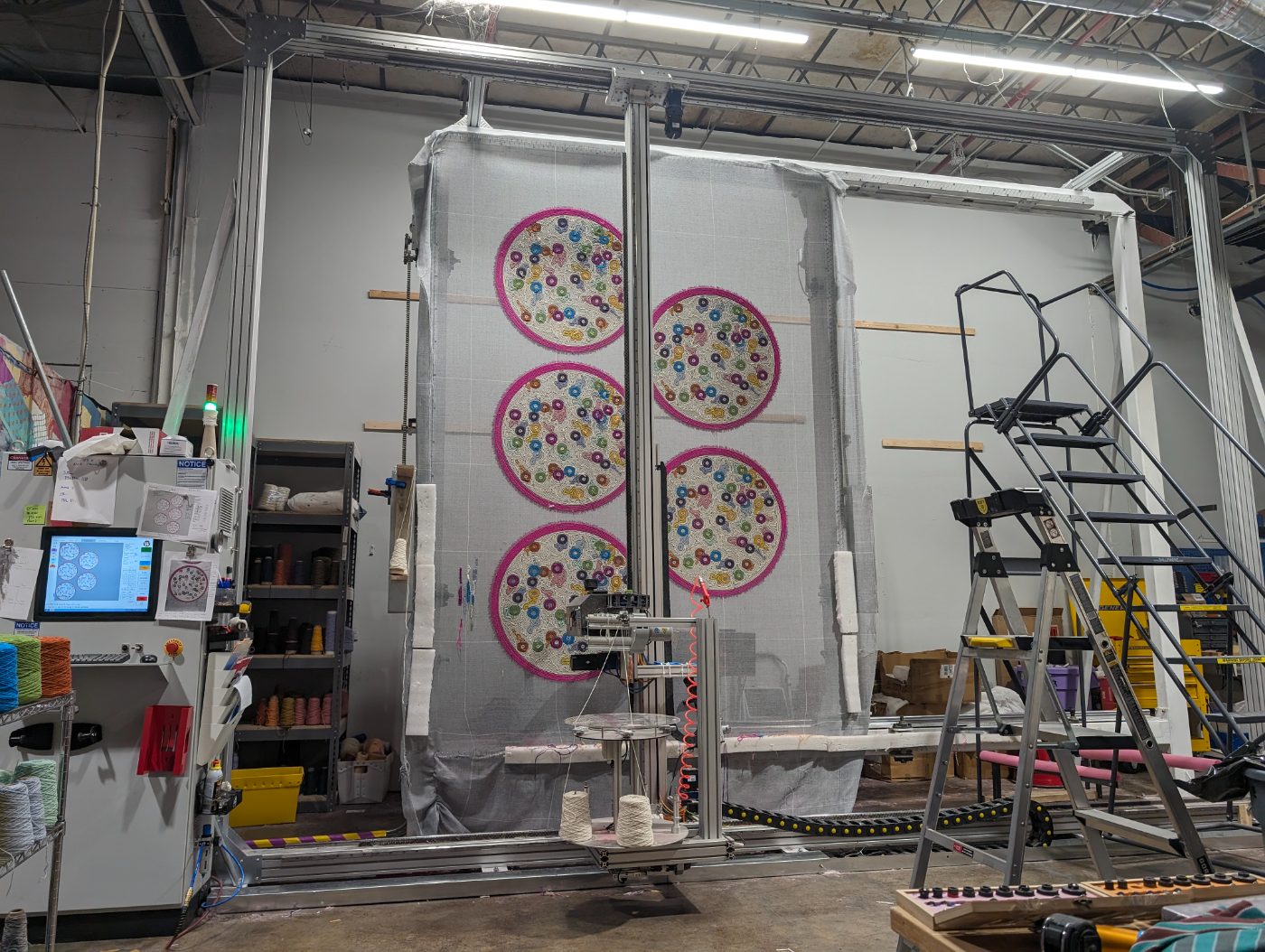
Key dates
- 1956Card’s patterned tufted pile fabric patent
- 1961A photocell controls the pattern attachment
- 1976Yarns dyed by digital colour data
- 1988Patent for a computer-controlled tufting machine
- 1994Wilcom’s patent for a computer-driven tufting head
- 1996Tuftco’s servo scroll attachment
- 2009ColorPoint and ColorTron
- 2014A Chinese patent for a servo gun-tufting machine
A photograph catalogued by the Bandy Heritage Center in Dalton is described as showing a Cobble Brothers loop-pile tufting machine 216 in (549 cm) wide, fitted with a scroll-type pattern attachment, with an 18 in (46 cm) pattern repeat. It carries no date.11“Before computers: chain-driven roll and scroll pattern attachments on broadloom tufting machines”, 1950s–1990s, Bandy Heritage Center (Dalton). Record On a broadloom machine the pattern came from how much yarn each needle got, and sets of yarn-feed rolls in the attachment metered it.22“Before computers: chain-driven roll and scroll pattern attachments on broadloom tufting machines”, 1950s–1990s, Bandy Heritage Center (Dalton). Record This chapter follows who, or what, decided that amount, from chains to computers, and a second line in which the hand tufting gun was put on a computer-guided frame. The multi-needle machine itself is the subject of chapter 5.
Joseph Card’s patent drawings, 1955 and 1956
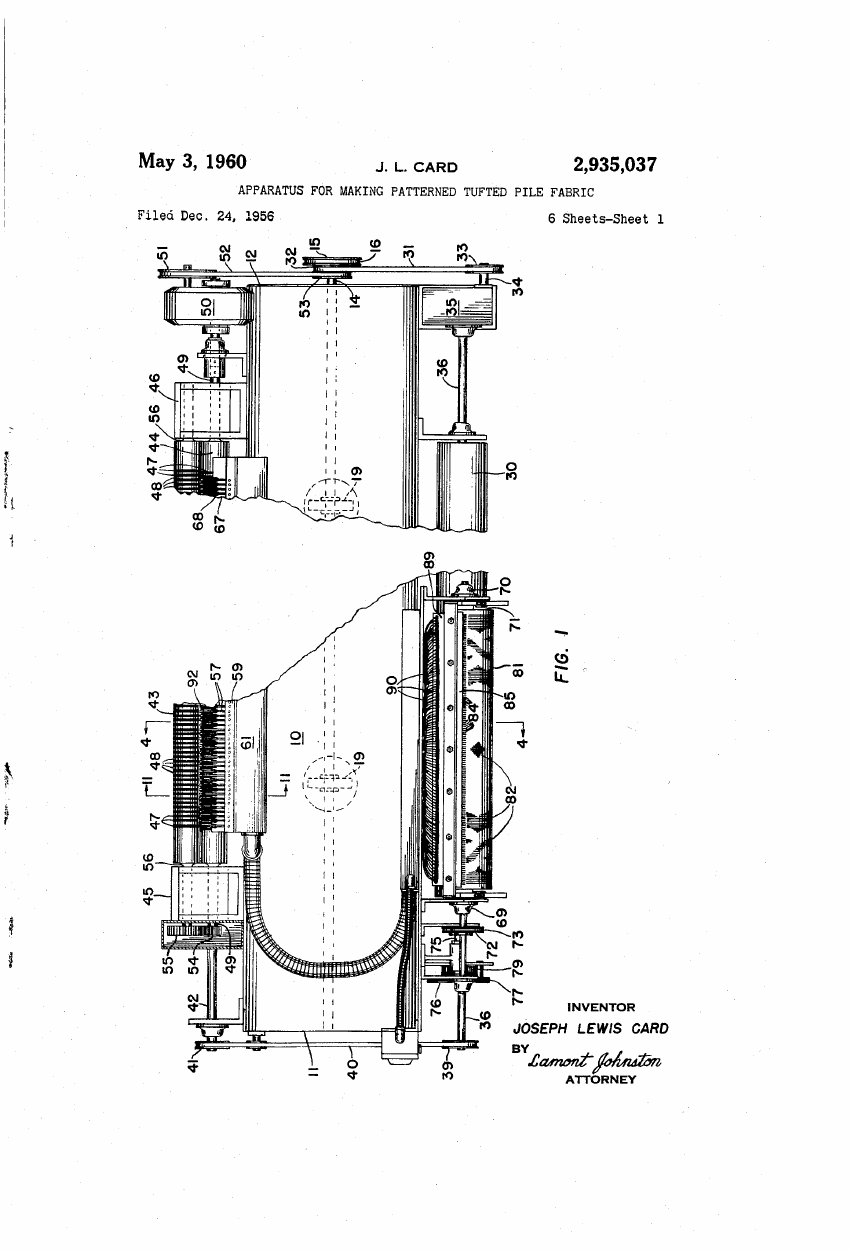
Joseph L. Card patented mechanisms for yarn feed and pattern control. He filed for a “Thread Feed Mechanism and Pattern Control” on 16 May 1955,33J. L. Card, “Thread Feed Mechanism and Pattern Control” (US2862465A), filed 16 May 1955, granted 2 Dec 1958. Record and on 24 December 1956 for an “Apparatus for Making Patterned Tufted Pile Fabric”, assigned to Cobble Brothers Machinery Co. of Chattanooga and granted in 1960.44Joseph L. Card, “Apparatus for Making Patterned Tufted Pile Fabric” (US2935037A), filed 24 Dec 1956, granted 3 May 1960. Record
Such devices had a fixed limit, which Tuftco’s patents of 1996–97 describe in looking back. The yarn-feed rolls were driven by chains or other linkage from the main drive shaft, so a whole pattern could use only two or three stitch heights, in fixed ratios to the shaft.55“Before computers: chain-driven roll and scroll pattern attachments on broadloom tufting machines”, 1950s–1990s, Bandy Heritage Center (Dalton). Record Tuftco Corp. (Morgante, Stanfield, Bishop), “Independent servo motor controlled scroll-type pattern attachment for tufting machine and computerized design system” (US6244203B1), provisional 27 Nov 1996; filed 26 Nov 1997 (appl. 08/980,045); grant date not seen. Record No dated first scroll attachment has been found.66“Before computers: chain-driven roll and scroll pattern attachments on broadloom tufting machines”, 1950s–1990s, Bandy Heritage Center (Dalton). Record
Singer Cobble was already looking beyond the chain in 1961. Its earliest electrical pattern-control patent found so far, the “Photocell controlled pattern attachment for tufting machines”, was filed on 29 May 1961: a photocell, not a cam or chain, controls the pattern attachment. Later patents cite it as prior art, among them a German “Elektrische Steuervorrichtung für eine Tuftingmaschine”. How the photocell read the pattern is still to be confirmed from the patent’s text.77Singer Cobble Inc., “Photocell controlled pattern attachment for tufting machines” (US3103187A), filed 29 May 1961; published 10 Sep 1963. Record By the mid-1960s carpet mills were patenting yarn-feed pattern control too: Callaway Mills filed a “Pattern attachment” on 18 April 1967.88“Pattern attachment for tufting machines” (US3375797A), filed 15 Sep 1966 (appl. 579,643); GB counterpart GB1123540A published 14 Aug 1968. Record One early use of pattern data in a carpet mill went to the yarn instead of the machine.
Westpoint Pepperell’s colour stations, 1976
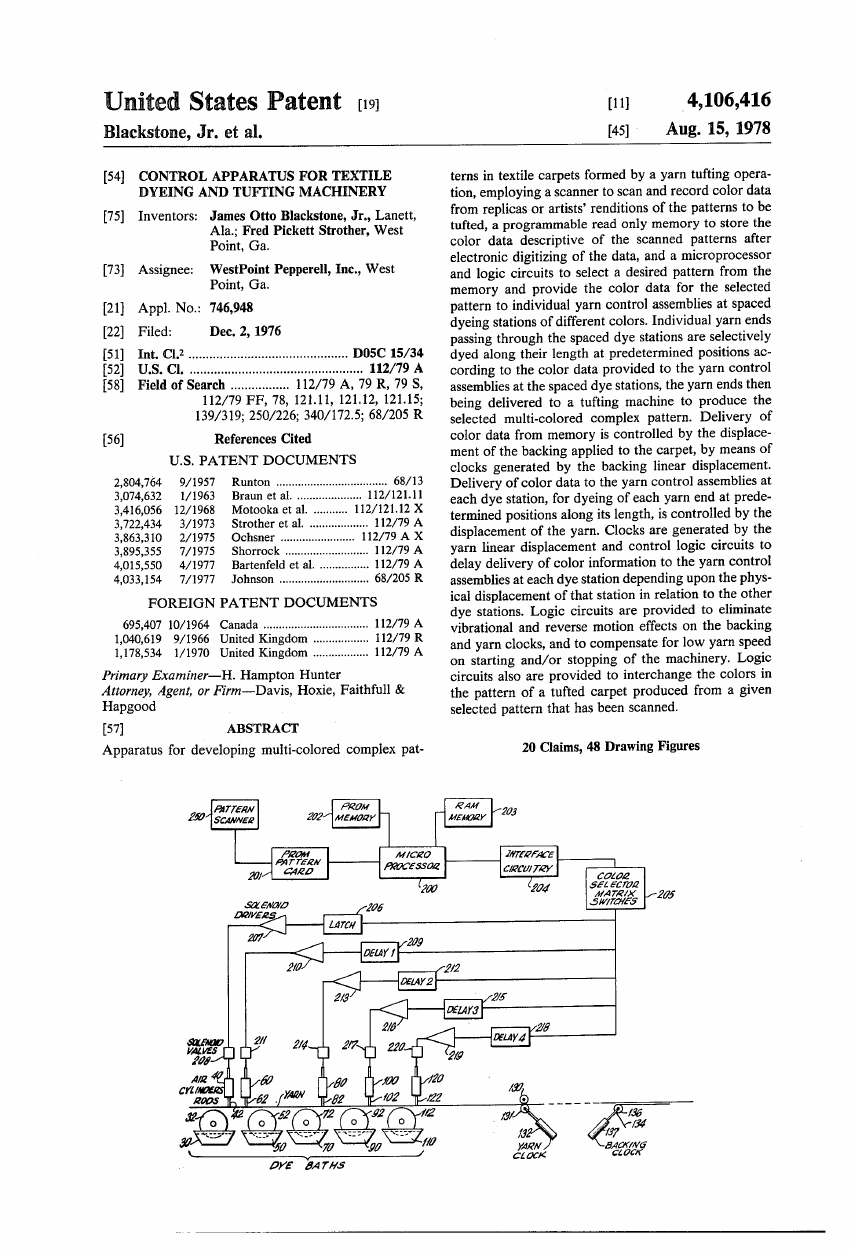
A Westpoint Pepperell patent, “Control apparatus for textile dyeing and tufting machinery”, with a priority date of 2 December 1976, puts the data at the dye stations instead of the needles. Each yarn is dyed at several colour stations whose yarn-control assemblies are “individually controllable by digital color pattern data”, and the yarns are then fed to a tufting station to make a predetermined complex design.99Westpoint Pepperell, “Control apparatus for textile dyeing and tufting machinery” (US4106416A), priority 2 Dec 1976; published 15 Aug 1978. Record
In this patent the design existed as data before a single tuft was made, and the tufting machine received yarn that already carried it. A patent filed twelve years later put a computer in charge of the machine itself.
US patent 4,867,080, granted 1989
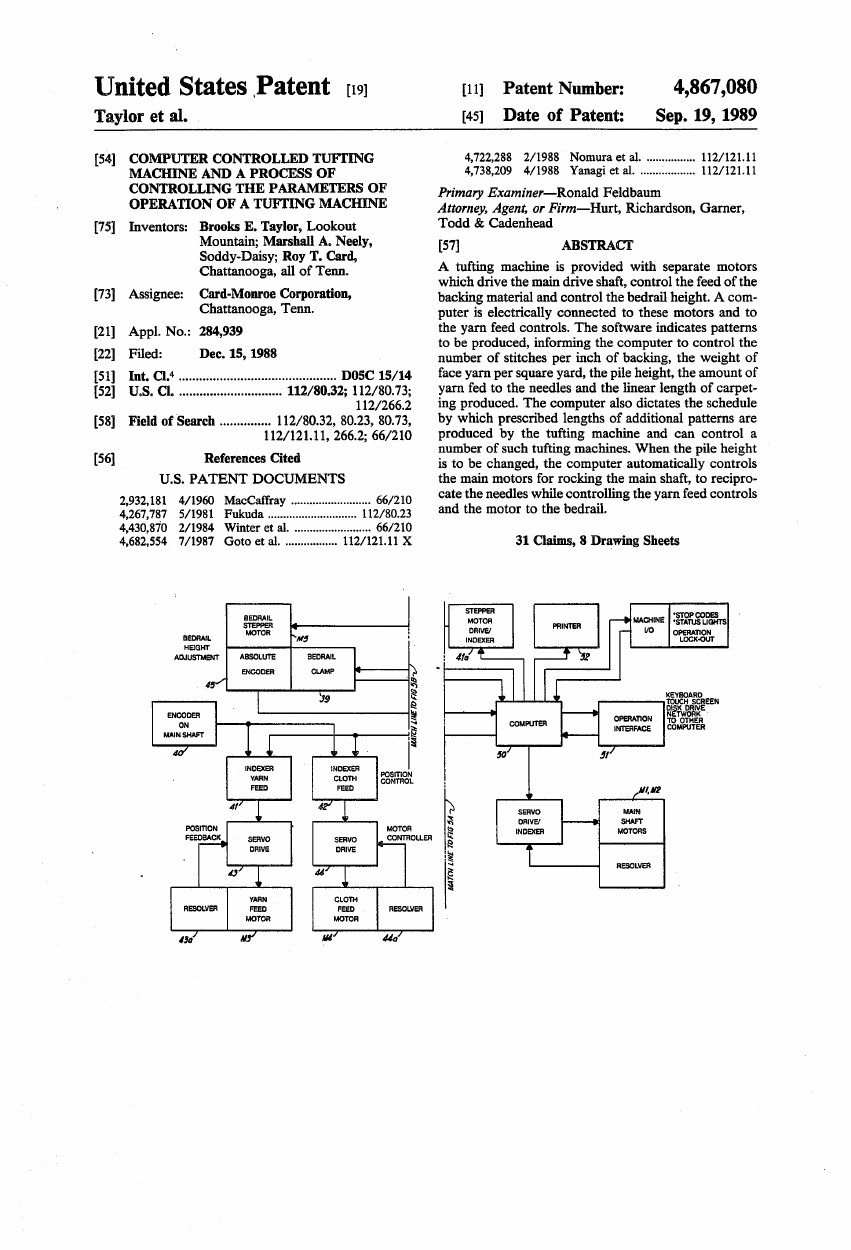
Brooks E. Taylor, Marshall A. Neely and Roy T. Card filed in December 1988 for a “Computer controlled tufting machine and a process of controlling the parameters of operation of a tufting machine”, granted on 19 September 1989. In it a computer controls motors on the backing feed and the yarn feed, so that stitch rate, pile height and face-yarn weight are changed from the computer instead of by changing sheaves on the gearbox.1010Brooks E. Taylor, Marshall A. Neely & Roy T. Card, “Computer controlled tufting machine and a process of controlling the parameters of operation of a tufting machine” (US4867080A), filed 15 Dec 1988 (Google record says 2 Dec 1988); granted 19 Sep 1989. Record
Later patents cite it as the start of computer control giving “greater precision and variety” in patterned tufting, though no source found calls it the first computer-controlled tufting machine.1111Brooks E. Taylor, Marshall A. Neely & Roy T. Card, “Computer controlled tufting machine and a process of controlling the parameters of operation of a tufting machine” (US4867080A), filed 15 Dec 1988 (Google record says 2 Dec 1988); granted 19 Sep 1989. Record Card-Monroe’s timeline lists Command Performance under 1989; a link with this patent has not been shown.1212“Card-Monroe Corp. (CMC)”, founded 1981 (as Charles Monroe Company); Card-Monroe 1983, Card-Monroe Corp. (CMC). Record Brooks E. Taylor, Marshall A. Neely & Roy T. Card, “Computer controlled tufting machine and a process of controlling the parameters of operation of a tufting machine” (US4867080A), filed 15 Dec 1988 (Google record says 2 Dec 1988); granted 19 Sep 1989. Record Card and Taylor followed with a Card-Monroe patent for “enhanced graphic appearances” in tufted carpet, filed in 1989, which a patent of 2003 credits with computerised design centres, where designers develop patterns on a computer.1313Roy T. Card & Brooks E. Taylor / Card-Monroe, “Method and apparatus for producing enhanced graphic appearances in a tufted product and a product produced therefrom” (US5058518A), filed 1989; published 22 Oct 1991. Record
The chain itself went in Tuftco’s patents of the late 1990s. Its “Independent servo motor controlled scroll-type pattern attachment for tufting machine and computerized design system”, with a provisional application of 27 November 1996, gives each set of yarn-feed rolls its own servo motor, and a computerised design system to handle “the large numbers of individually controllable design parameters”.1414Tuftco Corp. (Morgante, Stanfield, Bishop), “Independent servo motor controlled scroll-type pattern attachment for tufting machine and computerized design system” (US6244203B1), provisional 27 Nov 1996; filed 26 Nov 1997 (appl. 08/980,045); grant date not seen. Record Servo-driven rolls could set how much yarn went to the needles. Which yarn each needle took was a separate problem, and another line of machines had already set out to solve it.
The CYP machine from Ringgold, Georgia
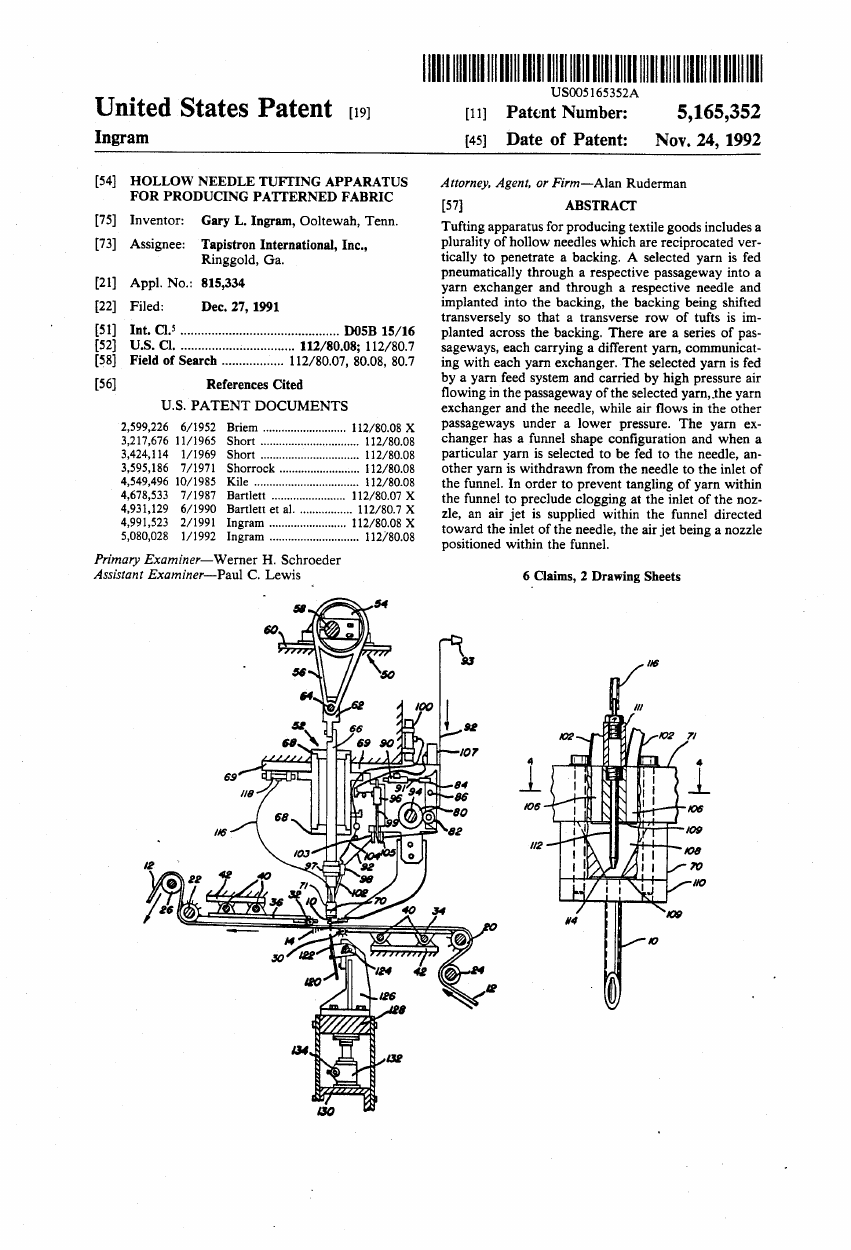
Gary L. Ingram’s “Hollow needle tufting apparatus for producing patterned fabric”, filed on 27 December 1991 and assigned to Tapistron International, places colour by moving the cloth. Reciprocating hollow needles carry the yarns, and the backing is shifted so that each colour lands where the pattern needs it.1515Gary L. Ingram / Tapistron International, “Hollow needle tufting apparatus for producing patterned fabric” (US5165352A), filed 27 Dec 1991; granted 24 Nov 1992. Record
Ingram had started from an older idea. Kile’s US 4,549,496, issued on 29 October 1985, is described as a multi-head machine with pneumatically fed hollow needles placing yarns of different colours. Ingram’s “Tufting apparatus”, dated 12 February 1991, is described as a modification of it that shifts the backing sideways instead of the needle heads, so that much less weight moves.1616Gary L. Ingram / Textile Corporation of America (later Tapistron), “Tufting apparatus” (US4991523A), application 07/366,545; patent dated 12 Feb 1991. Record
Tapistron, of Ringgold, Georgia, was founded in 1986 according to Bloomberg, and made the machine as the CYP, for Computerized Yarn Placement. A FloorDaily article dates the CYP to 1992, later than Ingram’s first patents, and describes it as slow but able to tuft woven-looking patterns in six component colours. In July 2001 Chattanoogan.com reported that Tapistron had filed for bankruptcy in 1996, had sold equipment to Shaw Industries, and was being sold at auction.1717“Tapistron International: computerised yarn placement (CYP) tufting, Ringgold, Georgia”, founded 1986 (Bloomberg); CYP dated 1992 (one trade article); bankruptcy filed 1996; sold at auction 2001, Tapistron International, Inc.. Record The broadloom builders took up colour placement in the 2000s.
ColorPoint at the FloorTek Expo, Dalton, 2009
Card-Monroe filed its “Yarn color placement system” on 15 February 2008: yarns of different colours are coordinated so that only the selected colour shows at each stitch.1818Card-Monroe Corp., “Yarn color placement system” (US8141505B2), filed 15 Feb 2008; granted 27 Mar 2012. Record A preview of the FloorTek Expo in Dalton in 2009 announced the result. Card-Monroe was introducing ColorPoint, which places “up to six colors or more anywhere in a carpet pattern with pinpoint accuracy”, and Tuftco had introduced its own ColorTron earlier that year.1919“Card-Monroe ColorPoint and Tuftco ColorTron launched: yarn colour placement in broadloom tufting (2009)”, 2009, FloorDaily (FloorTek Expo 2009 preview). Record
The two firms met in court. In 2014 Card-Monroe sued Tuftco over its ColorTuft and iTuft machines. The parties settled on 6 November 2017, and an agreed order held the patents valid and enforceable and enjoined Tuftco from selling single-needle-bar ColorTuft and iTuft c machines.2020“Card-Monroe v. Tuftco: the ColorPoint patent suit over computer colour-placement tufting (2014–2017)”, filed 2014; settled 6 Nov 2017; injunction 9 Nov 2017, U.S. District Court, E.D. Tenn.. Record
In Europe, Cobble, part of the Belgian Vandewiele group since 2013 according to Vandewiele’s timeline,2121“Cobble (Cobble Brothers / Singer-Cobble / Vandewiele)”, 1930s (Cobble brothers); UK subsidiary 1955, Cobble (Cobble Brothers / Singer-Cobble / Vandewiele). Record built Colortec, a graphics machine whose needles “tuft only where pile is required”. It existed by 2018, and at ITMA 2019 Cobble launched the Colortec L+, with individually controlled needles.2222“Cobble (Vandewiele) Colortec: individually controlled needles and individual pile delivery (2018–2019)”, IPD shown 2018; Colortec L+ launched 20–26 Jun 2019, Cobble / Vandewiele. Record In August 2023 Card-Monroe turned to the hollow needle, filing for a hollow-needle machine for patterns in several yarn colours. Its filings say that earlier hollow-needle machines, of the Kile, Davis and Tapistron line, were limited by needle spacing in how many colours each needle could take.2323Card-Monroe Corp. (Mathews, Christman, Lovelady, Vetter), “Tufting machines and methods of tufting” (US12180632B2): the Hollow Needle machine, filed 21 Aug 2023 (appl. 18/235,917); published as US20240068144A1; grant date not seen. Record All of this happened inside the broadloom machine. The second line began with a single needle.
Wilcom’s tufting head, Sydney
On this second line the earliest patent cited here came from a maker of embroidery software. Wilcom, a Sydney maker of CAD/CAM software for embroidery, carpets and rugs,2424“Wilcom AutoTuft (Sydney): robotic single-head tufting machines for custom rugs”, patents from 1994; AutoTuft trade reports 2012, Wilcom Pty Ltd. Record filed in 1994 for a “Method and system of tufting”. A tufting head is moved automatically over a backing stretched on a frame, and the needle position is corrected for the direction of traverse, the yarn and the backing.2525Wilcom Tufting Pty Ltd (Aubourg, Pongrass, Wilson), “Method and system of tufting” (US5503092A), filed 1994 (appl. 08/190,070); granted 2 Apr 1996. Record
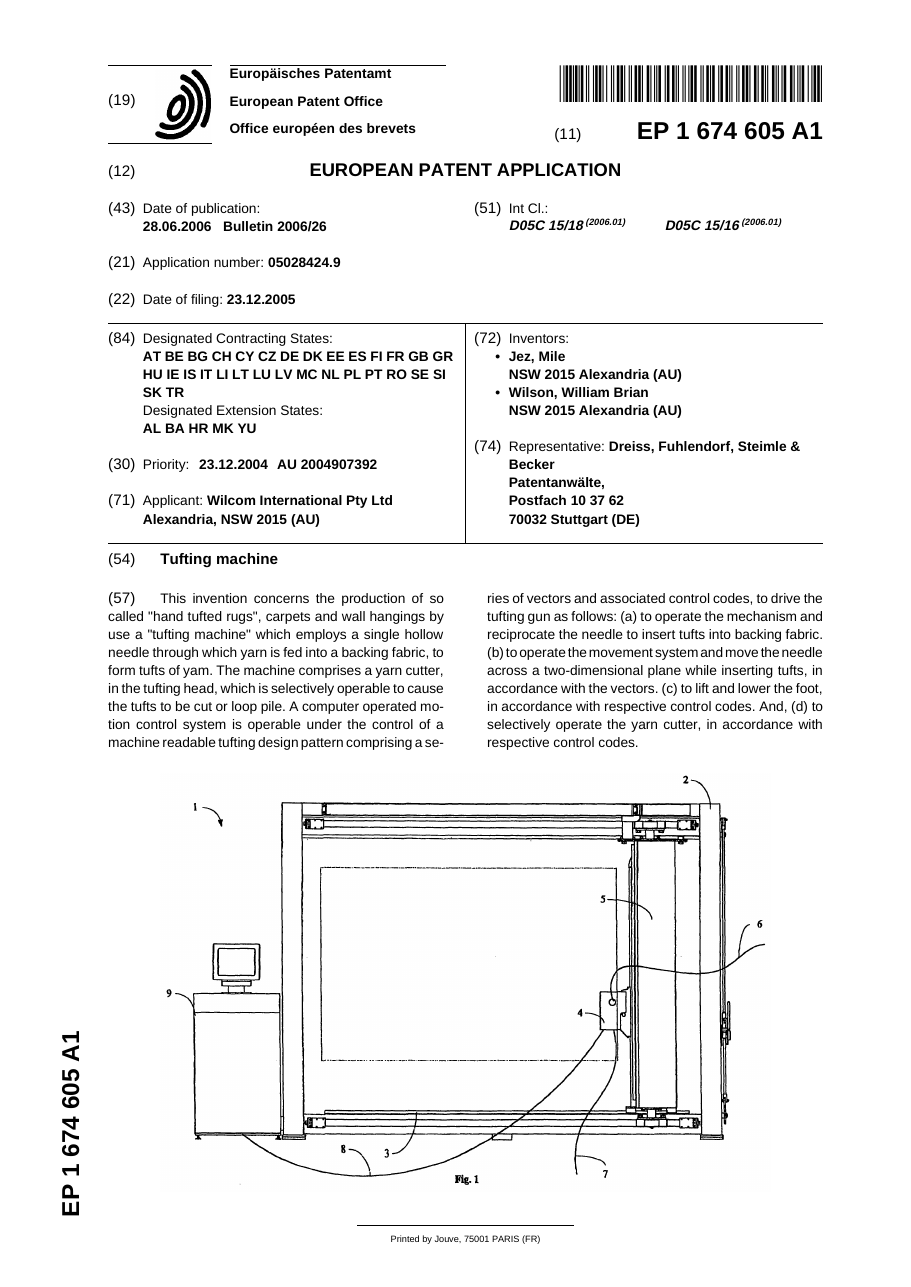
Wilcom’s “Tufting machine”, with an Australian priority date of 23 December 2004, moves a single hollow-needle head from vector design files, with a cutter that switches between cut and loop pile. Its background notes that tufting guns “may be controlled and guided manually by a human operator” (chapter 9).2626Wilcom Pty Ltd, “Tufting machine” (EP1674605A1), AU priority 23 Dec 2004; A1 published 28 Jun 2006; B1 granted 25 Jan 2012. Record A second patent, with priority of 4 January 2008, added varied pile height, and its background describes the hand guns:2727Wilcom Pty Ltd, “An improved tufting machine” (EP2077348B1), AU priority 4 Jan 2008 (AU2008900045); B1 granted 31 Aug 2011. Record
a traditional hand tufting gun for instance, Hofmann™ or Hartleb™, each of which are limited to tufting along an outline at a constant pile height
Wilcom Pty Ltd, “An improved tufting machine”, priority 2008Wilcom sold the machines as AutoTuft. In 2012 Textile World reported a pneumatic head with a rotating needle for full-speed cornering and cut/loop switching tuft by tuft, and new agents in India and China, for machines making custom rugs with a “hand-tufted” look for less than hand tufting.2828“Wilcom AutoTuft (Sydney): robotic single-head tufting machines for custom rugs”, patents from 1994; AutoTuft trade reports 2012, Wilcom Pty Ltd. Record
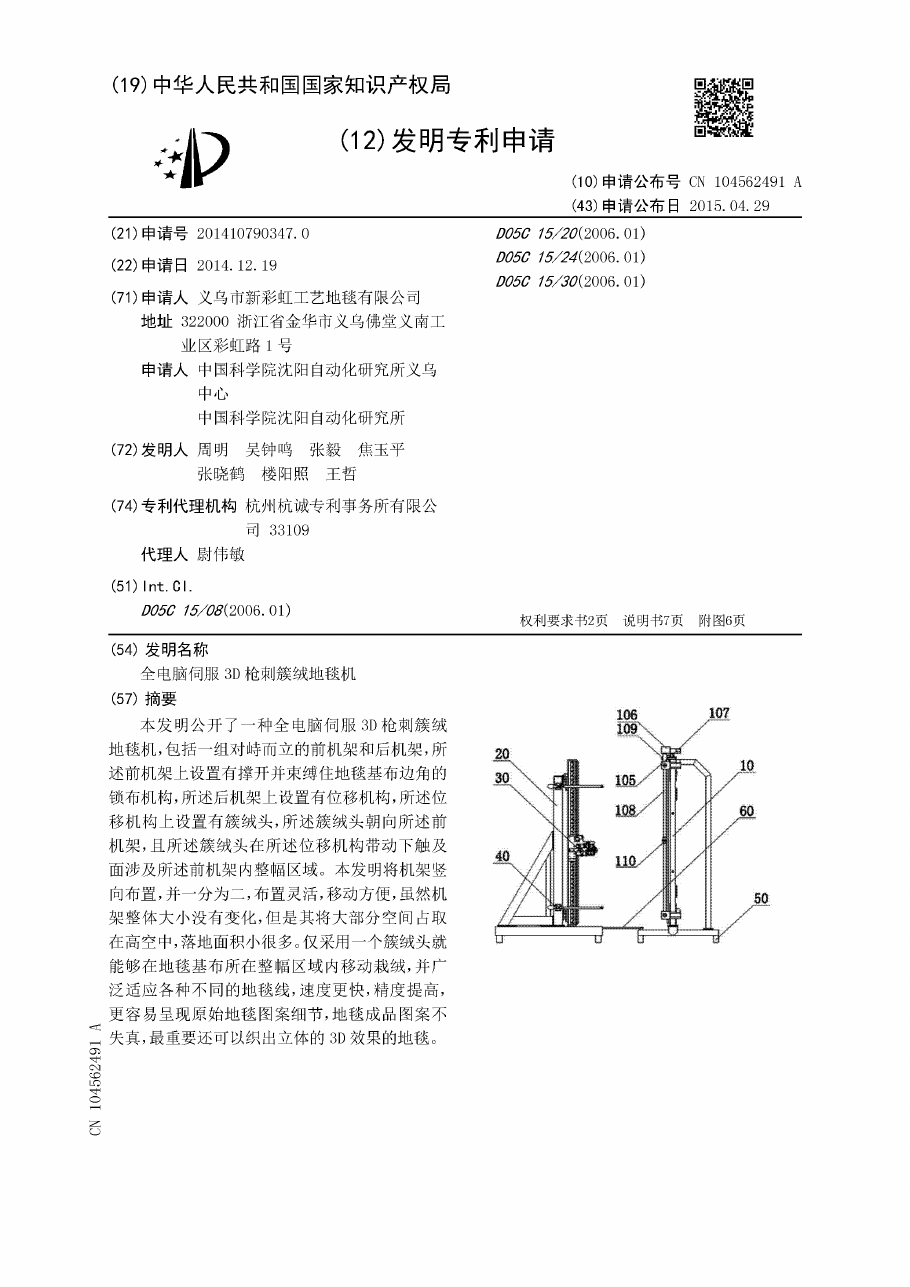
In China one such design came from a research institute working with a carpet maker. On 19 December 2014 the Shenyang Institute of Automation of the Chinese Academy of Sciences and a Yiwu carpet maker, the Yiwu New Rainbow Craft Carpet Co., with others, applied for a “Fully computerised servo 3D gun-tufted carpet machine”: a tufting head on a servo-driven X–Y mechanism, with a cutter so that cut and loop pile can be switched freely.2929Shenyang Institute of Automation (CAS), Yiwu New Rainbow Craft Carpet Co. et al., “Fully computerised servo 3D gun-tufted carpet machine” (CN104562491A), filed 19 Dec 2014; granted as CN104562491B (now lapsed). Record
In May 2025 China Daily reported that Yangxin Ruixin Group and Donghua University had produced “China’s first fully digital intelligent robot for hand-tufted carpets”, which follows pre-programmed designs; the “first” is the newspaper’s claim, and the article gives no date.3030“Yangxin Ruixin and Donghua University: 'China’s first fully digital intelligent robot for hand-tufted carpets'”, reported May 2025 (development date not given), China Daily. Record Yangxin Ruixin filed in 2020 for a pneumatic gun for an intelligent gun-tufted carpet robot,3131Yangxin Ruixin Group, “Pneumatic multifunctional carpet tufting gun for an intelligent gun-tufted carpet robot” (CN111705448A), filed 30 Jun 2020; published 25 Sep 2020. Record one of several Chinese filings on automated gun-tufting machines that search results date to 2019 and 2020.3232“Stable yarn-feeding and tensioning equipment for a carpet gun-tufting machine” (CN111441143A), filed 17 Jan 2019 (per search summary). Record “Fully automatic carpet gun-tufting machine head and its working method” (CN111876919A), priority 11 Aug 2020; published 3 Nov 2020. Record Soon after, the gun on a machine reached the individual maker.
Owen Trueblood’s gun on a robot arm, 2022

In February 2022 Owen Trueblood posted a log on Hackaday.io showing how he had taken a consumer tufting gun and replaced its motor controller with an Arduino. He added a jack carrying an on/off input and a speed input, so that a robot could drive the gun. Hackaday covered it in March as the slow kind of machine that can tuft any pattern, unlike fast industrial tufters made for fixed ones.3333“Owen Trueblood’s robot-arm tufting system: a hacked tufting gun on a UR5 (2022)”, Feb–Mar 2022; exhibited Apr 2023, Hackaday.io. Record According to a write-up of the collaboration, the gun went on a UR5 robot arm, and for the Ground Truth IRL exhibition in April 2023 it tufted the shapes of New York park wildlife zones, filled in by hand with a punch needle.3434“Owen Trueblood’s robot-arm tufting system: a hacked tufting gun on a UR5 (2022)”, Feb–Mar 2022; exhibited Apr 2023, Hackaday.io. Record
Trueblood’s was a hacked consumer gun; firms had brought tufting robots into custom rug making earlier (chapter 11). In 2013 Delos, of Calhoun, Georgia, launched an aircraft-carpet division using a custom-made robotic tufting machine. Reporting its 2016 lookbook, a trade paper said the robots sped up the work but about 85% of it was still done by craftsmen.3535“Delos was robot-tufting custom rugs and aircraft carpet in Georgia by 2013”, 2013; 2016, AIN (Aviation International News). Record In July 2017 Interior Design reported that Carpet Sign, of Asten in the Netherlands, had just acquired a 3-D tufting robot able to vary pile height without stopping, and had Karim Rashid design a collection for it.3636“Carpet Sign (Asten, Netherlands): 3-D tufting robot rugs with Karim Rashid (2017) and Richard Hutten (2019)”, 2017; 2019, Carpet Sign. Record In Milan, cc-tapis says it uses “automated robotufting technology” for one-off pieces, while most of its collections are still made by hand in Nepal and India.3737“European design-rug firms add 'robotufting' alongside handmade production: cc-tapis (Milan) and Van Besouw (Netherlands)”, 2022 onwards, cc-tapis. Record
Tuft the World, the Philadelphia firm co-founded by this book’s author,3838“Tuft the World”, founded 2018, Tuft the World. Record showed rugs made on a large robotic tufting machine at Paradigm Gallery in 2023.3939“TTW Editions at Paradigm Gallery: rugs made by a large robotic tufting machine (2023)”, 2023, Paradigm Gallery + Studio. Record Reporting on the firm’s CNC machine in 2024, Technical.ly noted that its users still adjust tuft density and row spacing by hand and change yarn colours and tuft heads, and that makers disagree about what counts as handmade; the firm lists its pieces as “robo-tufted and hand-finished in Philadelphia”.4040“Tuft the World’s CNC tufting robot: carpal tunnel, a $75,000 machine and the 'handmade' question (2023–2024)”, bought by 2023; reported 2023–2024, Tuft the World. Record Chapter 13 follows the hand gun’s return to the home in the same years.
This chapter argues that programmable tufting grew along two separate lines. On the broadloom machine, control of the pattern passed from chain-driven yarn-feed rolls to computers and servo motors, and then to the choice of colour at each needle. The single hand gun, from the 1990s, was carried over the backing by a computer-guided frame, and in some of the studios that now use such robots, people still adjust the machine and finish the rugs by hand.
Notes
- 1“Before computers: chain-driven roll and scroll pattern attachments on broadloom tufting machines.” Research note. bandyheritagecenter.pastperfectonline.com/photo/8CAB4598-A255-467E-8C6F-442640452218. Record
- 2“Before computers: chain-driven roll and scroll pattern attachments on broadloom tufting machines.” Research note. bandyheritagecenter.pastperfectonline.com/photo/8CAB4598-A255-467E-8C6F-442640452218. Record
- 3J. L. Card, “Thread Feed Mechanism and Pattern Control” (US2862465A), filed 16 May 1955, granted 2 Dec 1958. patents.google.com/patent/US2862465A/en. Record
- 4Joseph L. Card, “Apparatus for Making Patterned Tufted Pile Fabric” (US2935037A), filed 24 Dec 1956, granted 3 May 1960; assigned to Cobble Brothers Machinery Co. patents.google.com/patent/US2935037A/en. Record
- 5“Before computers: chain-driven roll and scroll pattern attachments on broadloom tufting machines.” Research note. bandyheritagecenter.pastperfectonline.com/photo/8CAB4598-A255-467E-8C6F-442640452218. Record Tuftco Corp. (Morgante, Stanfield, Bishop), “Independent servo motor controlled scroll-type pattern attachment for tufting machine and computerized design system” (US6244203B1), provisional 27 Nov 1996; filed 26 Nov 1997 (appl. 08/980,045); grant date not seen. patents.google.com/patent/US6244203B1/en. Record
- 6“Before computers: chain-driven roll and scroll pattern attachments on broadloom tufting machines.” Research note. bandyheritagecenter.pastperfectonline.com/photo/8CAB4598-A255-467E-8C6F-442640452218. Record
- 7Singer Cobble Inc., “Photocell controlled pattern attachment for tufting machines” (US3103187A), filed 29 May 1961; published 10 Sep 1963. patents.google.com/patent/US3103187A/en. Record
- 8“Pattern attachment for tufting machines” (US3375797A), filed 15 Sep 1966 (appl. 579,643); GB counterpart GB1123540A published 14 Aug 1968. patents.google.com/patent/US3375797A/en. Record
- 9Westpoint Pepperell, “Control apparatus for textile dyeing and tufting machinery” (US4106416A), priority 2 Dec 1976; published 15 Aug 1978. patents.google.com/patent/US4106416A/en. Record
- 10Brooks E. Taylor, Marshall A. Neely & Roy T. Card, “Computer controlled tufting machine and a process of controlling the parameters of operation of a tufting machine” (US4867080A), filed 15 Dec 1988 (Google record says 2 Dec 1988); granted 19 Sep 1989. patents.google.com/patent/US4867080A/en. Record
- 11Brooks E. Taylor, Marshall A. Neely & Roy T. Card, “Computer controlled tufting machine and a process of controlling the parameters of operation of a tufting machine” (US4867080A), filed 15 Dec 1988 (Google record says 2 Dec 1988); granted 19 Sep 1989. patents.google.com/patent/US4867080A/en. Record
- 12Charles Monroe and Lewis Card Jr.; joined by Lewis Card Sr. and Roy Card. “Card-Monroe Corp. (CMC),” founded 1981 (as Charles Monroe Company); Card-Monroe 1983. Card-Monroe Corp. (CMC). cardmonroe.com/about-us. Record Brooks E. Taylor, Marshall A. Neely & Roy T. Card, “Computer controlled tufting machine and a process of controlling the parameters of operation of a tufting machine” (US4867080A), filed 15 Dec 1988 (Google record says 2 Dec 1988); granted 19 Sep 1989. patents.google.com/patent/US4867080A/en. Record
- 13Roy T. Card & Brooks E. Taylor / Card-Monroe, “Method and apparatus for producing enhanced graphic appearances in a tufted product and a product produced therefrom” (US5058518A), filed 1989; published 22 Oct 1991. patents.google.com/patent/US5058518A/en. Record
- 14Tuftco Corp. (Morgante, Stanfield, Bishop), “Independent servo motor controlled scroll-type pattern attachment for tufting machine and computerized design system” (US6244203B1), provisional 27 Nov 1996; filed 26 Nov 1997 (appl. 08/980,045); grant date not seen. patents.google.com/patent/US6244203B1/en. Record
- 15Gary L. Ingram / Tapistron International, “Hollow needle tufting apparatus for producing patterned fabric” (US5165352A), filed 27 Dec 1991; granted 24 Nov 1992. patents.google.com/patent/US5165352A/en. Record
- 16Gary L. Ingram / Textile Corporation of America (later Tapistron), “Tufting apparatus” (US4991523A), application 07/366,545; patent dated 12 Feb 1991. patents.google.com/patent/US4991523A/en. Record
- 17Tapistron International, Inc.; Gary L. Ingram (inventor). “Tapistron International: computerised yarn placement (CYP) tufting, Ringgold, Georgia,” founded 1986 (Bloomberg); CYP dated 1992 (one trade article); bankruptcy filed 1996; sold at auction 2001. Tapistron International, Inc. chattanoogan.com/2001/7/10/10705/Tapistron-International-Being-Sold-At.aspx. Record
- 18Card-Monroe Corp., “Yarn color placement system” (US8141505B2), filed 15 Feb 2008; granted 27 Mar 2012. patents.google.com/patent/US8141505B2/en. Record
- 19Card-Monroe Corp.; Tuftco Corp. “Card-Monroe ColorPoint and Tuftco ColorTron launched: yarn colour placement in broadloom tufting (2009),” 2009. FloorDaily (FloorTek Expo 2009 preview). floordaily.net/floorfocus/floortek-expo-2009-preview-augustseptember-2009. Record
- 20Card-Monroe Corp.; Tuftco Corp. “Card-Monroe v. Tuftco: the ColorPoint patent suit over computer colour-placement tufting (2014–2017),” filed 2014; settled 6 Nov 2017; injunction 9 Nov 2017. U.S. District Court, E.D. Tenn. floordaily.net/flooring-news/card-monroe-corp-wins-colorpoint-patent-infringement-case. Record
- 21Joe C. Cobble and brothers; later Spencer H. Wright. “Cobble (Cobble Brothers / Singer-Cobble / Vandewiele),” 1930s (Cobble brothers); UK subsidiary 1955. Cobble (Cobble Brothers / Singer-Cobble / Vandewiele). cobble.co.uk/en. Record
- 22Cobble, a Vandewiele company. “Cobble (Vandewiele) Colortec: individually controlled needles and individual pile delivery (2018–2019),” IPD shown 2018; Colortec L+ launched 20–26 Jun 2019. Cobble / Vandewiele. textileworld.com/textile-world/2019/05/itma-2019-exhibitor-preview-cobble-a-vandewiele-company. Record
- 23Card-Monroe Corp. (Mathews, Christman, Lovelady, Vetter), “Tufting machines and methods of tufting” (US12180632B2): the Hollow Needle machine, filed 21 Aug 2023 (appl. 18/235,917); published as US20240068144A1; grant date not seen. patents.google.com/patent/US12180632B2/en. Record
- 24Wilcom Pty Ltd / Wilcom AutoTuft Pty Ltd. “Wilcom AutoTuft (Sydney): robotic single-head tufting machines for custom rugs,” patents from 1994; AutoTuft trade reports 2012. Wilcom Pty Ltd. textileworld.com/textile-world/new-products/2012/07/wilcoms-autotuft-pneumatic-tufting-head-produces-special-tufting-effects. Record
- 25Wilcom Tufting Pty Ltd (Aubourg, Pongrass, Wilson), “Method and system of tufting” (US5503092A), filed 1994 (appl. 08/190,070); granted 2 Apr 1996. patents.google.com/patent/US5503092A/en. Record
- 26Wilcom Pty Ltd, “Tufting machine” (EP1674605A1), AU priority 23 Dec 2004; A1 published 28 Jun 2006; B1 granted 25 Jan 2012. patents.google.com/patent/EP1674605A1/en. Record
- 27Wilcom Pty Ltd, “An improved tufting machine” (EP2077348B1), AU priority 4 Jan 2008 (AU2008900045); B1 granted 31 Aug 2011. patents.google.com/patent/EP2077348B1/en. Record
- 28Wilcom Pty Ltd / Wilcom AutoTuft Pty Ltd. “Wilcom AutoTuft (Sydney): robotic single-head tufting machines for custom rugs,” patents from 1994; AutoTuft trade reports 2012. Wilcom Pty Ltd. textileworld.com/textile-world/new-products/2012/07/wilcoms-autotuft-pneumatic-tufting-head-produces-special-tufting-effects. Record
- 29Shenyang Institute of Automation (CAS), Yiwu New Rainbow Craft Carpet Co. et al., “Fully computerised servo 3D gun-tufted carpet machine” (CN104562491A), filed 19 Dec 2014; granted as CN104562491B (now lapsed). patents.google.com/patent/CN104562491A/zh. Record
- 30Yangxin Ruixin Group; Donghua University. “Yangxin Ruixin and Donghua University: 'China’s first fully digital intelligent robot for hand-tufted carpets',” reported May 2025 (development date not given). China Daily. global.chinadaily.com.cn/a/202505/12/WS682169dda310a04af22bec34_2.html. Record
- 31Yangxin Ruixin Group, “Pneumatic multifunctional carpet tufting gun for an intelligent gun-tufted carpet robot” (CN111705448A), filed 30 Jun 2020; published 25 Sep 2020. patents.google.com/patent/CN111705448A/zh. Record
- 32“Stable yarn-feeding and tensioning equipment for a carpet gun-tufting machine” (CN111441143A), filed 17 Jan 2019 (per search summary). patents.google.com/patent/CN111441143A/zh. Record “Fully automatic carpet gun-tufting machine head and its working method” (CN111876919A), priority 11 Aug 2020; published 3 Nov 2020. patents.google.com/patent/CN111876919A/zh. Record
- 33Owen Trueblood. “Owen Trueblood’s robot-arm tufting system: a hacked tufting gun on a UR5 (2022),” Feb–Mar 2022; exhibited Apr 2023. Hackaday.io. hackaday.io/project/184058-robotic-tufting-system/log/203292-hacking-the-tufting-gun. Record
- 34Owen Trueblood. “Owen Trueblood’s robot-arm tufting system: a hacked tufting gun on a UR5 (2022),” Feb–Mar 2022; exhibited Apr 2023. Hackaday.io. hackaday.io/project/184058-robotic-tufting-system/log/203292-hacking-the-tufting-gun. Record
- 35“Delos was robot-tufting custom rugs and aircraft carpet in Georgia by 2013.” Research note. backend.ainonline.com/aviation-news/business-aviation/2013-10-22/delos-rugs-launches-aircraft-carpet-division. Record
- 36Carpet Sign; Karim Rashid; Richard Hutten. “Carpet Sign (Asten, Netherlands): 3-D tufting robot rugs with Karim Rashid (2017) and Richard Hutten (2019),” 2017; 2019. Carpet Sign. interiordesign.net/designwire/karim-rashid-designs-carpet-sign-collection-made-by-3-d-tufting-robot. Record
- 37“European design-rug firms add 'robotufting' alongside handmade production: cc-tapis (Milan) and Van Besouw (Netherlands).” Research note. cc-tapis.com/made-in-milan. Record
- 38Tiernan Alexander and Tim Eads (founders). “Tuft the World,” founded 2018. Tuft the World. Record
- 39Tuft the World. “TTW Editions at Paradigm Gallery: rugs made by a large robotic tufting machine (2023),” 2023. Paradigm Gallery + Studio. paradigmarts.org/blogs/news/tuft-the-world-ttf-editions. Record
- 40“Tuft the World’s CNC tufting robot: carpal tunnel, a $75,000 machine and the 'handmade' question (2023–2024).” Research note. technical.ly/civic-news/cnc-machines-rug-making. Record
Where the sources are
- US patents19
- Tuft the World2
- Bandy Heritage Center (Dalton)1
- Card-Monroe Corp. (CMC)1
- Tapistron International, Inc.1
- FloorDaily (FloorTek Expo 2009 preview)1
- U.S. District Court, E.D. Tenn.1
- Cobble (Cobble Brothers / Singer-Cobble / Vandewiele)1
- Cobble / Vandewiele1
- Wilcom Pty Ltd1
- China Daily1
- Hackaday.io1
- AIN (Aviation International News)1
- Carpet Sign1
- cc-tapis1
- Paradigm Gallery + Studio1